The 99 mark for the US dollar has become a major battleground! A triple whammy of inflation, energy, and policy factors is about to ignite a market surge.
2026-05-27 17:45:04
On Wednesday, May 27th, the US dollar index continued to fluctuate around the 99 level. On the daily chart, the price is above the Bollinger Middle Band at 98.67, but still has room to move towards the Upper Band at 99.57, indicating that the short-term correction has not yet developed into a one-sided trend. Meanwhile, the US April CPI rose 3.8% year-on-year, and the core CPI rose 2.8% year-on-year. The March PCE price index rose 3.5% year-on-year, and the core PCE rose 3.2% year-on-year, indicating that inflation stickiness has once again become the main factor influencing the dollar's pricing.
The US dollar index did not follow a simple linear trend of "rising interest rates equaling a stronger dollar" this time because the market is not trading on a single interest rate differential, but rather a comprehensive risk premium encompassing inflation, growth, energy, and policy credibility. The Federal Reserve's April meeting maintained the target range for the federal funds rate at 3.50% to 3.75%, and emphasized that it would assess new data, changes in the outlook, and the balance of risks. This means that the policy rate itself has not changed, but the policy response function is becoming more data-dependent.
The focus of Federal Reserve's latest statement was not a direct call for interest rate hikes, but rather an opposition to prematurely predicting the next policy direction. He believes that most recent data points to rising, rather than falling, inflation risks, and that continued attention needs to be paid to the risk of a weakening labor market. For traders, the value of this kind of statement lies in lowering expectations of unilateral easing, allowing the dollar index to still be supported by interest rate expectations even when it falls.
From the daily chart, the US dollar index is currently trading around 99, with the Bollinger Band middle line around 98.67, the upper line around 99.57, and the lower line around 97.77. The price's return above the middle line indicates a recovery from the previous dip around 97.63, but the area around 99.51 remains a resistance zone from recent highs. The MACD histogram is in positive territory, with the fast and slow lines trending upwards, but momentum hasn't expanded significantly. This combination suggests a slightly bullish consolidation rather than a trend acceleration.
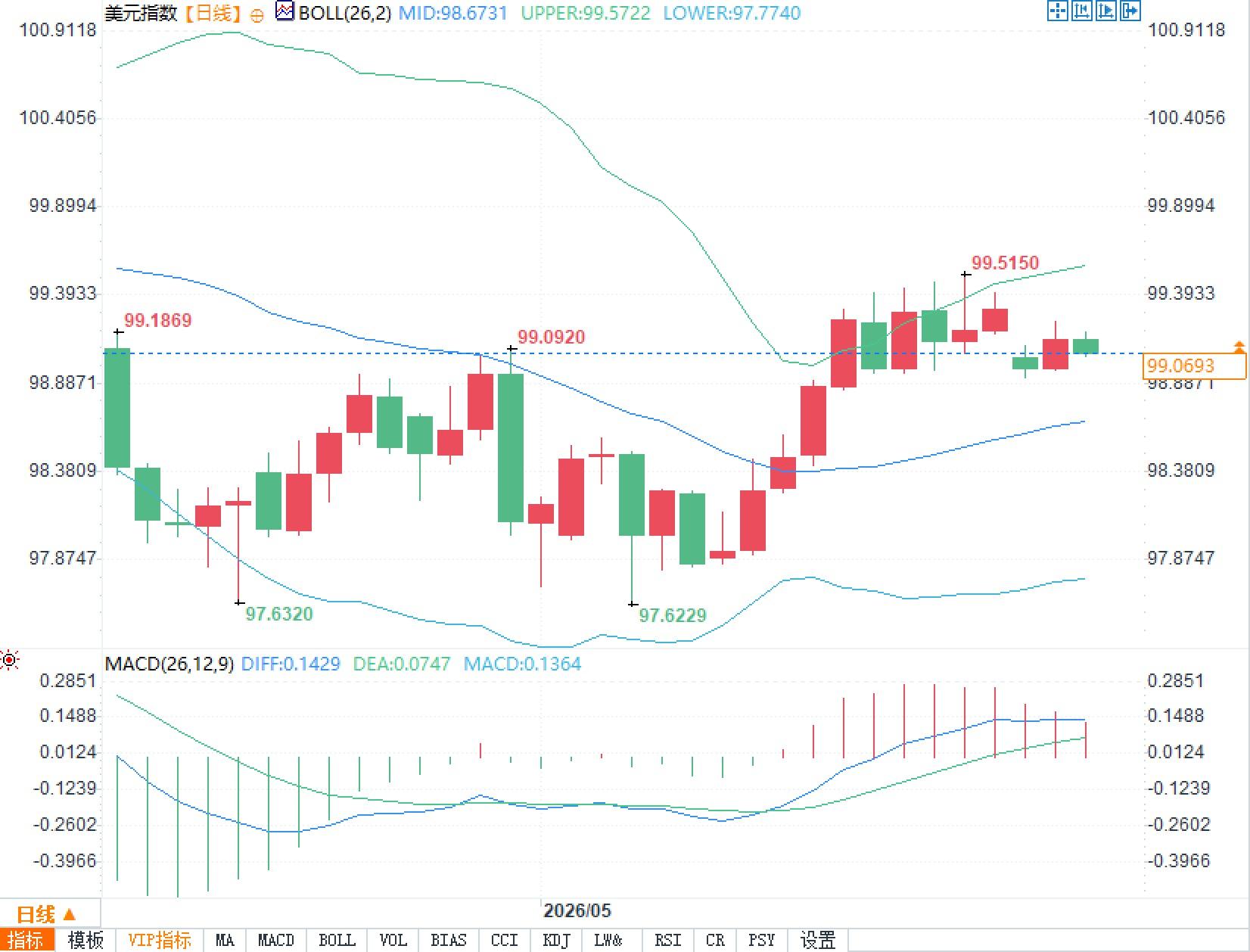
The US dollar index traded around 99, with limited change from the previous trading day. The market did not directly interpret Kashkari's comments as a definitive signal of an interest rate hike, but rather priced them in as "the Fed is in no hurry to ease monetary policy." Therefore, the area around 99.00 became the sentiment center, the area around 98.70 determined the resilience of any pullback, and the 99.50 to 99.70 range determined the quality of any rebound.
Energy price fluctuations triggered by the Middle East conflict are currently the most difficult variable for the US dollar index to be fully explained by traditional models. On May 27, Brent crude oil fell back to around $93, while WTI crude oil fluctuated around $90. Although prices have declined, they remain in a high range that is sufficient to influence inflation expectations. The decline in oil prices may ease short-term risk aversion, but it does not mean that inflationary pressures have disappeared.
Kashkari mentioned the need to observe the progress of US-Iran negotiations and how global supply chains respond. The market implication of this is whether the energy shock will evolve from a one-off price disturbance into a second wave of transmission affecting transportation, business costs, wage expectations, and bond yields. If this second wave strengthens, it will be difficult for the Federal Reserve to maintain a dovish tone in its statement. Support for the US dollar index will also shift from safe-haven demand to real interest rates and policy credibility.
U.S. nonfarm payrolls increased by 115,000 in April, while the unemployment rate remained at 4.3%, with approximately 7.4 million people unemployed. The data wasn't particularly strong, but it also didn't create pressure for the Federal Reserve to immediately shift to an easing stance. The job market is cooling but not stalling, making inflation risks more likely to take precedence in policy priorities.
This is precisely the key reason why the US dollar index has not fallen sharply in the near term. If employment deteriorates rapidly, the market will be more aggressive in trading for interest rate cuts, weakening the support for the dollar's interest rate differential; if inflation continues to exceed the target while employment only slows moderately, the Federal Reserve will have more reason to maintain a neutral or even tight stance. The current trend of the US dollar index is between these two paths, and the focus of trading is not on judging whether the Federal Reserve will act immediately, but rather on judging whether it will remove the hints of easing.
Question 1: Does Kashkari's speech mean the Federal Reserve is preparing to raise interest rates?
A: That's not the right way to interpret it. He emphasized that it's too early to predict the next policy move, and the key point is that the Federal Reserve needs to maintain its options, not give premature easing signals. For the dollar index, this will weaken the rate-cutting trade, but it may not directly trigger a one-sided rise.
Question 2: Why is the US dollar index repeatedly struggling around the 99 level?
A: The 99 level represents a convergence point of technical indicators, interest rate expectations, and risk aversion. Holding above 99 only indicates a continuation of the recovery; the true strength or weakness will depend on whether the 99.50 to 99.70 range can be effectively broken.
Question 3: Why hasn't the drop in oil prices significantly weakened the US dollar?
A: The short-term decline in oil prices has reduced demand for safe-haven assets, but energy costs remain high, and the risk of a second round of inflation transmission has not disappeared. As long as the Federal Reserve remains cautious about inflation, the dollar index will continue to be supported by policy expectations.
The core issue facing the US dollar index has shifted from expectations of interest rate cuts to inflation risks.
The US dollar index did not follow a simple linear trend of "rising interest rates equaling a stronger dollar" this time because the market is not trading on a single interest rate differential, but rather a comprehensive risk premium encompassing inflation, growth, energy, and policy credibility. The Federal Reserve's April meeting maintained the target range for the federal funds rate at 3.50% to 3.75%, and emphasized that it would assess new data, changes in the outlook, and the balance of risks. This means that the policy rate itself has not changed, but the policy response function is becoming more data-dependent.
The focus of Federal Reserve's latest statement was not a direct call for interest rate hikes, but rather an opposition to prematurely predicting the next policy direction. He believes that most recent data points to rising, rather than falling, inflation risks, and that continued attention needs to be paid to the risk of a weakening labor market. For traders, the value of this kind of statement lies in lowering expectations of unilateral easing, allowing the dollar index to still be supported by interest rate expectations even when it falls.
Why is the 99 level important? Technical analysis shows that the shift from bullish to bearish has not yet been completed.
From the daily chart, the US dollar index is currently trading around 99, with the Bollinger Band middle line around 98.67, the upper line around 99.57, and the lower line around 97.77. The price's return above the middle line indicates a recovery from the previous dip around 97.63, but the area around 99.51 remains a resistance zone from recent highs. The MACD histogram is in positive territory, with the fast and slow lines trending upwards, but momentum hasn't expanded significantly. This combination suggests a slightly bullish consolidation rather than a trend acceleration.
The US dollar index traded around 99, with limited change from the previous trading day. The market did not directly interpret Kashkari's comments as a definitive signal of an interest rate hike, but rather priced them in as "the Fed is in no hurry to ease monetary policy." Therefore, the area around 99.00 became the sentiment center, the area around 98.70 determined the resilience of any pullback, and the 99.50 to 99.70 range determined the quality of any rebound.
The energy shock is making communication more difficult for the Federal Reserve.
Energy price fluctuations triggered by the Middle East conflict are currently the most difficult variable for the US dollar index to be fully explained by traditional models. On May 27, Brent crude oil fell back to around $93, while WTI crude oil fluctuated around $90. Although prices have declined, they remain in a high range that is sufficient to influence inflation expectations. The decline in oil prices may ease short-term risk aversion, but it does not mean that inflationary pressures have disappeared.
Kashkari mentioned the need to observe the progress of US-Iran negotiations and how global supply chains respond. The market implication of this is whether the energy shock will evolve from a one-off price disturbance into a second wave of transmission affecting transportation, business costs, wage expectations, and bond yields. If this second wave strengthens, it will be difficult for the Federal Reserve to maintain a dovish tone in its statement. Support for the US dollar index will also shift from safe-haven demand to real interest rates and policy credibility.
The labor market has not given the Federal Reserve enough reason to ease monetary policy.
U.S. nonfarm payrolls increased by 115,000 in April, while the unemployment rate remained at 4.3%, with approximately 7.4 million people unemployed. The data wasn't particularly strong, but it also didn't create pressure for the Federal Reserve to immediately shift to an easing stance. The job market is cooling but not stalling, making inflation risks more likely to take precedence in policy priorities.
This is precisely the key reason why the US dollar index has not fallen sharply in the near term. If employment deteriorates rapidly, the market will be more aggressive in trading for interest rate cuts, weakening the support for the dollar's interest rate differential; if inflation continues to exceed the target while employment only slows moderately, the Federal Reserve will have more reason to maintain a neutral or even tight stance. The current trend of the US dollar index is between these two paths, and the focus of trading is not on judging whether the Federal Reserve will act immediately, but rather on judging whether it will remove the hints of easing.
Frequently Asked Questions
Question 1: Does Kashkari's speech mean the Federal Reserve is preparing to raise interest rates?
A: That's not the right way to interpret it. He emphasized that it's too early to predict the next policy move, and the key point is that the Federal Reserve needs to maintain its options, not give premature easing signals. For the dollar index, this will weaken the rate-cutting trade, but it may not directly trigger a one-sided rise.
Question 2: Why is the US dollar index repeatedly struggling around the 99 level?
A: The 99 level represents a convergence point of technical indicators, interest rate expectations, and risk aversion. Holding above 99 only indicates a continuation of the recovery; the true strength or weakness will depend on whether the 99.50 to 99.70 range can be effectively broken.
Question 3: Why hasn't the drop in oil prices significantly weakened the US dollar?
A: The short-term decline in oil prices has reduced demand for safe-haven assets, but energy costs remain high, and the risk of a second round of inflation transmission has not disappeared. As long as the Federal Reserve remains cautious about inflation, the dollar index will continue to be supported by policy expectations.
- Risk Warning and Disclaimer
- The market involves risk, and trading may not be suitable for all investors. This article is for reference only and does not constitute personal investment advice, nor does it take into account certain users’ specific investment objectives, financial situation, or other needs. Any investment decisions made based on this information are at your own risk.