ECB Decision Countdown: Rate Hike a Certainty, Lagarde's Guiding Path in September is Key
2026-06-09 08:57:07
On Tuesday (June 9) during the Asian session, the euro opened higher but then fell against the US dollar, currently trading slightly lower around 1.1530.
The high opening and subsequent decline in the exchange rate reflects the market's gradual digestion of expectations that the European Central Bank will soon raise interest rates.
Following the acceleration of inflation in May, economists and traders widely expect the European Central Bank to raise interest rates by 25 basis points at its meeting this Thursday (June 11).
With the US-Iran conflict proving to be a longer-term driver of inflation, futures markets indicate a 97% probability of a rate hike in June.
At the same time, the European Central Bank will release its latest macroeconomic forecasts, expecting inflation estimates for 2026 and 2027 to be significantly revised upward.
Most economists expect another rate hike in September, but the European Central Bank will continue to adhere to its "data-dependent" monetary policy path.
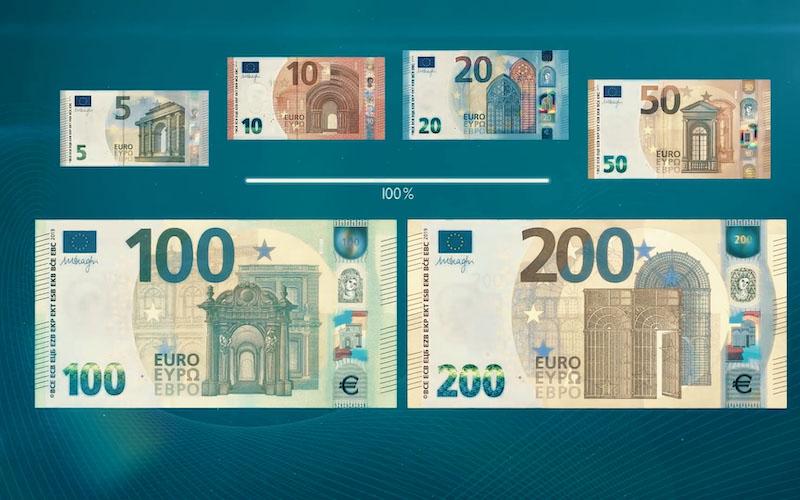
Following the acceleration of inflation in the Eurozone in May, the market believes there is a very high probability that the European Central Bank will raise interest rates in June. According to preliminary data, consumer prices rose 3.2% year-on-year in May, higher than April's 3.0% and well above the central bank's 2% inflation target. Core inflation, excluding volatile components such as energy and food, was 2.5%, higher than April's 2.2%.
Alessia Berardi, global head of macroeconomics at Amundi Investment Institute, said the European Central Bank may find it easier to argue that inflation is deviating from the baseline than to argue that hawks are holding rates steady, and therefore expects a precautionary 25-basis-point rate hike in June.
Berardi points out that the currently available data is indeed insufficient to assess the magnitude or duration of the impact of the Middle East conflict, while rising input costs have not yet been fully passed on to final prices, and demand pressures remain weak. She believes that if the data allows, there may be another rate hike in Q3. Amundi's forecast rules out the possibility of a return to low interest rates in 2027, as core CPI is expected to remain around 2.5%.
Bas van Geffen, senior macro strategist at Rabobank, said a June rate hike by the European Central Bank is almost a certainty, with more than 90% of economists expecting deposit rates to rise by 25 basis points to 2.25%.
van Geffen noted, "The ECB doesn't want to repeat the mistake of underestimating inflation. At this stage, the cost of maintaining interest rates in terms of public confidence in combating inflation may outweigh the risks of raising rates." He expects another rate hike this year, most likely in September, but if the situation in the Middle East persists for longer, the ECB may have to tighten further.
However, van Geffen also cautioned that the current economic environment differs from that of 2022—the economy is weaker and the labor market has loosened, limiting the ECB's room for aggressive tightening. He emphasized that what we are seeing now is more of a limited action of "one or two rate hikes" rather than a long-term tightening cycle.
According to Rainer Guntermann, an analyst at Commerzbank, a 25-basis-point rate hike by the European Central Bank on Thursday is almost a certainty and has already been fully priced into by the market. This would be the first rate hike since September 2023.
Guntermann believes that a second rate hike in July was premature, but expects another hike in September. Lower oil prices should then ease inflation, preventing the ECB from tightening policy to a restrictive level and even paving the way for rate cuts in 2027. He points out that the current rate hike cycle differs from the previous one (which saw a cumulative increase of 450 basis points) in its context—long-term inflation expectations remain near the target, while growth prospects are weak and public finances are strained.
The policy outlook is becoming more complex as the European Central Bank must balance persistently high inflation with a weak economy. Therefore, the latest macroeconomic forecasts, to be released on June 11, are likely to be a key focus for investors.
A recent report by Deutsche Bank's research division points out that the risk of a significant slowdown in the Eurozone economy is rising due to the energy shock triggered by the situation in the Middle East. The bank has sharply lowered its 2026 GDP growth forecast for the Eurozone from 1.1% in its November Global Outlook to 0.5%.
The report analyzes that the energy shock is mainly transmitted through four channels: rising inflation eroding household purchasing power, increased uncertainty suppressing investment, tighter monetary policy, and weakening exports due to slowing global demand. The bank estimates that Eurozone energy import spending will increase by approximately 1% of GDP in 2026.
Looking at the quarterly figures, the Eurozone economy is projected to contract by 0.1% quarter-on-quarter in the second quarter, stagnate in the third quarter, and resume moderate growth in the fourth quarter. The growth rate is expected to rebound to 1.1% in 2027. As the Eurozone's largest economy, Germany's growth is projected at 0.5% in 2026, with expansionary fiscal policy being the main stabilizing force. France and Italy's growth rates are projected at 0.5% and 0.4% respectively in 2026, with the latter being the weakest among the four major economies.
Deutsche Bank notes that current risks remain skewed to the downside. In an extreme scenario, if the Strait of Hormuz remains closed throughout the summer, Eurozone economic growth could fall to zero in 2026, while inflation could climb to 3.5%.
According to BNP Paribas' latest forecast, the Eurozone's GDP growth rate will slow from 1.5% in 2025 to 1.0% in 2026, before rebounding slightly to 1.3% in 2027.
BNP Paribas points out that despite the energy shock, investments in defense, artificial intelligence, and electrification will continue to support economic activity. Analysts believe that the spillover effects of the Middle East conflict will lead to slower growth, but thanks to investment in these strategic areas, intra-regional trade will remain active, helping the economy withstand the impact of the energy shock.
Regarding inflation, BNP Paribas projects that the inflation rate will rebound to 3.0% in 2026 and further rise to 3.3% in 2027. With the rise in inflation, the European Central Bank may initiate its first interest rate hike in June 2026, raising rates by a total of 50 basis points throughout the year, bringing the deposit facility rate to 2.5%. Under the baseline scenario (gradual normalization of the situation in the Middle East but continued price pressures), the US dollar will experience a very gradual depreciation against the euro, reflecting the continued diversification of global asset allocation from the US dollar.
The European Central Bank, which faced criticism for its slow response to surging inflation in 2022, may be looking to take a more aggressive stance this year. However, Carmignac chief economist Rafael Gallardo stated, "This is not 2022. The profit-employment link is much weaker than in 2022, and a looser labor market means less bargaining power for workers, which limits the room for tightening to two rate hikes this summer."
However, Tantori of BNP Paribas Asset Management believes this could pose a "political" risk—namely, ill-timed tightening. He points to two other risks: inflation may begin to decline after the summer, and the economy may slow further—the latter not yet priced into the market.
According to a media survey, 60% of economists expect another rate hike in 2026, possibly in September, which is in line with market pricing. DWS's Carstens stated, "We don't expect any dramatic changes, but rather a gradual adjustment in monetary policy, with the benchmark interest rate rising by about 50 basis points to 2.50% overall. The next step is likely in September." BNP Paribas Asset Management's baseline scenario remains two 25-basis-point rate hikes—in June and September respectively—followed by a prolonged period of inactivity for the remainder of the forecast (until the end of 2027).
The eurozone government bond market has experienced significant volatility this year, with interest rate expectations shifting from potential further cuts to hikes following the outbreak of the US-Iran conflict. Eurozone sovereign bond yields remain high—German 10-year bond yields are near 3.0%—reflecting higher issuance volumes, fiscal concerns, and an uncertain growth outlook. Interest rate hikes typically push up yields, depress bond prices, and reduce the attractiveness of existing bonds, especially those issued during periods of high interest rates.
BNP Paribas Asset Management's Tantori points out that against the backdrop of bond oversupply and rising inflation, investors are "highly sensitive to government bond prices and may demand higher yields." Inflationary pressures stem not only from the Middle East wars but also from the development of artificial intelligence, known for its high energy consumption.
In summary, the market has largely priced in the ECB's 25 basis point rate hike on Thursday. The real focus is on two points: first, the latest macroeconomic forecasts released with the interest rate decision, which expect inflation estimates for 2026 and 2027 to be significantly revised upward; and second, President Lagarde's guidance on the subsequent path—the market has already priced in another 25 basis point rate hike in September, but the ECB will most likely continue to emphasize "data dependence."
The European Central Bank (ECB) currently faces a complex trade-off: on the one hand, inflationary pressures driven by the energy shock persist; on the other hand, the economy has shown signs of slowing. Unlike in 2022, the current labor market is weaker, wage transmission is limited, and excessive tightening could pose "political risks." The key focus of this meeting will be whether Lagarde hints at further rate hikes in July or September, and how the central bank views the balance between recession risks and inflation.
The euro is currently in a clear downtrend against the US dollar on the daily chart, with the price breaking below the key support level of the 200-day moving average, indicating strong overall bearish momentum.
The moving average system is in a typical bearish formation, with the price breaking below the MA20, MA50, MA100, and MA200. Each moving average forms a layer of resistance, with the previous low of 1.1410 as the support level. A break below this level would open up further downside potential.
In terms of indicators, the MACD's DIFF line is below the DEA line, and the green bars continue to expand, indicating continued bearish momentum. The RSI value is 35.20, in a weak range. Although it is close to oversold, there are no obvious rebound signals yet, and the short-term weakness is unlikely to change. Overall, the technical signals for EUR/USD are bearish, with a short-term downward trend. Any rebounds should be considered technical corrections, and there is significant resistance above.
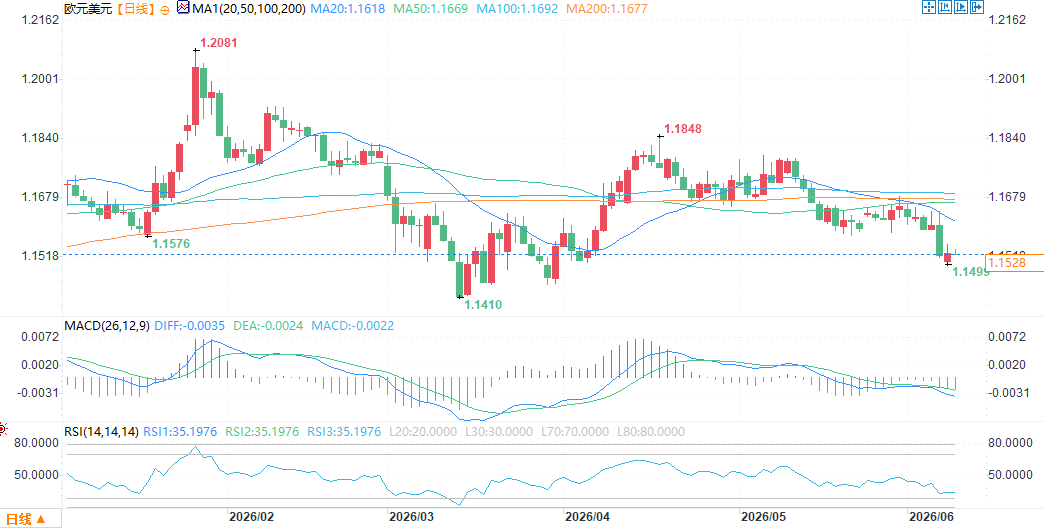
(Euro/USD daily chart, source: FX678)
At 8:56 AM Beijing time on June 9, the euro was trading at 1.1527/28 against the US dollar.
The high opening and subsequent decline in the exchange rate reflects the market's gradual digestion of expectations that the European Central Bank will soon raise interest rates.
Following the acceleration of inflation in May, economists and traders widely expect the European Central Bank to raise interest rates by 25 basis points at its meeting this Thursday (June 11).
With the US-Iran conflict proving to be a longer-term driver of inflation, futures markets indicate a 97% probability of a rate hike in June.
At the same time, the European Central Bank will release its latest macroeconomic forecasts, expecting inflation estimates for 2026 and 2027 to be significantly revised upward.
Most economists expect another rate hike in September, but the European Central Bank will continue to adhere to its "data-dependent" monetary policy path.
A June rate hike is almost a certainty.
Following the acceleration of inflation in the Eurozone in May, the market believes there is a very high probability that the European Central Bank will raise interest rates in June. According to preliminary data, consumer prices rose 3.2% year-on-year in May, higher than April's 3.0% and well above the central bank's 2% inflation target. Core inflation, excluding volatile components such as energy and food, was 2.5%, higher than April's 2.2%.
Alessia Berardi, global head of macroeconomics at Amundi Investment Institute, said the European Central Bank may find it easier to argue that inflation is deviating from the baseline than to argue that hawks are holding rates steady, and therefore expects a precautionary 25-basis-point rate hike in June.
Berardi points out that the currently available data is indeed insufficient to assess the magnitude or duration of the impact of the Middle East conflict, while rising input costs have not yet been fully passed on to final prices, and demand pressures remain weak. She believes that if the data allows, there may be another rate hike in Q3. Amundi's forecast rules out the possibility of a return to low interest rates in 2027, as core CPI is expected to remain around 2.5%.
Bas van Geffen, senior macro strategist at Rabobank, said a June rate hike by the European Central Bank is almost a certainty, with more than 90% of economists expecting deposit rates to rise by 25 basis points to 2.25%.
van Geffen noted, "The ECB doesn't want to repeat the mistake of underestimating inflation. At this stage, the cost of maintaining interest rates in terms of public confidence in combating inflation may outweigh the risks of raising rates." He expects another rate hike this year, most likely in September, but if the situation in the Middle East persists for longer, the ECB may have to tighten further.
However, van Geffen also cautioned that the current economic environment differs from that of 2022—the economy is weaker and the labor market has loosened, limiting the ECB's room for aggressive tightening. He emphasized that what we are seeing now is more of a limited action of "one or two rate hikes" rather than a long-term tightening cycle.
According to Rainer Guntermann, an analyst at Commerzbank, a 25-basis-point rate hike by the European Central Bank on Thursday is almost a certainty and has already been fully priced into by the market. This would be the first rate hike since September 2023.
Guntermann believes that a second rate hike in July was premature, but expects another hike in September. Lower oil prices should then ease inflation, preventing the ECB from tightening policy to a restrictive level and even paving the way for rate cuts in 2027. He points out that the current rate hike cycle differs from the previous one (which saw a cumulative increase of 450 basis points) in its context—long-term inflation expectations remain near the target, while growth prospects are weak and public finances are strained.
Inflation revisions and growth revisions occur simultaneously.
The policy outlook is becoming more complex as the European Central Bank must balance persistently high inflation with a weak economy. Therefore, the latest macroeconomic forecasts, to be released on June 11, are likely to be a key focus for investors.
A recent report by Deutsche Bank's research division points out that the risk of a significant slowdown in the Eurozone economy is rising due to the energy shock triggered by the situation in the Middle East. The bank has sharply lowered its 2026 GDP growth forecast for the Eurozone from 1.1% in its November Global Outlook to 0.5%.
The report analyzes that the energy shock is mainly transmitted through four channels: rising inflation eroding household purchasing power, increased uncertainty suppressing investment, tighter monetary policy, and weakening exports due to slowing global demand. The bank estimates that Eurozone energy import spending will increase by approximately 1% of GDP in 2026.
Looking at the quarterly figures, the Eurozone economy is projected to contract by 0.1% quarter-on-quarter in the second quarter, stagnate in the third quarter, and resume moderate growth in the fourth quarter. The growth rate is expected to rebound to 1.1% in 2027. As the Eurozone's largest economy, Germany's growth is projected at 0.5% in 2026, with expansionary fiscal policy being the main stabilizing force. France and Italy's growth rates are projected at 0.5% and 0.4% respectively in 2026, with the latter being the weakest among the four major economies.
Deutsche Bank notes that current risks remain skewed to the downside. In an extreme scenario, if the Strait of Hormuz remains closed throughout the summer, Eurozone economic growth could fall to zero in 2026, while inflation could climb to 3.5%.
According to BNP Paribas' latest forecast, the Eurozone's GDP growth rate will slow from 1.5% in 2025 to 1.0% in 2026, before rebounding slightly to 1.3% in 2027.
BNP Paribas points out that despite the energy shock, investments in defense, artificial intelligence, and electrification will continue to support economic activity. Analysts believe that the spillover effects of the Middle East conflict will lead to slower growth, but thanks to investment in these strategic areas, intra-regional trade will remain active, helping the economy withstand the impact of the energy shock.
Regarding inflation, BNP Paribas projects that the inflation rate will rebound to 3.0% in 2026 and further rise to 3.3% in 2027. With the rise in inflation, the European Central Bank may initiate its first interest rate hike in June 2026, raising rates by a total of 50 basis points throughout the year, bringing the deposit facility rate to 2.5%. Under the baseline scenario (gradual normalization of the situation in the Middle East but continued price pressures), the US dollar will experience a very gradual depreciation against the euro, reflecting the continued diversification of global asset allocation from the US dollar.
Expectations of another rate hike in September remain, but the risks should not be ignored.
The European Central Bank, which faced criticism for its slow response to surging inflation in 2022, may be looking to take a more aggressive stance this year. However, Carmignac chief economist Rafael Gallardo stated, "This is not 2022. The profit-employment link is much weaker than in 2022, and a looser labor market means less bargaining power for workers, which limits the room for tightening to two rate hikes this summer."
However, Tantori of BNP Paribas Asset Management believes this could pose a "political" risk—namely, ill-timed tightening. He points to two other risks: inflation may begin to decline after the summer, and the economy may slow further—the latter not yet priced into the market.
According to a media survey, 60% of economists expect another rate hike in 2026, possibly in September, which is in line with market pricing. DWS's Carstens stated, "We don't expect any dramatic changes, but rather a gradual adjustment in monetary policy, with the benchmark interest rate rising by about 50 basis points to 2.50% overall. The next step is likely in September." BNP Paribas Asset Management's baseline scenario remains two 25-basis-point rate hikes—in June and September respectively—followed by a prolonged period of inactivity for the remainder of the forecast (until the end of 2027).
The impact of interest rate hikes on the bond market
The eurozone government bond market has experienced significant volatility this year, with interest rate expectations shifting from potential further cuts to hikes following the outbreak of the US-Iran conflict. Eurozone sovereign bond yields remain high—German 10-year bond yields are near 3.0%—reflecting higher issuance volumes, fiscal concerns, and an uncertain growth outlook. Interest rate hikes typically push up yields, depress bond prices, and reduce the attractiveness of existing bonds, especially those issued during periods of high interest rates.
BNP Paribas Asset Management's Tantori points out that against the backdrop of bond oversupply and rising inflation, investors are "highly sensitive to government bond prices and may demand higher yields." Inflationary pressures stem not only from the Middle East wars but also from the development of artificial intelligence, known for its high energy consumption.
In summary, the market has largely priced in the ECB's 25 basis point rate hike on Thursday. The real focus is on two points: first, the latest macroeconomic forecasts released with the interest rate decision, which expect inflation estimates for 2026 and 2027 to be significantly revised upward; and second, President Lagarde's guidance on the subsequent path—the market has already priced in another 25 basis point rate hike in September, but the ECB will most likely continue to emphasize "data dependence."
The European Central Bank (ECB) currently faces a complex trade-off: on the one hand, inflationary pressures driven by the energy shock persist; on the other hand, the economy has shown signs of slowing. Unlike in 2022, the current labor market is weaker, wage transmission is limited, and excessive tightening could pose "political risks." The key focus of this meeting will be whether Lagarde hints at further rate hikes in July or September, and how the central bank views the balance between recession risks and inflation.
Technical Analysis
The euro is currently in a clear downtrend against the US dollar on the daily chart, with the price breaking below the key support level of the 200-day moving average, indicating strong overall bearish momentum.
The moving average system is in a typical bearish formation, with the price breaking below the MA20, MA50, MA100, and MA200. Each moving average forms a layer of resistance, with the previous low of 1.1410 as the support level. A break below this level would open up further downside potential.
In terms of indicators, the MACD's DIFF line is below the DEA line, and the green bars continue to expand, indicating continued bearish momentum. The RSI value is 35.20, in a weak range. Although it is close to oversold, there are no obvious rebound signals yet, and the short-term weakness is unlikely to change. Overall, the technical signals for EUR/USD are bearish, with a short-term downward trend. Any rebounds should be considered technical corrections, and there is significant resistance above.
(Euro/USD daily chart, source: FX678)
At 8:56 AM Beijing time on June 9, the euro was trading at 1.1527/28 against the US dollar.
- Risk Warning and Disclaimer
- The market involves risk, and trading may not be suitable for all investors. This article is for reference only and does not constitute personal investment advice, nor does it take into account certain users’ specific investment objectives, financial situation, or other needs. Any investment decisions made based on this information are at your own risk.