The US dollar index opened lower but then rose. Will Wednesday's CPI data help it break through its previous high?
2026-06-09 09:14:51
On Tuesday (June 9) during the Asian session, the US dollar index fluctuated narrowly at high levels, currently trading around 100.00. On Monday, the US dollar index rose and then fell back, briefly reaching a near two-month high of 100.21 during the Asian session due to renewed fighting in the Middle East, but retreated to around the 100 mark after Trump called for a ceasefire.
With both Iran and Israel announcing a cessation of attacks on each other, investors' attention is shifting from Middle East geopolitics to the risk of continued inflation in the United States.
Last Friday's much stronger-than-expected non-farm payroll report reinforced market expectations that the Federal Reserve will maintain high interest rates for an extended period, providing support for a stronger dollar. The dollar index is expected to remain firm ahead of the CPI data release.
Iran and Israel announced a cessation of attacks on each other on March 8, less than 24 hours after clashes resumed.
According to the Islamic Republic News Agency (IRNA), the central headquarters of the Iranian Armed Forces, Hatam Anbia, issued a statement on the same day saying that the Iranian armed forces have now ended their recent military operations in response to Israel’s recent military operations in southern Lebanon and the southern suburbs of Beirut.
Israeli Prime Minister Benjamin Netanyahu issued a statement on the 8th, saying that Israel has temporarily suspended its attacks on Iran after Iran stopped firing on Israel.
Market attention has now shifted to inflation concerns triggered by last Friday's strong jobs report.
A much stronger-than-expected May jobs report propelled the dollar higher across the board on Friday. Data from the U.S. Bureau of Labor Statistics showed that nonfarm payrolls increased by 172,000 in May, far exceeding economists' previous forecasts of approximately 85,000. Meanwhile, the combined figures for the previous two months were revised upwards by 93,000, further reinforcing the assessment that the labor market remains tight. The unemployment rate remained stable at 4.3%, the lowest level since August of last year, and well below the long-term historical average of 5.7%.
This better-than-expected performance sends a clear signal: despite persistently rising energy prices and the Strait of Hormuz being closed for over 100 days, the U.S. labor market shows no signs of substantial weakness. The breadth of job growth has also improved, with robust job increases recorded in the service, manufacturing, and construction sectors. Meanwhile, the annual wage growth rate remains at 3.4%, indicating that while inflationary pressures from the labor market have eased from their peak, demand for workers remains resilient.
The market reacted swiftly to the data. This report fundamentally altered investors' expectations regarding the Federal Reserve's policy path—previously, the prevailing market view was that the Fed might maintain interest rates or even cut them this year, but the strong jobs data completely reversed this assessment. Federal funds futures show that traders are now fully pricing in a 25 basis point rate hike by the Fed before the end of the year, with the probability jumping from 45% a week ago to over 70%. This data lays a crucial foundation for Wednesday's upcoming CPI report—if inflation rises in tandem, the logic behind a Fed rate hike will be further solidified.
Newly appointed Federal Reserve Chairman Kevin Warsh faces an environment where he may not be able to deliver the interest rate cuts he hopes to see. The market had been anticipating easing policies to support economic growth, but last Friday's data changed that expectation.
Cleveland Fed President Beth Hammark stated that the economy is "near my definition of full employment," while noting that inflation remains a concern requiring action. Stephen Brown of Capital Economics wrote that these data "should further alleviate the FOMC's concerns about downside risks to the labor market," making it harder for policymakers to ignore high inflation.
Tight labor markets have increased the importance of the May CPI data to be released this Wednesday. Economists expect overall inflation to rise about 0.5% month-over-month in May, pushing the annual rate to around 4.2%, which would be the highest level in about three years. Core CPI, excluding food and energy, is expected to rise 0.3% month-over-month, with the annual rate remaining around 2.9%.
Weaker-than-expected CPI could boost the stock market and weaken the dollar by reopening the door to further easing by the Federal Reserve. However, given recent energy price movements, most signs point to upside risks.
While the Federal Reserve will almost certainly hold rates steady at next week's meeting, other major central banks around the world are rapidly turning hawkish, with markets increasingly worried that these central banks may face the risk of "falling behind the curve"—being forced to take aggressive tightening action only after inflationary pressures have accumulated.
In Europe, the European Central Bank (ECB) is expected to raise interest rates this Thursday, marking its first rate hike since September 2023. Eurozone inflation rebounded to 3.2% in May, with core inflation rising to 2.5%, well above the 2% target. Despite an unexpected decline in Eurozone GDP in the first quarter and a sharp drop in German factory orders, the ECB has had to take action to maintain its credibility in combating inflation. The market has already fully priced in a 25 basis point rate hike this week and anticipates another hike in September.
In Japan, inflationary pressures are also building. Soaring energy import costs coupled with a weak yen are transmitting imported inflation to all corners of the Japanese economy. Market observers expect the Bank of Japan to follow the global tightening trend and end its ultra-loose monetary policy this year. Although the exact timing remains uncertain, the direction of interest rate hikes is gradually becoming clearer.
In the UK, while the Bank of England is more inclined to raise than cut interest rates at its meeting later this month, it faces a more complex trade-off. Inflation remains above target, but economic activity has shown signs of slowing, with the housing market particularly vulnerable. However, given rising expectations of a Fed rate hike and the European Central Bank's preemptive action, a Bank of England decision to hold rates steady could face additional imported inflationary pressures from a depreciating pound.
Overall, the divergence in global monetary policy is narrowing—the Federal Reserve is holding rates steady, while other major central banks are raising interest rates or signaling rate hikes. This pattern of "US rates unchanged, other countries following suit" may provide the US dollar with a relative advantage in the short term, but it also means that if the Federal Reserve is forced to follow suit with tightening in the future, volatility in global financial markets will further intensify.
The US dollar index is currently in a strong upward channel on the daily chart. The price has rebounded continuously from the May low of 97.62 and recently rose to near the 100 mark, approaching the previous high of 100.64, with a clear bullish trend.
The moving average system is in a bullish alignment, with the price above the 20-day, 50-day, 100-day, and 200-day moving averages. Support levels are around 99.27 and 98.89, which appear to be solid. The key resistance level is around 100.64; a break above this level could open up further upside potential.
In terms of indicators, the MACD DIFF line is above the DEA line, and the red bars continue to expand, indicating that bullish momentum is still strengthening. The RSI value is 64.99, which is in the bullish zone but has not yet entered overbought territory, suggesting further upside potential. Overall, the US dollar index shows a clear short-term strength, and pullbacks do not change the upward trend. Attention should be paid to whether it can break through the previous high resistance level.
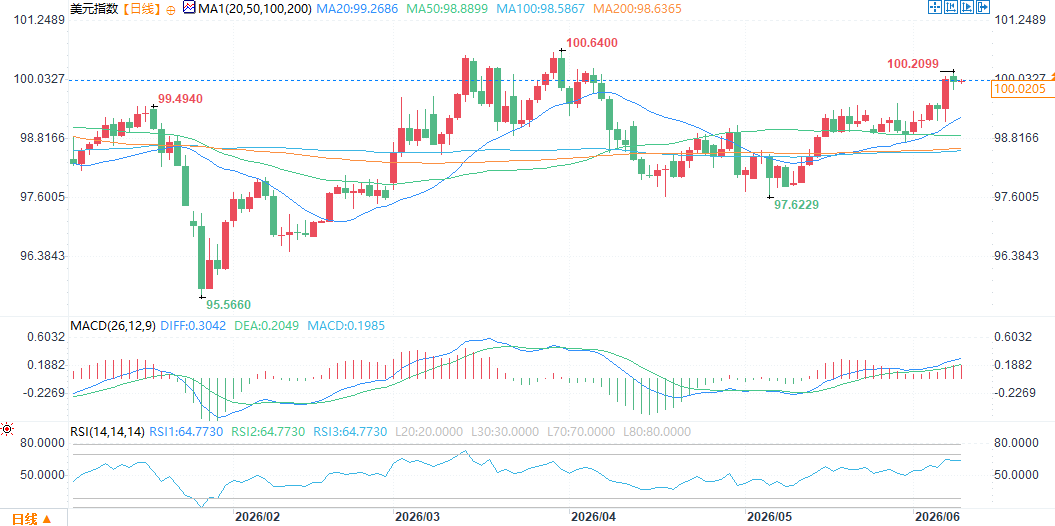
(US Dollar Index Daily Chart, Source: FX678)
At 9:14 AM Beijing time on June 9, the US dollar index was at 100.00.
With both Iran and Israel announcing a cessation of attacks on each other, investors' attention is shifting from Middle East geopolitics to the risk of continued inflation in the United States.
Last Friday's much stronger-than-expected non-farm payroll report reinforced market expectations that the Federal Reserve will maintain high interest rates for an extended period, providing support for a stronger dollar. The dollar index is expected to remain firm ahead of the CPI data release.
Iran and Israel have both announced a cessation of attacks on each other.
Iran and Israel announced a cessation of attacks on each other on March 8, less than 24 hours after clashes resumed.
According to the Islamic Republic News Agency (IRNA), the central headquarters of the Iranian Armed Forces, Hatam Anbia, issued a statement on the same day saying that the Iranian armed forces have now ended their recent military operations in response to Israel’s recent military operations in southern Lebanon and the southern suburbs of Beirut.
Israeli Prime Minister Benjamin Netanyahu issued a statement on the 8th, saying that Israel has temporarily suspended its attacks on Iran after Iran stopped firing on Israel.
Market attention has now shifted to inflation concerns triggered by last Friday's strong jobs report.
May non-farm payrolls far exceeded expectations
A much stronger-than-expected May jobs report propelled the dollar higher across the board on Friday. Data from the U.S. Bureau of Labor Statistics showed that nonfarm payrolls increased by 172,000 in May, far exceeding economists' previous forecasts of approximately 85,000. Meanwhile, the combined figures for the previous two months were revised upwards by 93,000, further reinforcing the assessment that the labor market remains tight. The unemployment rate remained stable at 4.3%, the lowest level since August of last year, and well below the long-term historical average of 5.7%.
This better-than-expected performance sends a clear signal: despite persistently rising energy prices and the Strait of Hormuz being closed for over 100 days, the U.S. labor market shows no signs of substantial weakness. The breadth of job growth has also improved, with robust job increases recorded in the service, manufacturing, and construction sectors. Meanwhile, the annual wage growth rate remains at 3.4%, indicating that while inflationary pressures from the labor market have eased from their peak, demand for workers remains resilient.
The market reacted swiftly to the data. This report fundamentally altered investors' expectations regarding the Federal Reserve's policy path—previously, the prevailing market view was that the Fed might maintain interest rates or even cut them this year, but the strong jobs data completely reversed this assessment. Federal funds futures show that traders are now fully pricing in a 25 basis point rate hike by the Fed before the end of the year, with the probability jumping from 45% a week ago to over 70%. This data lays a crucial foundation for Wednesday's upcoming CPI report—if inflation rises in tandem, the logic behind a Fed rate hike will be further solidified.
The new Federal Reserve chairman faces a complex environment, with CPI data becoming crucial.
Newly appointed Federal Reserve Chairman Kevin Warsh faces an environment where he may not be able to deliver the interest rate cuts he hopes to see. The market had been anticipating easing policies to support economic growth, but last Friday's data changed that expectation.
Cleveland Fed President Beth Hammark stated that the economy is "near my definition of full employment," while noting that inflation remains a concern requiring action. Stephen Brown of Capital Economics wrote that these data "should further alleviate the FOMC's concerns about downside risks to the labor market," making it harder for policymakers to ignore high inflation.
Tight labor markets have increased the importance of the May CPI data to be released this Wednesday. Economists expect overall inflation to rise about 0.5% month-over-month in May, pushing the annual rate to around 4.2%, which would be the highest level in about three years. Core CPI, excluding food and energy, is expected to rise 0.3% month-over-month, with the annual rate remaining around 2.9%.
Weaker-than-expected CPI could boost the stock market and weaken the dollar by reopening the door to further easing by the Federal Reserve. However, given recent energy price movements, most signs point to upside risks.
Global central banks diverge: the Federal Reserve holds rates steady, while the European Central Bank is poised to raise rates.
While the Federal Reserve will almost certainly hold rates steady at next week's meeting, other major central banks around the world are rapidly turning hawkish, with markets increasingly worried that these central banks may face the risk of "falling behind the curve"—being forced to take aggressive tightening action only after inflationary pressures have accumulated.
In Europe, the European Central Bank (ECB) is expected to raise interest rates this Thursday, marking its first rate hike since September 2023. Eurozone inflation rebounded to 3.2% in May, with core inflation rising to 2.5%, well above the 2% target. Despite an unexpected decline in Eurozone GDP in the first quarter and a sharp drop in German factory orders, the ECB has had to take action to maintain its credibility in combating inflation. The market has already fully priced in a 25 basis point rate hike this week and anticipates another hike in September.
In Japan, inflationary pressures are also building. Soaring energy import costs coupled with a weak yen are transmitting imported inflation to all corners of the Japanese economy. Market observers expect the Bank of Japan to follow the global tightening trend and end its ultra-loose monetary policy this year. Although the exact timing remains uncertain, the direction of interest rate hikes is gradually becoming clearer.
In the UK, while the Bank of England is more inclined to raise than cut interest rates at its meeting later this month, it faces a more complex trade-off. Inflation remains above target, but economic activity has shown signs of slowing, with the housing market particularly vulnerable. However, given rising expectations of a Fed rate hike and the European Central Bank's preemptive action, a Bank of England decision to hold rates steady could face additional imported inflationary pressures from a depreciating pound.
Overall, the divergence in global monetary policy is narrowing—the Federal Reserve is holding rates steady, while other major central banks are raising interest rates or signaling rate hikes. This pattern of "US rates unchanged, other countries following suit" may provide the US dollar with a relative advantage in the short term, but it also means that if the Federal Reserve is forced to follow suit with tightening in the future, volatility in global financial markets will further intensify.
Technical Analysis
The US dollar index is currently in a strong upward channel on the daily chart. The price has rebounded continuously from the May low of 97.62 and recently rose to near the 100 mark, approaching the previous high of 100.64, with a clear bullish trend.
The moving average system is in a bullish alignment, with the price above the 20-day, 50-day, 100-day, and 200-day moving averages. Support levels are around 99.27 and 98.89, which appear to be solid. The key resistance level is around 100.64; a break above this level could open up further upside potential.
In terms of indicators, the MACD DIFF line is above the DEA line, and the red bars continue to expand, indicating that bullish momentum is still strengthening. The RSI value is 64.99, which is in the bullish zone but has not yet entered overbought territory, suggesting further upside potential. Overall, the US dollar index shows a clear short-term strength, and pullbacks do not change the upward trend. Attention should be paid to whether it can break through the previous high resistance level.
(US Dollar Index Daily Chart, Source: FX678)
At 9:14 AM Beijing time on June 9, the US dollar index was at 100.00.
- Risk Warning and Disclaimer
- The market involves risk, and trading may not be suitable for all investors. This article is for reference only and does not constitute personal investment advice, nor does it take into account certain users’ specific investment objectives, financial situation, or other needs. Any investment decisions made based on this information are at your own risk.