Gold's slight rebound does not change the downward trend; it awaits a pressure test.
2026-06-09 10:04:22
International gold prices continued to be under pressure during Asian trading hours on Tuesday, with spot gold (XAU/USD) fluctuating around $4,330, maintaining its consolidation near three-month lows. Cooling market risk aversion and renewed expectations of US interest rates were the main factors weighing on gold's recent performance.

Recent developments in the Middle East have shown signs of a temporary easing of tensions. Iran and Israel have agreed to reduce military operations against each other, after escalating regional tensions threatened the peace process and prompted US President Trump to call for de-escalation. With the risk of conflict temporarily reduced, demand for safe-haven assets has weakened significantly, causing gold to lose some support.
However, regional risks have not completely disappeared. Iran previously announced the end of its military operations against Israel, but its Central Military Command also warned that if Israel continues military strikes, including those against southern Lebanon, Iran will take a stronger response. This means that significant uncertainty remains in the Middle East, and any new military conflict could reignite market risk aversion.
Despite ongoing geopolitical risks, market focus has gradually shifted to the outlook for US monetary policy. The latest strong US employment data indicates a resilient labor market. This has prompted investors to reassess the Federal Reserve's future policy direction and increased expectations for further monetary tightening.
The market generally believes that a persistently strong job market could lead to sustained high wage growth, thereby increasing the risk of a resurgence in inflation. Against this backdrop, the likelihood of the Federal Reserve maintaining higher interest rates or even raising them further is increasing. According to data from the CME Group's FedWatch tool, the market now expects a 43% probability of a 25 basis point rate hike by the Fed in December, compared to only about 14% a month ago. This change reflects a significant adjustment in investors' expectations regarding the future path of interest rates.
For gold, rising interest rate expectations pose a direct threat. Since gold itself does not generate interest income, the opportunity cost of holding gold increases when market interest rates rise, leading funds to flow to assets with higher yields, thus diminishing gold's attractiveness. Therefore, the recent strength of US Treasury yields and the US dollar index has continued to suppress gold prices.
Meanwhile, energy supply risks in the Middle East remain a concern for the market. Some analysts believe that a renewed escalation of regional tensions could push up international energy prices and exacerbate global inflationary pressures, thus forcing the Federal Reserve to maintain its high-interest-rate policy for an extended period. The gold market is currently facing a dual struggle between safe-haven demand and high-interest-rate pressures, and subsequent economic data will be a crucial factor in determining market direction.
This week, market focus will be on US inflation data. Investors are awaiting the Consumer Price Index (CPI) to be released on Wednesday and the Producer Price Index (PPI) to be released on Thursday. If the inflation data is higher than market expectations, the probability of the Federal Reserve further tightening policy may continue to rise, thereby increasing downward pressure on gold; conversely, if inflation shows signs of cooling, it may alleviate market concerns about interest rate hikes and provide some rebound opportunities for gold.
From a fund flow perspective, market sentiment is currently cautious. Some institutional investors are reducing their long positions in gold while increasing their allocation to the US dollar and fixed-income assets. Ahead of major economic data releases, the gold market may maintain a weak and volatile pattern.
From a daily chart perspective, gold prices have been declining recently, generally trading within a downward channel. Prices have fallen to their lowest level since late March, indicating that bears still dominate the market. The moving average system is gradually turning bearish, with short-term moving averages crossing below medium- and long-term moving averages, reflecting a weakening market trend. The MACD indicator continues to trade below the zero line, with the green histogram bars expanding further, indicating strong bearish momentum. The RSI indicator has fallen to around 40, not yet entering oversold territory, suggesting further downside potential. Key support levels to watch are the $4300 and $4250 area, while key resistance levels are around $4360 and $4400.
From a 4-hour chart perspective, gold prices continue to be suppressed by the descending trendline, limiting the strength of any short-term rebound. The MACD indicator maintains its death cross structure, but the green momentum bars have narrowed, indicating a slight weakening of bearish momentum. The RSI indicator is hovering around 45, suggesting a cautious market sentiment. If the price can break through the $4360 resistance area, it may rebound further to test the $4400 level; if it breaks below the $4300 support, it may further decline to $4250 or even lower. Overall, the short-term trend remains bearish, but a technical correction cannot be ruled out before the release of important economic data.
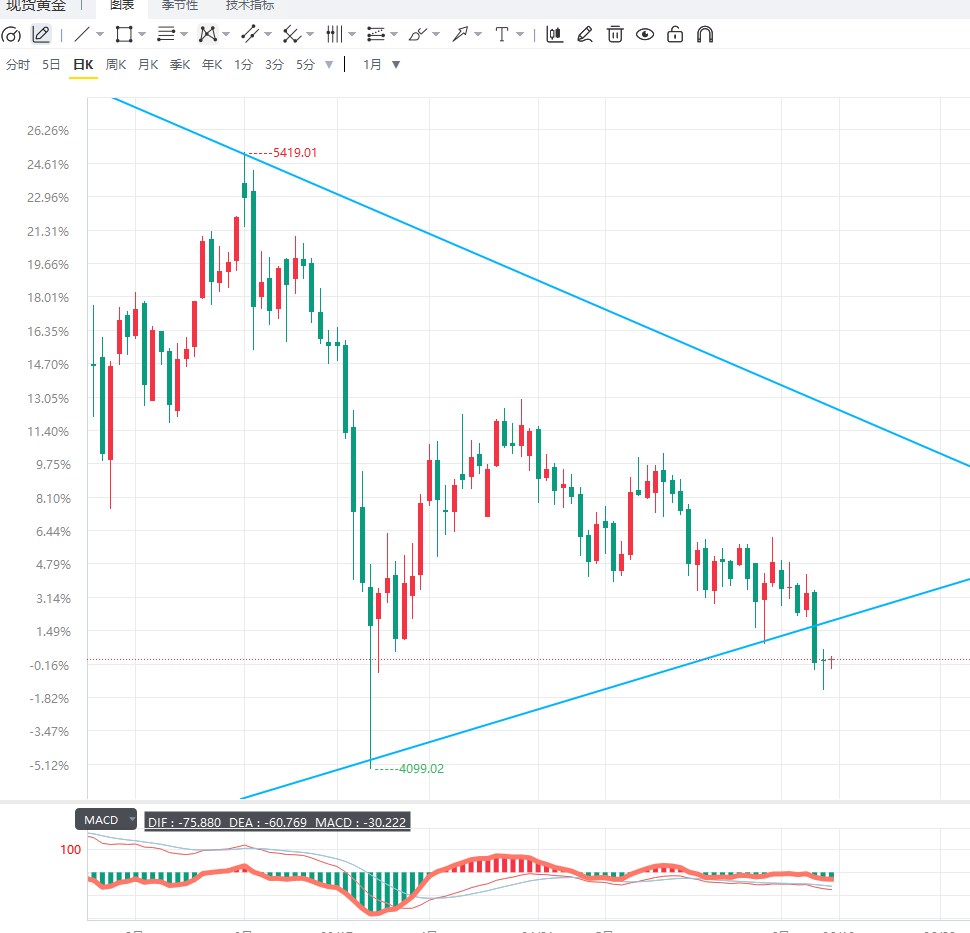
Editor's Summary : The gold market is currently undergoing a transition from being driven by safe-haven sentiment to being driven by interest rate expectations. With signs of easing tensions in the Middle East, the traditional safe-haven appeal of gold has weakened, while strong US economic data has reinforced market expectations that the Federal Reserve will maintain high interest rates or even raise them further. The US CPI and PPI data to be released in the coming days will be key factors determining the next phase of gold's price movement. If inflation exceeds expectations, market expectations for interest rate hikes may continue to rise, and gold faces further adjustment risks; if inflationary pressures ease significantly, it is expected to prompt the market to reassess the monetary policy path, thus providing momentum for a gold rebound. Overall, gold still faces short-term pressure, but geopolitical risks and global economic uncertainties continue to provide potential support for its medium- to long-term trend.
Recent developments in the Middle East have shown signs of a temporary easing of tensions. Iran and Israel have agreed to reduce military operations against each other, after escalating regional tensions threatened the peace process and prompted US President Trump to call for de-escalation. With the risk of conflict temporarily reduced, demand for safe-haven assets has weakened significantly, causing gold to lose some support.
However, regional risks have not completely disappeared. Iran previously announced the end of its military operations against Israel, but its Central Military Command also warned that if Israel continues military strikes, including those against southern Lebanon, Iran will take a stronger response. This means that significant uncertainty remains in the Middle East, and any new military conflict could reignite market risk aversion.
Despite ongoing geopolitical risks, market focus has gradually shifted to the outlook for US monetary policy. The latest strong US employment data indicates a resilient labor market. This has prompted investors to reassess the Federal Reserve's future policy direction and increased expectations for further monetary tightening.
The market generally believes that a persistently strong job market could lead to sustained high wage growth, thereby increasing the risk of a resurgence in inflation. Against this backdrop, the likelihood of the Federal Reserve maintaining higher interest rates or even raising them further is increasing. According to data from the CME Group's FedWatch tool, the market now expects a 43% probability of a 25 basis point rate hike by the Fed in December, compared to only about 14% a month ago. This change reflects a significant adjustment in investors' expectations regarding the future path of interest rates.
For gold, rising interest rate expectations pose a direct threat. Since gold itself does not generate interest income, the opportunity cost of holding gold increases when market interest rates rise, leading funds to flow to assets with higher yields, thus diminishing gold's attractiveness. Therefore, the recent strength of US Treasury yields and the US dollar index has continued to suppress gold prices.
Meanwhile, energy supply risks in the Middle East remain a concern for the market. Some analysts believe that a renewed escalation of regional tensions could push up international energy prices and exacerbate global inflationary pressures, thus forcing the Federal Reserve to maintain its high-interest-rate policy for an extended period. The gold market is currently facing a dual struggle between safe-haven demand and high-interest-rate pressures, and subsequent economic data will be a crucial factor in determining market direction.
This week, market focus will be on US inflation data. Investors are awaiting the Consumer Price Index (CPI) to be released on Wednesday and the Producer Price Index (PPI) to be released on Thursday. If the inflation data is higher than market expectations, the probability of the Federal Reserve further tightening policy may continue to rise, thereby increasing downward pressure on gold; conversely, if inflation shows signs of cooling, it may alleviate market concerns about interest rate hikes and provide some rebound opportunities for gold.
From a fund flow perspective, market sentiment is currently cautious. Some institutional investors are reducing their long positions in gold while increasing their allocation to the US dollar and fixed-income assets. Ahead of major economic data releases, the gold market may maintain a weak and volatile pattern.
From a daily chart perspective, gold prices have been declining recently, generally trading within a downward channel. Prices have fallen to their lowest level since late March, indicating that bears still dominate the market. The moving average system is gradually turning bearish, with short-term moving averages crossing below medium- and long-term moving averages, reflecting a weakening market trend. The MACD indicator continues to trade below the zero line, with the green histogram bars expanding further, indicating strong bearish momentum. The RSI indicator has fallen to around 40, not yet entering oversold territory, suggesting further downside potential. Key support levels to watch are the $4300 and $4250 area, while key resistance levels are around $4360 and $4400.
From a 4-hour chart perspective, gold prices continue to be suppressed by the descending trendline, limiting the strength of any short-term rebound. The MACD indicator maintains its death cross structure, but the green momentum bars have narrowed, indicating a slight weakening of bearish momentum. The RSI indicator is hovering around 45, suggesting a cautious market sentiment. If the price can break through the $4360 resistance area, it may rebound further to test the $4400 level; if it breaks below the $4300 support, it may further decline to $4250 or even lower. Overall, the short-term trend remains bearish, but a technical correction cannot be ruled out before the release of important economic data.
Editor's Summary : The gold market is currently undergoing a transition from being driven by safe-haven sentiment to being driven by interest rate expectations. With signs of easing tensions in the Middle East, the traditional safe-haven appeal of gold has weakened, while strong US economic data has reinforced market expectations that the Federal Reserve will maintain high interest rates or even raise them further. The US CPI and PPI data to be released in the coming days will be key factors determining the next phase of gold's price movement. If inflation exceeds expectations, market expectations for interest rate hikes may continue to rise, and gold faces further adjustment risks; if inflationary pressures ease significantly, it is expected to prompt the market to reassess the monetary policy path, thus providing momentum for a gold rebound. Overall, gold still faces short-term pressure, but geopolitical risks and global economic uncertainties continue to provide potential support for its medium- to long-term trend.
- Risk Warning and Disclaimer
- The market involves risk, and trading may not be suitable for all investors. This article is for reference only and does not constitute personal investment advice, nor does it take into account certain users’ specific investment objectives, financial situation, or other needs. Any investment decisions made based on this information are at your own risk.