On one hand, there's a "ceasefire but no reconciliation" in the Middle East; on the other hand, expectations for a Fed rate hike are rising: silver is caught in a dilemma.
2026-06-09 10:38:38
On Tuesday (June 9) during the Asian session, spot silver traded in a narrow range, currently hovering around $67.70 per ounce.
Uncertainty surrounding the Middle East situation and rising market expectations for a Federal Reserve interest rate hike are both putting pressure on silver. Although Iran and Israel agreed to a cessation of mutual attacks under President Trump's mediation, Israeli Prime Minister Netanyahu declared that the war with Iran and Hezbollah is "not over." Meanwhile, strong US jobs data exacerbated inflation concerns and reinforced expectations of interest rate hikes, reducing the attractiveness of silver as a non-interest-bearing asset.
Following President Trump's intervention, Iran and Israel announced a cessation of mutual attacks on June 8, less than 24 hours after resuming hostilities. This news briefly brought hope for easing tensions in the Middle East, and market risk aversion eased somewhat. The Hatam Anbia Central Headquarters of the Iranian Armed Forces issued a statement saying that in response to Israel's recent military operations in southern Lebanon and the southern suburbs of Beirut, Iranian forces had ended their current military operations. Israeli Prime Minister Netanyahu subsequently stated that Israel had temporarily suspended its attacks on Iran after Iran ceased fire.
However, long-term stability remains a distant prospect. In his statement, Netanyahu also declared that the war with Iran and Hezbollah is "not over," despite claiming that both adversaries are weaker than ever. This statement suggests that Israel has not abandoned its strategic pressure on Iran and Hezbollah, and could resume military operations at any time depending on the situation.
Iran has also reserved the right to retaliate. While the Iranian military has confirmed a halt to the current attacks, its central command warned that if Israel resumes military operations—including strikes on Iranian soil or in southern Lebanon—Iran will respond with a “more severe and destructive force.” This power struggle—a ceasefire for respite while retaining the right to retaliate—keeps the situation in the Middle East fragile.
This ongoing geopolitical friction has provided some support for safe-haven assets like silver, but has also limited their upside potential. On one hand, safe-haven demand provides a floor for silver, preventing a sharp decline; on the other hand, the continuation of the ceasefire agreement limits further escalation of risk aversion, making it difficult for silver to break through upper resistance levels. The market will continue to focus on whether Israel and Iran are truly adhering to the ceasefire agreement, and whether Hezbollah in Lebanon will be drawn into a wider conflict. Any accidental clashes on either side could reignite risk aversion and drive a silver rebound.
Continued geopolitical tensions, coupled with strong US employment data, are simultaneously pushing up inflation expectations from two directions. On the one hand, the ongoing closure of the Strait of Hormuz has kept energy prices high, with crude oil remaining above $90, which is being passed on to end consumers through gasoline, electricity, and transportation costs. On the other hand, the US added 172,000 non-farm jobs in May, far exceeding expectations, indicating that the labor market remains tight and wage growth pressures are difficult to alleviate. These two forces combined have significantly increased market concerns about inflation and strengthened expectations of a Federal Reserve interest rate hike. As a non-interest-bearing asset, the opportunity cost of holding silver increases when interest rates rise, thus reducing its attractiveness.
According to data from the CME FedWatch tool, traders have increased the probability of a 25 basis point rate hike in December to 42%, significantly higher than 14% a month ago. This change reflects a repricing of the market's expectations for the Fed's policy path—just weeks ago, the mainstream market expectation was for rates to remain unchanged or even be cut this year, but strong employment data has completely changed that assessment. Federal funds futures show that the probability of at least one rate hike before the end of the year is now close to 73%, while the probability of a single rate hike in December has also risen to 42%.
The market is currently holding its breath awaiting the US Consumer Price Index (CPI) data to be released on Wednesday and the Producer Price Index (PPI) data to be released on Thursday, in order to determine the Federal Reserve's next move. Economists expect the overall CPI to rise to 4.2% year-on-year in May, a new high in more than three years. If inflation data continues to rise, it will further solidify market expectations for interest rate hikes, and may even push the probability of a December rate hike to above 50%. This means additional pressure on silver—higher interest rate expectations will push up the dollar and US Treasury yields, while silver, a non-interest-bearing asset, will face the risk of capital outflows. Conversely, if inflation unexpectedly weakens, it may partially offset the expectation of a rate hike, providing some breathing room for silver.
UBS Group holds a cautiously bearish view on the silver market and has recently significantly lowered its silver price target. The latest forecasts from UBS strategists Wayne Gordon and Dominic Schneider indicate that the silver supply deficit in 2026 will narrow sharply from the previously estimated 300 million ounces to approximately 60-70 million ounces, leading the bank to comprehensively lower its price outlook.
UBS has lowered its silver price target for the end of the second quarter of 2026 from $100/oz to $85, its September target from $95 to $85, its year-end target from $85 to $80, and its March 2027 forecast from $85 to $75.
The bank pointed out that three pressures have led to a narrowing supply gap: demand in the photovoltaic sector has weakened due to high prices, demand for silverware and jewelry has been suppressed by high prices, and total ETF holdings have decreased by nearly 70 million ounces. UBS believes that investment demand will be revised down from the previous forecast of over 400 million ounces to 300 million ounces, and calls this forecast "still generous."
UBS also stated that gold remains a key factor in stabilizing silver prices, and expects the gold-silver ratio to converge towards the 75-80 range over time. In terms of trading strategy, the bank favors selling volatility rather than holding direct long positions, believing that selling downside risk to earn holding gains is an attractive strategy over the next three months.
The current technical outlook for spot silver on the daily chart is generally weak, with prices having broken through key support levels, indicating significant downward pressure in the short term.
In terms of price, the current price is around 67.70, which has broken through the previous consolidation platform and the MA20, MA50 and MA100 moving averages. The support below points to the previous low of 66.13 and 60.96.
The indicators are bearish: the MACD indicator's DIFF and DEA have both crossed below the zero axis, and the green bars continue to expand, indicating that the bearish momentum is still being released; the RSI indicator has fallen back to 35.586, which is close to the oversold zone, but there has been no clear reversal signal yet, and the downward momentum has not yet exhausted.
Overall, the moving average system is in a bearish alignment, and the price rebounded weakly after breaking through a key support level. Coupled with the MACD and RSI indicators both releasing weak signals, silver is likely to continue its downward trend in the short term. Going forward, the effectiveness of the 200-day moving average and the support level around 66 needs to be closely monitored. A break below these levels could open up further downside potential.
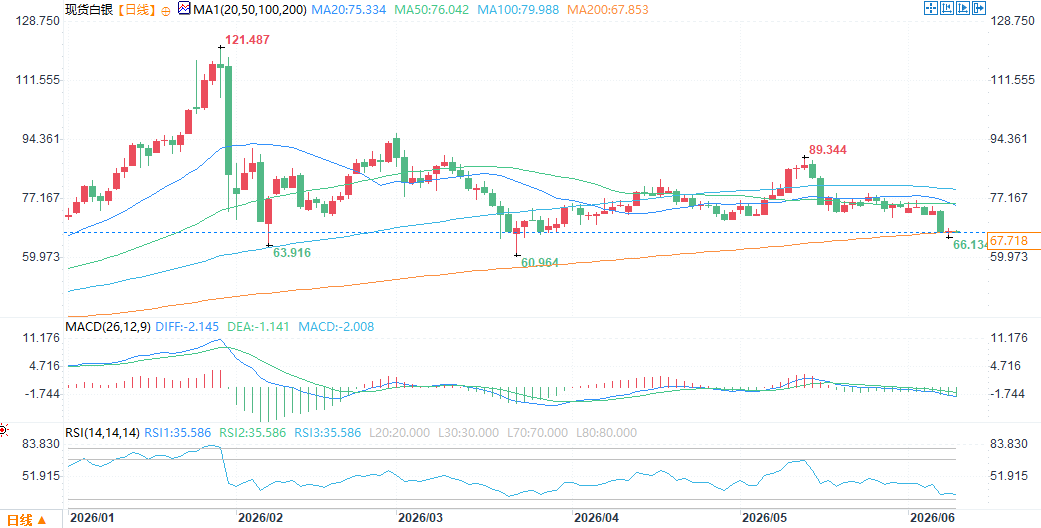
(Spot silver daily chart, source: EasyForex)
At 10:37 AM Beijing time on June 9, spot silver was trading at $67.67 per ounce.
Uncertainty surrounding the Middle East situation and rising market expectations for a Federal Reserve interest rate hike are both putting pressure on silver. Although Iran and Israel agreed to a cessation of mutual attacks under President Trump's mediation, Israeli Prime Minister Netanyahu declared that the war with Iran and Hezbollah is "not over." Meanwhile, strong US jobs data exacerbated inflation concerns and reinforced expectations of interest rate hikes, reducing the attractiveness of silver as a non-interest-bearing asset.
Hopes for a ceasefire in the Middle East are emerging, but long-term stability remains elusive.
Following President Trump's intervention, Iran and Israel announced a cessation of mutual attacks on June 8, less than 24 hours after resuming hostilities. This news briefly brought hope for easing tensions in the Middle East, and market risk aversion eased somewhat. The Hatam Anbia Central Headquarters of the Iranian Armed Forces issued a statement saying that in response to Israel's recent military operations in southern Lebanon and the southern suburbs of Beirut, Iranian forces had ended their current military operations. Israeli Prime Minister Netanyahu subsequently stated that Israel had temporarily suspended its attacks on Iran after Iran ceased fire.
However, long-term stability remains a distant prospect. In his statement, Netanyahu also declared that the war with Iran and Hezbollah is "not over," despite claiming that both adversaries are weaker than ever. This statement suggests that Israel has not abandoned its strategic pressure on Iran and Hezbollah, and could resume military operations at any time depending on the situation.
Iran has also reserved the right to retaliate. While the Iranian military has confirmed a halt to the current attacks, its central command warned that if Israel resumes military operations—including strikes on Iranian soil or in southern Lebanon—Iran will respond with a “more severe and destructive force.” This power struggle—a ceasefire for respite while retaining the right to retaliate—keeps the situation in the Middle East fragile.
This ongoing geopolitical friction has provided some support for safe-haven assets like silver, but has also limited their upside potential. On one hand, safe-haven demand provides a floor for silver, preventing a sharp decline; on the other hand, the continuation of the ceasefire agreement limits further escalation of risk aversion, making it difficult for silver to break through upper resistance levels. The market will continue to focus on whether Israel and Iran are truly adhering to the ceasefire agreement, and whether Hezbollah in Lebanon will be drawn into a wider conflict. Any accidental clashes on either side could reignite risk aversion and drive a silver rebound.
Rising expectations of a Federal Reserve rate hike put pressure on non-interest-bearing assets.
Continued geopolitical tensions, coupled with strong US employment data, are simultaneously pushing up inflation expectations from two directions. On the one hand, the ongoing closure of the Strait of Hormuz has kept energy prices high, with crude oil remaining above $90, which is being passed on to end consumers through gasoline, electricity, and transportation costs. On the other hand, the US added 172,000 non-farm jobs in May, far exceeding expectations, indicating that the labor market remains tight and wage growth pressures are difficult to alleviate. These two forces combined have significantly increased market concerns about inflation and strengthened expectations of a Federal Reserve interest rate hike. As a non-interest-bearing asset, the opportunity cost of holding silver increases when interest rates rise, thus reducing its attractiveness.
According to data from the CME FedWatch tool, traders have increased the probability of a 25 basis point rate hike in December to 42%, significantly higher than 14% a month ago. This change reflects a repricing of the market's expectations for the Fed's policy path—just weeks ago, the mainstream market expectation was for rates to remain unchanged or even be cut this year, but strong employment data has completely changed that assessment. Federal funds futures show that the probability of at least one rate hike before the end of the year is now close to 73%, while the probability of a single rate hike in December has also risen to 42%.
The market is currently holding its breath awaiting the US Consumer Price Index (CPI) data to be released on Wednesday and the Producer Price Index (PPI) data to be released on Thursday, in order to determine the Federal Reserve's next move. Economists expect the overall CPI to rise to 4.2% year-on-year in May, a new high in more than three years. If inflation data continues to rise, it will further solidify market expectations for interest rate hikes, and may even push the probability of a December rate hike to above 50%. This means additional pressure on silver—higher interest rate expectations will push up the dollar and US Treasury yields, while silver, a non-interest-bearing asset, will face the risk of capital outflows. Conversely, if inflation unexpectedly weakens, it may partially offset the expectation of a rate hike, providing some breathing room for silver.
Institutional Views
UBS Group holds a cautiously bearish view on the silver market and has recently significantly lowered its silver price target. The latest forecasts from UBS strategists Wayne Gordon and Dominic Schneider indicate that the silver supply deficit in 2026 will narrow sharply from the previously estimated 300 million ounces to approximately 60-70 million ounces, leading the bank to comprehensively lower its price outlook.
UBS has lowered its silver price target for the end of the second quarter of 2026 from $100/oz to $85, its September target from $95 to $85, its year-end target from $85 to $80, and its March 2027 forecast from $85 to $75.
The bank pointed out that three pressures have led to a narrowing supply gap: demand in the photovoltaic sector has weakened due to high prices, demand for silverware and jewelry has been suppressed by high prices, and total ETF holdings have decreased by nearly 70 million ounces. UBS believes that investment demand will be revised down from the previous forecast of over 400 million ounces to 300 million ounces, and calls this forecast "still generous."
UBS also stated that gold remains a key factor in stabilizing silver prices, and expects the gold-silver ratio to converge towards the 75-80 range over time. In terms of trading strategy, the bank favors selling volatility rather than holding direct long positions, believing that selling downside risk to earn holding gains is an attractive strategy over the next three months.
Technical Outlook
The current technical outlook for spot silver on the daily chart is generally weak, with prices having broken through key support levels, indicating significant downward pressure in the short term.
In terms of price, the current price is around 67.70, which has broken through the previous consolidation platform and the MA20, MA50 and MA100 moving averages. The support below points to the previous low of 66.13 and 60.96.
The indicators are bearish: the MACD indicator's DIFF and DEA have both crossed below the zero axis, and the green bars continue to expand, indicating that the bearish momentum is still being released; the RSI indicator has fallen back to 35.586, which is close to the oversold zone, but there has been no clear reversal signal yet, and the downward momentum has not yet exhausted.
Overall, the moving average system is in a bearish alignment, and the price rebounded weakly after breaking through a key support level. Coupled with the MACD and RSI indicators both releasing weak signals, silver is likely to continue its downward trend in the short term. Going forward, the effectiveness of the 200-day moving average and the support level around 66 needs to be closely monitored. A break below these levels could open up further downside potential.
(Spot silver daily chart, source: EasyForex)
At 10:37 AM Beijing time on June 9, spot silver was trading at $67.67 per ounce.
- Risk Warning and Disclaimer
- The market involves risk, and trading may not be suitable for all investors. This article is for reference only and does not constitute personal investment advice, nor does it take into account certain users’ specific investment objectives, financial situation, or other needs. Any investment decisions made based on this information are at your own risk.