The risk of a surge in oil prices is building, and the global economy will be impacted.
2026-06-09 11:18:44
Tensions in the Middle East have escalated again, with the conflict between Iran and Israel pushing international oil prices higher at the start of the week. Global crude oil inventories remain low and difficult to replenish, widening the supply gap. Multiple energy companies and authoritative institutions have issued warnings that the crude oil market is approaching a supply tipping point, significantly increasing the probability of a sharp price increase and potentially causing a significant impact on the global economy.
As geopolitical conflicts continue to escalate, the global oil supply shortage is becoming increasingly prominent, and industry warnings are rising one after another.
The International Energy Agency predicts that the critical point for crude oil supply will occur in July or August, while Neil Chapman, senior vice president of ExxonMobil, believes that the crisis could arrive as early as the beginning of July.
Chevron CEO Mike Wirth stated at an industry event that supply constraints will directly impact the spot market in the coming weeks, and oil price increases are expected to continue in June and July. He explained that market buffers are being depleted, and the market's ability to withstand supply-demand imbalances has significantly weakened.
An unnamed energy industry executive said that current crude oil inventories are at dangerously low levels, and the industry has warned senior officials in various countries of potential risks in mid-to-late June, with inventories nearing their bottom.
The Middle East is a core global oil-producing region. Due to the situation, at least ten million barrels of crude oil production capacity per day has been forced to stop, with some estimates suggesting the actual loss could reach as high as fourteen million barrels. To cope with the supply shortage, several major countries have begun releasing crude oil reserves. Data from the U.S. Energy Information Administration shows that the country's total commercial and strategic petroleum reserves have fallen to 791 million barrels, the lowest level since February 2024.
However, a divergence has emerged in market trading . Traders are betting on a return to normal shipping in the Strait of Hormuz, and have continued to reduce their long positions in Brent crude oil, bringing the current open interest to an 18-week low. Short positions have tripled, indicating a strong short-term bearish sentiment in the market. However, industry insiders generally believe that the supply constraints in the physical market will ultimately dominate the price trend, and short-term market sentiment is unlikely to reverse the fundamental trend.
There are widespread concerns in the market that once the inventory buffer is completely exhausted, oil prices will be forced to rise sharply, ultimately either consumers will bear the higher cost of fuel or crude oil demand will shrink significantly.
JPMorgan Chase stated that if shipping in the Strait of Hormuz cannot return to normal by the end of this month, oil prices will surge, but given the current situation, this goal is unlikely to be achieved in the short term. Goldman Sachs also noted that previous oil price increases have already caused some demand to decline, but there is an upper limit to the contraction in demand; excessive suppression of demand would drag down the overall economy.
A major Asian country's proactive reduction in crude oil imports has temporarily eased the pace of rising international oil prices. Related data shows that the decline in domestic refinery processing volume is limited, and actual demand for crude oil remains solid. When inventories become insufficient, large-scale purchases will inevitably resume, potentially reversing market trends.
Phil Blancato, chief market strategist at Osek Wealth Management, said that consumer confidence has now fallen to historic lows and that if oil prices remain high for an extended period, the global economy will suffer a substantial shock.
Overall , current crude oil reserves in various countries can temporarily fill the production gap, but if the tensions in the Middle East continue for several weeks or even a month, the crude oil market landscape will be completely changed once the reserves are depleted, and the risks of soaring oil prices and economic downturns will also increase simultaneously.
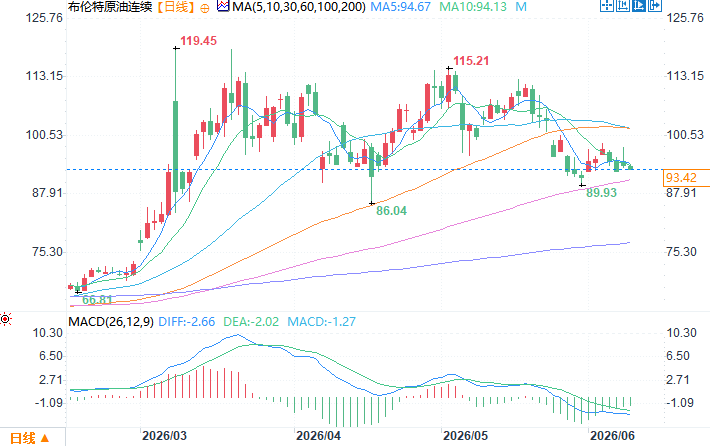
Brent crude oil daily chart source: EasyForex
At 11:18 AM Beijing time on June 9th, Brent crude oil futures were trading at $93.40 per barrel.
Multiple warnings of a supply crisis have increased upward pressure on oil prices.
As geopolitical conflicts continue to escalate, the global oil supply shortage is becoming increasingly prominent, and industry warnings are rising one after another.
The International Energy Agency predicts that the critical point for crude oil supply will occur in July or August, while Neil Chapman, senior vice president of ExxonMobil, believes that the crisis could arrive as early as the beginning of July.
Chevron CEO Mike Wirth stated at an industry event that supply constraints will directly impact the spot market in the coming weeks, and oil price increases are expected to continue in June and July. He explained that market buffers are being depleted, and the market's ability to withstand supply-demand imbalances has significantly weakened.
An unnamed energy industry executive said that current crude oil inventories are at dangerously low levels, and the industry has warned senior officials in various countries of potential risks in mid-to-late June, with inventories nearing their bottom.
The production capacity gap continues to widen, and reserves in various countries are being depleted at an accelerated pace.
The Middle East is a core global oil-producing region. Due to the situation, at least ten million barrels of crude oil production capacity per day has been forced to stop, with some estimates suggesting the actual loss could reach as high as fourteen million barrels. To cope with the supply shortage, several major countries have begun releasing crude oil reserves. Data from the U.S. Energy Information Administration shows that the country's total commercial and strategic petroleum reserves have fallen to 791 million barrels, the lowest level since February 2024.
However, a divergence has emerged in market trading . Traders are betting on a return to normal shipping in the Strait of Hormuz, and have continued to reduce their long positions in Brent crude oil, bringing the current open interest to an 18-week low. Short positions have tripled, indicating a strong short-term bearish sentiment in the market. However, industry insiders generally believe that the supply constraints in the physical market will ultimately dominate the price trend, and short-term market sentiment is unlikely to reverse the fundamental trend.
Supply-demand imbalance harbors hidden dangers, and global economic pressure intensifies.
There are widespread concerns in the market that once the inventory buffer is completely exhausted, oil prices will be forced to rise sharply, ultimately either consumers will bear the higher cost of fuel or crude oil demand will shrink significantly.
JPMorgan Chase stated that if shipping in the Strait of Hormuz cannot return to normal by the end of this month, oil prices will surge, but given the current situation, this goal is unlikely to be achieved in the short term. Goldman Sachs also noted that previous oil price increases have already caused some demand to decline, but there is an upper limit to the contraction in demand; excessive suppression of demand would drag down the overall economy.
A major Asian country's proactive reduction in crude oil imports has temporarily eased the pace of rising international oil prices. Related data shows that the decline in domestic refinery processing volume is limited, and actual demand for crude oil remains solid. When inventories become insufficient, large-scale purchases will inevitably resume, potentially reversing market trends.
Phil Blancato, chief market strategist at Osek Wealth Management, said that consumer confidence has now fallen to historic lows and that if oil prices remain high for an extended period, the global economy will suffer a substantial shock.
Overall , current crude oil reserves in various countries can temporarily fill the production gap, but if the tensions in the Middle East continue for several weeks or even a month, the crude oil market landscape will be completely changed once the reserves are depleted, and the risks of soaring oil prices and economic downturns will also increase simultaneously.
Brent crude oil daily chart source: EasyForex
At 11:18 AM Beijing time on June 9th, Brent crude oil futures were trading at $93.40 per barrel.
- Risk Warning and Disclaimer
- The market involves risk, and trading may not be suitable for all investors. This article is for reference only and does not constitute personal investment advice, nor does it take into account certain users’ specific investment objectives, financial situation, or other needs. Any investment decisions made based on this information are at your own risk.