USD/JPY technically strong but intervention risk rising: a dual game between Fed rate hike expectations and verbal warnings from Japan.
2026-06-09 11:32:21
On Tuesday (June 9) during Asian trading hours, the US dollar rose against the Japanese yen to around 160.20, after rising for seven consecutive trading days.
Escalating tensions in the Middle East boosted the safe-haven dollar, while strong US jobs data further solidified market expectations of a Federal Reserve rate hike, providing support for the dollar. However, renewed strong warnings from Japanese authorities, stating their readiness to take decisive measures to prevent a weakening of the yen, limited the upside potential for the dollar against the yen.
The U.S. economy achieved its third consecutive month of strong job growth in May. Data released by the Bureau of Labor Statistics showed that nonfarm payrolls increased by 172,000 in May, with the previous month's figure revised upward from 115,000 to 179,000, far exceeding market expectations of 85,000. The unemployment rate remained stable at 4.3%, in line with market expectations. This report sends a clear signal: despite continued rises in energy prices and the Strait of Hormuz being closed for over 100 days, the U.S. labor market has not shown any substantial signs of weakness. The breadth of job growth also improved, with the service, manufacturing, and construction sectors all recording robust job increases.
Following strong U.S. jobs data, traders increased their bets on a Federal Reserve rate hike, providing support for the dollar. According to data from the CME FedWatch tool, the market is currently pricing in a 43% probability of a 25 basis point rate hike in December, significantly higher than the approximately 14% a month ago. This shift reflects a repricing of the Fed's policy path – just weeks ago, the prevailing expectation was for rates to remain unchanged or even cut this year, but the strong jobs data has completely changed that assessment. The continued escalation of geopolitical tensions in the Middle East further boosted the safe-haven dollar, pushing the dollar higher against the yen.
Faced with the continued weakening of the yen, Japanese authorities have once again issued a strong verbal warning. Japanese Finance Minister Satsuki Katayama stated clearly on Tuesday that the government's position remains unchanged, and that the authorities are fully prepared to take decisive and appropriate action to protect the domestic currency and prevent excessive exchange rate fluctuations from negatively impacting the economy and people's livelihoods. This statement quickly attracted market attention, and investors' expectations for possible further intervention by Japanese authorities have increased, thus putting some resistance to the upward movement of the USD/JPY exchange rate.
Looking back at late April and early May, Japanese authorities implemented several rounds of actual intervention measures, buying large amounts of yen and selling large amounts of dollars. At that time, the dollar-yen exchange rate briefly broke through the 160 mark, reaching a multi-decade high. Under several days of strong intervention from the Japanese Ministry of Finance, the exchange rate quickly fell back, hitting a low of around 155, a drop of over 500 points. While the intervention failed to completely reverse the yen's weakening trend, it successfully slowed the rate of depreciation and injected uncertainty into the market—investors began to be wary of excessively betting on yen depreciation above the 160 mark.
However, with rising US Treasury yields and increasing expectations of a Federal Reserve rate hike, the yen has weakened again, and the USD/JPY exchange rate has quietly returned to the 160 level. The market is currently closely watching whether Japanese authorities will intervene again. Compared to the last intervention, the environment is more complex: on the one hand, expectations of a Fed rate hike are stronger than before, and the logic of a strong dollar is more solidified; on the other hand, although the situation in the Middle East has temporarily eased, long-term uncertainties remain, and safe-haven funds still tend to flow into the dollar.
Katayama Satsuki's verbal warning can be seen as a standard "courtesy first, then force" approach. If the USD/JPY exchange rate quickly breaks through 161 or even 162 after the CPI data is released, Japanese authorities are likely to intervene again during the holiday period when liquidity is lower.
This week, market attention will be focused on the US May Consumer Price Index (CPI) data released on Wednesday, which will be a key variable influencing the short-term trend of the USD/JPY exchange rate. Following the much stronger-than-expected May non-farm payroll data, market expectations for the Federal Reserve's policy path have fundamentally shifted—from "rate cuts this year" a few weeks ago to "at least one rate hike before the end of the year." The CPI data will be a litmus test to verify this logic.
Economists generally expect the overall CPI in May to rise to 4.2% year-on-year, the highest level in more than three years, with a month-on-month increase of about 0.5%. The core CPI, excluding energy and food, is expected to remain around 2.9% year-on-year, with a month-on-month increase of 0.3%. If inflation data continues to rise, it will further solidify market expectations for a Federal Reserve rate hike. Currently, the CME FedWatch tool shows that the probability of a 25 basis point rate hike in December has risen to 43%, far higher than 14% a month ago. If the CPI exceeds expectations, this probability is likely to move towards 50% or higher. This will push the USD/USD index to break through the current resistance zone around 100.20, and the USD/JPY pair is expected to stabilize above the 160 level and rise further, testing the 161 or even 162 area.
Conversely, if inflation unexpectedly weakens—for example, with overall CPI falling below 4.0% year-on-year or core CPI falling below 0.2% month-on-month—it could prompt investors to reverse their previous hawkish pricing. At that point, market expectations for a Fed rate hike might ease, with the probability of a December rate hike potentially falling below 30%. This would provide breathing room for the yen, and the USD/JPY pair could give back some of its recent gains, retracing towards the 159 or even 158 area.
Furthermore, the threat of intervention by Japanese authorities is also a significant factor influencing exchange rates. If the USD/JPY exchange rate rapidly breaks through 161 due to higher-than-expected inflation, the Japanese Ministry of Finance may intervene again, selling dollars and buying yen to curb excessive appreciation of the exchange rate.
The USD/JPY pair is currently maintaining a strong upward trend on the daily chart, with a solid bullish pattern.
In terms of price, the current exchange rate is around 160.20, trading above all moving averages. The 20-day, 50-day, 100-day, and 200-day moving averages are in a bullish alignment, providing strong support for the price. Short-term resistance is at 160.47, while support levels are at the 20-day moving average (159.31), the previous consolidation range, and the 158.94 level.
The indicators are bullish: the MACD indicator's DIFF and DEA have formed a golden cross above the zero axis and continue to rise, with the red bars gradually increasing in volume, indicating that bullish momentum is still being released; the RSI indicator is at 63.40, which has not yet entered the severely overbought zone, and there is still room for upward momentum.
Overall, prices are in a clear upward channel, with moving averages in a bullish alignment and indicators confirming the trend strength. The USD/JPY pair is expected to continue its upward trend in the short term. However, given the proximity to previous highs, caution is advised regarding the risk of a pullback triggered by short-term profit-taking.
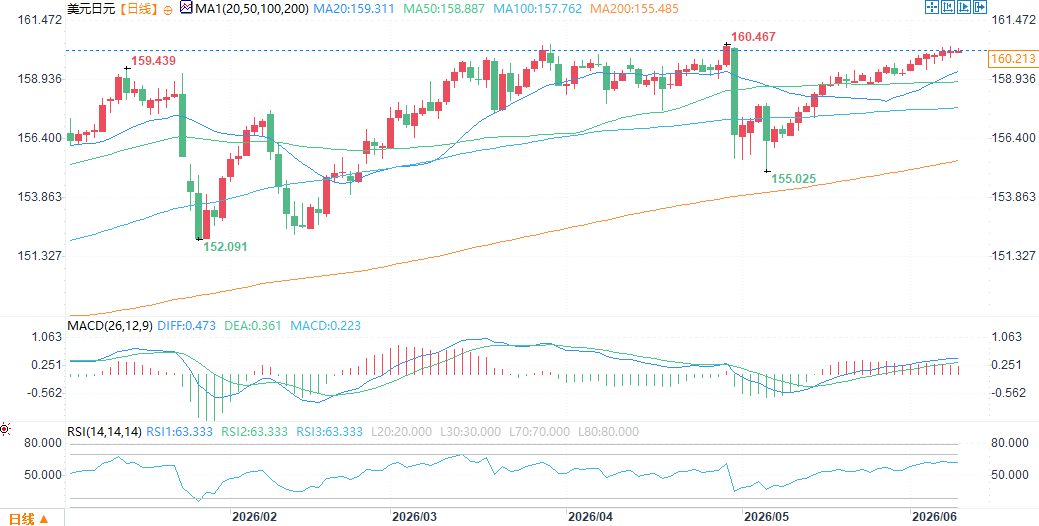
(USD/JPY daily chart, source: FX678)
At 11:31 Beijing time on June 9, the USD/JPY exchange rate was 160.22/23.
Escalating tensions in the Middle East boosted the safe-haven dollar, while strong US jobs data further solidified market expectations of a Federal Reserve rate hike, providing support for the dollar. However, renewed strong warnings from Japanese authorities, stating their readiness to take decisive measures to prevent a weakening of the yen, limited the upside potential for the dollar against the yen.
The dollar received support as expectations of a Fed rate hike intensified.
The U.S. economy achieved its third consecutive month of strong job growth in May. Data released by the Bureau of Labor Statistics showed that nonfarm payrolls increased by 172,000 in May, with the previous month's figure revised upward from 115,000 to 179,000, far exceeding market expectations of 85,000. The unemployment rate remained stable at 4.3%, in line with market expectations. This report sends a clear signal: despite continued rises in energy prices and the Strait of Hormuz being closed for over 100 days, the U.S. labor market has not shown any substantial signs of weakness. The breadth of job growth also improved, with the service, manufacturing, and construction sectors all recording robust job increases.
Following strong U.S. jobs data, traders increased their bets on a Federal Reserve rate hike, providing support for the dollar. According to data from the CME FedWatch tool, the market is currently pricing in a 43% probability of a 25 basis point rate hike in December, significantly higher than the approximately 14% a month ago. This shift reflects a repricing of the Fed's policy path – just weeks ago, the prevailing expectation was for rates to remain unchanged or even cut this year, but the strong jobs data has completely changed that assessment. The continued escalation of geopolitical tensions in the Middle East further boosted the safe-haven dollar, pushing the dollar higher against the yen.
Japanese authorities issue warning of intervention
Faced with the continued weakening of the yen, Japanese authorities have once again issued a strong verbal warning. Japanese Finance Minister Satsuki Katayama stated clearly on Tuesday that the government's position remains unchanged, and that the authorities are fully prepared to take decisive and appropriate action to protect the domestic currency and prevent excessive exchange rate fluctuations from negatively impacting the economy and people's livelihoods. This statement quickly attracted market attention, and investors' expectations for possible further intervention by Japanese authorities have increased, thus putting some resistance to the upward movement of the USD/JPY exchange rate.
Looking back at late April and early May, Japanese authorities implemented several rounds of actual intervention measures, buying large amounts of yen and selling large amounts of dollars. At that time, the dollar-yen exchange rate briefly broke through the 160 mark, reaching a multi-decade high. Under several days of strong intervention from the Japanese Ministry of Finance, the exchange rate quickly fell back, hitting a low of around 155, a drop of over 500 points. While the intervention failed to completely reverse the yen's weakening trend, it successfully slowed the rate of depreciation and injected uncertainty into the market—investors began to be wary of excessively betting on yen depreciation above the 160 mark.
However, with rising US Treasury yields and increasing expectations of a Federal Reserve rate hike, the yen has weakened again, and the USD/JPY exchange rate has quietly returned to the 160 level. The market is currently closely watching whether Japanese authorities will intervene again. Compared to the last intervention, the environment is more complex: on the one hand, expectations of a Fed rate hike are stronger than before, and the logic of a strong dollar is more solidified; on the other hand, although the situation in the Middle East has temporarily eased, long-term uncertainties remain, and safe-haven funds still tend to flow into the dollar.
Katayama Satsuki's verbal warning can be seen as a standard "courtesy first, then force" approach. If the USD/JPY exchange rate quickly breaks through 161 or even 162 after the CPI data is released, Japanese authorities are likely to intervene again during the holiday period when liquidity is lower.
Market focus shifts to US inflation data
This week, market attention will be focused on the US May Consumer Price Index (CPI) data released on Wednesday, which will be a key variable influencing the short-term trend of the USD/JPY exchange rate. Following the much stronger-than-expected May non-farm payroll data, market expectations for the Federal Reserve's policy path have fundamentally shifted—from "rate cuts this year" a few weeks ago to "at least one rate hike before the end of the year." The CPI data will be a litmus test to verify this logic.
Economists generally expect the overall CPI in May to rise to 4.2% year-on-year, the highest level in more than three years, with a month-on-month increase of about 0.5%. The core CPI, excluding energy and food, is expected to remain around 2.9% year-on-year, with a month-on-month increase of 0.3%. If inflation data continues to rise, it will further solidify market expectations for a Federal Reserve rate hike. Currently, the CME FedWatch tool shows that the probability of a 25 basis point rate hike in December has risen to 43%, far higher than 14% a month ago. If the CPI exceeds expectations, this probability is likely to move towards 50% or higher. This will push the USD/USD index to break through the current resistance zone around 100.20, and the USD/JPY pair is expected to stabilize above the 160 level and rise further, testing the 161 or even 162 area.
Conversely, if inflation unexpectedly weakens—for example, with overall CPI falling below 4.0% year-on-year or core CPI falling below 0.2% month-on-month—it could prompt investors to reverse their previous hawkish pricing. At that point, market expectations for a Fed rate hike might ease, with the probability of a December rate hike potentially falling below 30%. This would provide breathing room for the yen, and the USD/JPY pair could give back some of its recent gains, retracing towards the 159 or even 158 area.
Furthermore, the threat of intervention by Japanese authorities is also a significant factor influencing exchange rates. If the USD/JPY exchange rate rapidly breaks through 161 due to higher-than-expected inflation, the Japanese Ministry of Finance may intervene again, selling dollars and buying yen to curb excessive appreciation of the exchange rate.
Technical Analysis
The USD/JPY pair is currently maintaining a strong upward trend on the daily chart, with a solid bullish pattern.
In terms of price, the current exchange rate is around 160.20, trading above all moving averages. The 20-day, 50-day, 100-day, and 200-day moving averages are in a bullish alignment, providing strong support for the price. Short-term resistance is at 160.47, while support levels are at the 20-day moving average (159.31), the previous consolidation range, and the 158.94 level.
The indicators are bullish: the MACD indicator's DIFF and DEA have formed a golden cross above the zero axis and continue to rise, with the red bars gradually increasing in volume, indicating that bullish momentum is still being released; the RSI indicator is at 63.40, which has not yet entered the severely overbought zone, and there is still room for upward momentum.
Overall, prices are in a clear upward channel, with moving averages in a bullish alignment and indicators confirming the trend strength. The USD/JPY pair is expected to continue its upward trend in the short term. However, given the proximity to previous highs, caution is advised regarding the risk of a pullback triggered by short-term profit-taking.
(USD/JPY daily chart, source: FX678)
At 11:31 Beijing time on June 9, the USD/JPY exchange rate was 160.22/23.
- Risk Warning and Disclaimer
- The market involves risk, and trading may not be suitable for all investors. This article is for reference only and does not constitute personal investment advice, nor does it take into account certain users’ specific investment objectives, financial situation, or other needs. Any investment decisions made based on this information are at your own risk.