Will the Bank of Japan's 1% interest rate hike be enough to save the situation? Daiwa: A single rate hike won't suffice.
2026-06-09 13:46:05
On Tuesday (June 9) during the Asian session, the USD/JPY pair maintained a high-level consolidation pattern, currently trading around 160.15, after recording seven consecutive days of gains.
According to Nikkei, the Bank of Japan is expected to raise interest rates to 1.0% at its June meeting, and the Bank of Japan is considering halting its bond-buying activities.
Daiwa Securities believes that Bank of Japan Governor Kazuo Ueda's recent remarks have essentially become a clear signal of a June interest rate hike.
Consistent with the market's interpretation of the previous two tightening cycles, Daiwa points out that this rate hike is not due to an overheated economy, but rather stems from the consideration that "the cost of waiting has exceeded the cost of action"—delaying action may force the central bank to carry out larger-scale and more destructive rate hikes in the future.
Daiwa also analyzed two possible paths for the yield curve after the interest rate hike, and emphasized that a single interest rate hike is unlikely to fundamentally reverse the trend of yen depreciation.
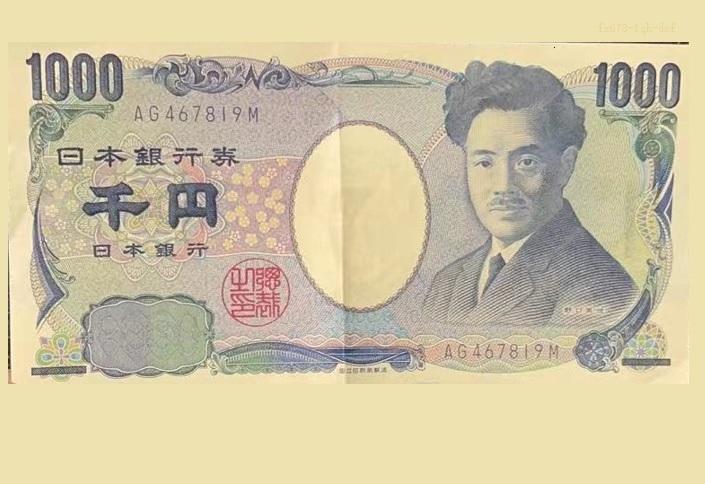
Kenji Yamamoto, a fixed-income strategist at Daiwa Securities, pointed out that Bank of Japan Governor Kazuo Ueda's recent use of the term "interest rate hike" in his speech essentially signals a clear interest rate increase at the June monetary policy meeting. This interpretation is consistent with the market's understanding of similar communications from the Bank of Japan during the previous two tightening cycles—the same wording was subsequently followed by policy action.
Daiwa emphasized that this rate hike should not be interpreted as a response to an overheated economy. Instead, it reflects the Bank of Japan's assessment that the cost of delaying action now outweighs the cost of taking action itself. Ueda explicitly stated in his speech that failure to act gradually could force the central bank to implement larger and more disruptive rate hikes in the future—a scenario Daiwa described as something the Bank of Japan is actively trying to avoid.
The core factor supporting a June rate hike is the Bank of Japan's reassessment of Middle East risks. In April, the Bank of Japan cited the Middle East conflict as a major reason for holding rates steady. However, Ueda's remarks suggest that buffered corporate profits, continued wage growth, and the absence of significant supply chain disruptions mean the Japanese economy has sufficient resilience to absorb the shock of high oil prices without immediately plunging into a severe recession.
Crucially, the Bank of Japan now views the same high oil prices not as a temporary shock, but as a channel that accelerates price transmission and pushes up potential inflation, thus fulfilling the conditions for the second-round effect to emerge.
Daiwa Securities has provided a clear projection of the future trend of the Japanese government bond market following the Bank of Japan's interest rate hike, with the key factor being how the market interprets the central bank's actions.
The first scenario is that after the interest rate hike is implemented, the market accepts the Bank of Japan's assessment that it "has not lagged behind the yield curve." In this case, investors will repric the endpoint of the policy rate, and short- to medium-term yields will be the first to reflect this expectation and gradually rise, while long-term yields, influenced by relatively stable inflation expectations, will see limited increases. The yield curve will thus flatten, which is the ideal outcome the Bank of Japan hoped to achieve through its communication with Governor Ueda.
The second scenario is that interest rate hikes are delayed, or the market believes that the central bank's actions are insufficient to address inflationary pressures. If this happens, market doubts about the central bank's resolve to control inflation will arise, and inflation expectations will rise. Long-term yields will face greater upward pressure, potentially exceeding the gains of short- and medium-term yields, leading to a steeper yield curve.
The market interpreted Governor Ueda's speech as an attempt to guide the market toward the first scenario through clear forward guidance—that is, to avoid being forced to raise interest rates more aggressively in the future, which would bring greater shocks to the bond market through timely and appropriate actions.
Daiwa Securities holds a clearly cautious view on whether a single interest rate hike can reverse the yen's decline. The firm points out that the fundamental reason for the yen's continued weakness lies in Japan's structurally low real interest rates—a core issue that remains unresolved even after falling oil prices and multiple foreign exchange interventions. Given the still significant interest rate differential between the US and Japan and the continued global capital flow to high-yield assets, a single interest rate hike is like a drop in the ocean, unlikely to fundamentally change the market's pricing logic for the yen.
Daiwa further emphasized that reversing the yen's depreciation trend requires sustained policy continuity and a credible policy path, rather than isolated, one-off actions. What the market truly needs to see is a clear commitment from the Bank of Japan to the future direction of interest rates, along with corresponding adjustments to its government bond purchase program. If there is a lack of follow-up action after the rate hike, the market may interpret it as a "one-off symbolic action," potentially exacerbating the pressure on the yen to depreciate.
Therefore, Daiwa believes that the Bank of Japan must comprehensively manage its interest rate path and government bond purchase program, gradually changing market expectations through sustained tightening signals in order to have a substantial and sustainable impact on the exchange rate. A single interest rate hike is not sufficient to mark a turning point in the yen's exchange rate.
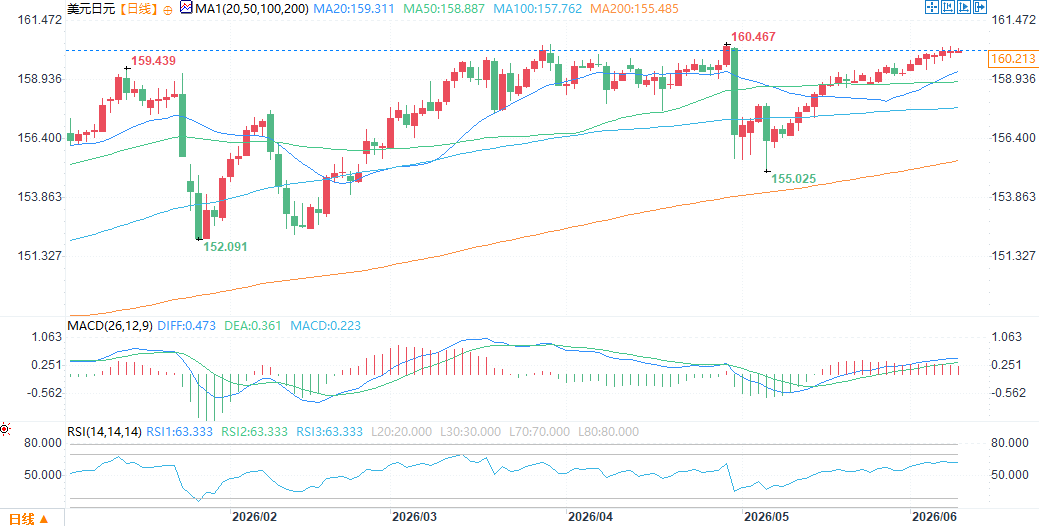
(USD/JPY daily chart, source: FX678)
At 13:41 Beijing time on June 9, the USD/JPY exchange rate was 160.13/14.
According to Nikkei, the Bank of Japan is expected to raise interest rates to 1.0% at its June meeting, and the Bank of Japan is considering halting its bond-buying activities.
Daiwa Securities believes that Bank of Japan Governor Kazuo Ueda's recent remarks have essentially become a clear signal of a June interest rate hike.
Consistent with the market's interpretation of the previous two tightening cycles, Daiwa points out that this rate hike is not due to an overheated economy, but rather stems from the consideration that "the cost of waiting has exceeded the cost of action"—delaying action may force the central bank to carry out larger-scale and more destructive rate hikes in the future.
Daiwa also analyzed two possible paths for the yield curve after the interest rate hike, and emphasized that a single interest rate hike is unlikely to fundamentally reverse the trend of yen depreciation.
The signal for a June rate hike is clear, based on a reassessment of risks in the Middle East.
Kenji Yamamoto, a fixed-income strategist at Daiwa Securities, pointed out that Bank of Japan Governor Kazuo Ueda's recent use of the term "interest rate hike" in his speech essentially signals a clear interest rate increase at the June monetary policy meeting. This interpretation is consistent with the market's understanding of similar communications from the Bank of Japan during the previous two tightening cycles—the same wording was subsequently followed by policy action.
Daiwa emphasized that this rate hike should not be interpreted as a response to an overheated economy. Instead, it reflects the Bank of Japan's assessment that the cost of delaying action now outweighs the cost of taking action itself. Ueda explicitly stated in his speech that failure to act gradually could force the central bank to implement larger and more disruptive rate hikes in the future—a scenario Daiwa described as something the Bank of Japan is actively trying to avoid.
The core factor supporting a June rate hike is the Bank of Japan's reassessment of Middle East risks. In April, the Bank of Japan cited the Middle East conflict as a major reason for holding rates steady. However, Ueda's remarks suggest that buffered corporate profits, continued wage growth, and the absence of significant supply chain disruptions mean the Japanese economy has sufficient resilience to absorb the shock of high oil prices without immediately plunging into a severe recession.
Crucially, the Bank of Japan now views the same high oil prices not as a temporary shock, but as a channel that accelerates price transmission and pushes up potential inflation, thus fulfilling the conditions for the second-round effect to emerge.
After the interest rate hike, the yield curve faces two paths.
Daiwa Securities has provided a clear projection of the future trend of the Japanese government bond market following the Bank of Japan's interest rate hike, with the key factor being how the market interprets the central bank's actions.
The first scenario is that after the interest rate hike is implemented, the market accepts the Bank of Japan's assessment that it "has not lagged behind the yield curve." In this case, investors will repric the endpoint of the policy rate, and short- to medium-term yields will be the first to reflect this expectation and gradually rise, while long-term yields, influenced by relatively stable inflation expectations, will see limited increases. The yield curve will thus flatten, which is the ideal outcome the Bank of Japan hoped to achieve through its communication with Governor Ueda.
The second scenario is that interest rate hikes are delayed, or the market believes that the central bank's actions are insufficient to address inflationary pressures. If this happens, market doubts about the central bank's resolve to control inflation will arise, and inflation expectations will rise. Long-term yields will face greater upward pressure, potentially exceeding the gains of short- and medium-term yields, leading to a steeper yield curve.
The market interpreted Governor Ueda's speech as an attempt to guide the market toward the first scenario through clear forward guidance—that is, to avoid being forced to raise interest rates more aggressively in the future, which would bring greater shocks to the bond market through timely and appropriate actions.
A single interest rate hike is unlikely to reverse the trend of yen depreciation.
Daiwa Securities holds a clearly cautious view on whether a single interest rate hike can reverse the yen's decline. The firm points out that the fundamental reason for the yen's continued weakness lies in Japan's structurally low real interest rates—a core issue that remains unresolved even after falling oil prices and multiple foreign exchange interventions. Given the still significant interest rate differential between the US and Japan and the continued global capital flow to high-yield assets, a single interest rate hike is like a drop in the ocean, unlikely to fundamentally change the market's pricing logic for the yen.
Daiwa further emphasized that reversing the yen's depreciation trend requires sustained policy continuity and a credible policy path, rather than isolated, one-off actions. What the market truly needs to see is a clear commitment from the Bank of Japan to the future direction of interest rates, along with corresponding adjustments to its government bond purchase program. If there is a lack of follow-up action after the rate hike, the market may interpret it as a "one-off symbolic action," potentially exacerbating the pressure on the yen to depreciate.
Therefore, Daiwa believes that the Bank of Japan must comprehensively manage its interest rate path and government bond purchase program, gradually changing market expectations through sustained tightening signals in order to have a substantial and sustainable impact on the exchange rate. A single interest rate hike is not sufficient to mark a turning point in the yen's exchange rate.
(USD/JPY daily chart, source: FX678)
At 13:41 Beijing time on June 9, the USD/JPY exchange rate was 160.13/14.
- Risk Warning and Disclaimer
- The market involves risk, and trading may not be suitable for all investors. This article is for reference only and does not constitute personal investment advice, nor does it take into account certain users’ specific investment objectives, financial situation, or other needs. Any investment decisions made based on this information are at your own risk.