Can the pound's rebound be sustained? It all depends on US inflation and UK GDP performance.
2026-06-09 14:48:35
On Tuesday (June 9) during the Asian session, the British pound continued to rebound against the US dollar, currently trading around 1.3360, and is expected to effectively continue the momentum of the previous day's rebound from a three-week low.
Iran and Israel announced a cessation of attacks on each other, reducing demand for the safe-haven dollar and providing some support for the pound. However, hawkish expectations from the Federal Reserve and domestic political turmoil in the UK limited the pound's upside potential. Market sentiment remained cautious ahead of key data releases.
The Iranian military announced on Monday that its strikes against Israel had ended, less than 24 hours after the exchange of fire. The central headquarters of the Iranian Armed Forces, Hatam Anbia, stated that the operation had concluded in response to Israel's recent military action against southern Lebanon and the southern suburbs of Beirut. However, Iran also issued a clear warning: further Israeli strikes against Lebanon would open the door to retaliation, in which case Iran would respond with a "more severe and devastating response."
Israeli Prime Minister Benjamin Netanyahu subsequently issued a statement acknowledging a ceasefire with Iran, stating that Israel had temporarily suspended its attacks on Iran after the latter stopped firing. However, Netanyahu also vowed to respond militarily to any future attacks and declared that the war with Iran and Hezbollah was "not over." This statement suggests that Israel has not abandoned its strategic pressure on Iran and Hezbollah in Lebanon, and could resume military operations at any time depending on the situation.
As a result, the safe-haven dollar fell further from its highs since late March, providing some support for the pound against the dollar.
However, the pound's upside potential remains limited, with multiple factors collectively suppressing the exchange rate's upward movement.
First, significant differences remain between the US and Iran on key issues such as Iran's nuclear program and the Strait of Hormuz. The ceasefire is more of a tactical respite than a fundamental reconciliation. Iran has explicitly warned of a "more severe and destructive response" if Israel resumes military action; Israeli Prime Minister Netanyahu has also declared that the war with Iran and Hezbollah is "not over." This fragile ceasefire means that geopolitical risks have not been completely eliminated, and market optimism is unlikely to continue to rise. If tensions escalate again, safe-haven funds will flow back into the US dollar, putting pressure on the pound.
Secondly, market expectations for a hawkish stance from the Federal Reserve remain strong. Driven by inflation concerns, traders are currently pricing in a greater than 70% probability of a Fed rate hike before the end of the year. Last Friday's much stronger-than-expected non-farm payroll report—adding 172,000 jobs, with the previous figure revised upwards by 93,000—fundamentally altered market assessments of the Fed's policy path. Just a few weeks ago, the prevailing market expectation was for interest rates to remain unchanged or even be cut this year; now, at least one rate hike before the end of the year has become the basic scenario. This hawkish expectation benefits dollar bulls and has largely suppressed the upside potential of the pound against the dollar.
Meanwhile, domestic political turmoil in the UK is also putting headwinds on the pound. Following the resignations of junior ministers, Prime Minister Keir Starmer's authority has been severely shaken, and political uncertainty has increased significantly. Market concerns about the stability of the UK government have intensified, with investors worried that such internal divisions could hinder the implementation of key economic policies. Furthermore, the UK economic fundamentals remain weak, and the growth outlook is bleak, making traders hesitant to make aggressive bullish bets on the pound. Under the dual pressures of politics and the economy, the pound's rebound momentum appears particularly fragile, and any short-term gains are likely to be seen as selling opportunities.
This week, the market's focus will be on US inflation data and UK monthly GDP figures. The US May CPI and PPI reports, released on Wednesday and Thursday respectively, will provide key clues for the market to judge the Federal Reserve's next policy move.
Economists expect the overall CPI to rise to 4.2% year-on-year in May. If inflation continues to rise, it will further solidify expectations of interest rate hikes, putting pressure on the pound. Friday's UK April GDP data will reflect the initial impact of the Middle East conflict on the UK economy. If the economic data falls short of expectations, it could further weaken the pound's appeal. These data will provide key guidance for the next direction of the exchange rate, and investors should closely monitor market reactions after the data release.
The GBP/USD pair is currently showing a weak short-term trend on the daily chart, while the medium-term consolidation pattern remains unchanged. The current exchange rate is trading below the 20-day moving average (MA20) (1.3473) and the 200-day moving average (MA200) (1.3417), only slightly above the previous low of 1.3159. Resistance is seen around 1.3443, while support lies at the 1.3300 level and the previous low of 1.3159.
In terms of indicators, the MACD's DIFF and DEA are running below the zero axis, and the green bars continue to expand, indicating some bearish momentum; the RSI has fallen back to 42.27, which is in the weak zone and has not yet shown a clear stabilization signal.
Overall, the exchange rate has broken below key moving averages in the short term, with weak rebound momentum and weak technical indicators, suggesting a high probability of continued downward movement in the short term. A break below 1.3300 could open up further downside potential; conversely, holding above and rebounding above the 1.3443 resistance level could lead to a return to the trading range.
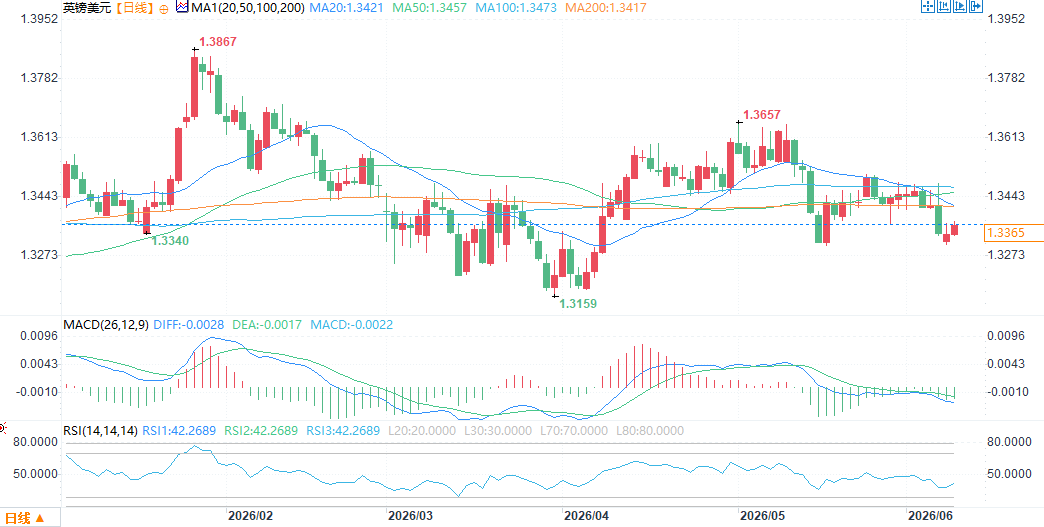
(GBP/USD daily chart, source: FX678)
At 14:48 Beijing time on June 9, the British pound was trading at 1.3364/65 against the US dollar.
Iran and Israel announced a cessation of attacks on each other, reducing demand for the safe-haven dollar and providing some support for the pound. However, hawkish expectations from the Federal Reserve and domestic political turmoil in the UK limited the pound's upside potential. Market sentiment remained cautious ahead of key data releases.
Geopolitical risks eased, putting pressure on the dollar and supporting the pound.
The Iranian military announced on Monday that its strikes against Israel had ended, less than 24 hours after the exchange of fire. The central headquarters of the Iranian Armed Forces, Hatam Anbia, stated that the operation had concluded in response to Israel's recent military action against southern Lebanon and the southern suburbs of Beirut. However, Iran also issued a clear warning: further Israeli strikes against Lebanon would open the door to retaliation, in which case Iran would respond with a "more severe and devastating response."
Israeli Prime Minister Benjamin Netanyahu subsequently issued a statement acknowledging a ceasefire with Iran, stating that Israel had temporarily suspended its attacks on Iran after the latter stopped firing. However, Netanyahu also vowed to respond militarily to any future attacks and declared that the war with Iran and Hezbollah was "not over." This statement suggests that Israel has not abandoned its strategic pressure on Iran and Hezbollah in Lebanon, and could resume military operations at any time depending on the situation.
As a result, the safe-haven dollar fell further from its highs since late March, providing some support for the pound against the dollar.
Multiple factors limit the upside potential of the pound.
However, the pound's upside potential remains limited, with multiple factors collectively suppressing the exchange rate's upward movement.
First, significant differences remain between the US and Iran on key issues such as Iran's nuclear program and the Strait of Hormuz. The ceasefire is more of a tactical respite than a fundamental reconciliation. Iran has explicitly warned of a "more severe and destructive response" if Israel resumes military action; Israeli Prime Minister Netanyahu has also declared that the war with Iran and Hezbollah is "not over." This fragile ceasefire means that geopolitical risks have not been completely eliminated, and market optimism is unlikely to continue to rise. If tensions escalate again, safe-haven funds will flow back into the US dollar, putting pressure on the pound.
Secondly, market expectations for a hawkish stance from the Federal Reserve remain strong. Driven by inflation concerns, traders are currently pricing in a greater than 70% probability of a Fed rate hike before the end of the year. Last Friday's much stronger-than-expected non-farm payroll report—adding 172,000 jobs, with the previous figure revised upwards by 93,000—fundamentally altered market assessments of the Fed's policy path. Just a few weeks ago, the prevailing market expectation was for interest rates to remain unchanged or even be cut this year; now, at least one rate hike before the end of the year has become the basic scenario. This hawkish expectation benefits dollar bulls and has largely suppressed the upside potential of the pound against the dollar.
Meanwhile, domestic political turmoil in the UK is also putting headwinds on the pound. Following the resignations of junior ministers, Prime Minister Keir Starmer's authority has been severely shaken, and political uncertainty has increased significantly. Market concerns about the stability of the UK government have intensified, with investors worried that such internal divisions could hinder the implementation of key economic policies. Furthermore, the UK economic fundamentals remain weak, and the growth outlook is bleak, making traders hesitant to make aggressive bullish bets on the pound. Under the dual pressures of politics and the economy, the pound's rebound momentum appears particularly fragile, and any short-term gains are likely to be seen as selling opportunities.
Market focus shifts to US inflation and UK GDP
This week, the market's focus will be on US inflation data and UK monthly GDP figures. The US May CPI and PPI reports, released on Wednesday and Thursday respectively, will provide key clues for the market to judge the Federal Reserve's next policy move.
Economists expect the overall CPI to rise to 4.2% year-on-year in May. If inflation continues to rise, it will further solidify expectations of interest rate hikes, putting pressure on the pound. Friday's UK April GDP data will reflect the initial impact of the Middle East conflict on the UK economy. If the economic data falls short of expectations, it could further weaken the pound's appeal. These data will provide key guidance for the next direction of the exchange rate, and investors should closely monitor market reactions after the data release.
Technical Analysis
The GBP/USD pair is currently showing a weak short-term trend on the daily chart, while the medium-term consolidation pattern remains unchanged. The current exchange rate is trading below the 20-day moving average (MA20) (1.3473) and the 200-day moving average (MA200) (1.3417), only slightly above the previous low of 1.3159. Resistance is seen around 1.3443, while support lies at the 1.3300 level and the previous low of 1.3159.
In terms of indicators, the MACD's DIFF and DEA are running below the zero axis, and the green bars continue to expand, indicating some bearish momentum; the RSI has fallen back to 42.27, which is in the weak zone and has not yet shown a clear stabilization signal.
Overall, the exchange rate has broken below key moving averages in the short term, with weak rebound momentum and weak technical indicators, suggesting a high probability of continued downward movement in the short term. A break below 1.3300 could open up further downside potential; conversely, holding above and rebounding above the 1.3443 resistance level could lead to a return to the trading range.
(GBP/USD daily chart, source: FX678)
At 14:48 Beijing time on June 9, the British pound was trading at 1.3364/65 against the US dollar.
- Risk Warning and Disclaimer
- The market involves risk, and trading may not be suitable for all investors. This article is for reference only and does not constitute personal investment advice, nor does it take into account certain users’ specific investment objectives, financial situation, or other needs. Any investment decisions made based on this information are at your own risk.