German industrial output rebounded more strongly than expected in April, causing the euro to recover from a sharp drop against the dollar.
2026-06-09 14:59:32
German industry showed signs of recovery in April, providing a positive signal for the recently weak European economy. The latest data released by the Federal Statistical Office of Germany shows that, after seasonal and working-day adjustments, German industrial output rose 0.4% month-on-month in April, in line with market expectations and significantly better than the revised 0.1% decline in March. The initial figure for March was a 0.7% decline, indicating that the actual performance of German industry was slightly better than previously anticipated by the market.

Year-on-year data shows that German industrial output fell 0.5% in April, remaining in negative territory, but a significant improvement from the revised 3.4% decline in March, reflecting a gradual easing of downward pressure on German manufacturing. As the Eurozone's largest economy, German industrial performance has long been considered a key indicator of European economic health. Over the past year, German industrial activity has been under pressure due to factors such as slowing global demand, fluctuating energy costs, and weak manufacturing orders. However, the latest data shows that industrial production has begun to show signs of stabilization, providing a positive signal for the market to assess the European economic outlook.
The euro received a modest boost after the data release. The market believes that improved industrial activity helps strengthen investor confidence in the eurozone's economic recovery. With the European Central Bank (ECB) about to announce its latest interest rate decision, the improved German industrial data further reinforces market expectations that the ECB will maintain a hawkish stance.
The market widely expects the European Central Bank (ECB) to raise interest rates by 25 basis points at its meeting this week. Previously released data showed that the eurozone inflation rate had risen to 3.2%, significantly higher than the ECB's long-term target. Given the continued inflationary pressures, the improving economic data undoubtedly provides the ECB with more room to further tighten policy.
Meanwhile, investors are also closely watching the upcoming US Consumer Price Index (CPI) data. Since US inflation performance will directly influence the Federal Reserve's future policy path, the future movement of the euro against the dollar will not only be affected by European economic data but will also be dominated by the overall performance of the US dollar.
Market reaction was mixed; after the release of German industrial production data, the euro rose slightly against the dollar to around 1.1545, a daily increase of approximately 0.11%. While the increase was limited, it indicates a positive market sentiment regarding the improving European economy. However, with US inflation data and the European Central Bank meeting approaching, investors remained cautious overall.
Analysts believe that if German industrial production continues to improve in the coming months, it will help alleviate market concerns about a slowdown in European economic growth and further support the performance of euro-denominated assets. However, if global demand recovers slower than expected, German manufacturing may still face some pressure.
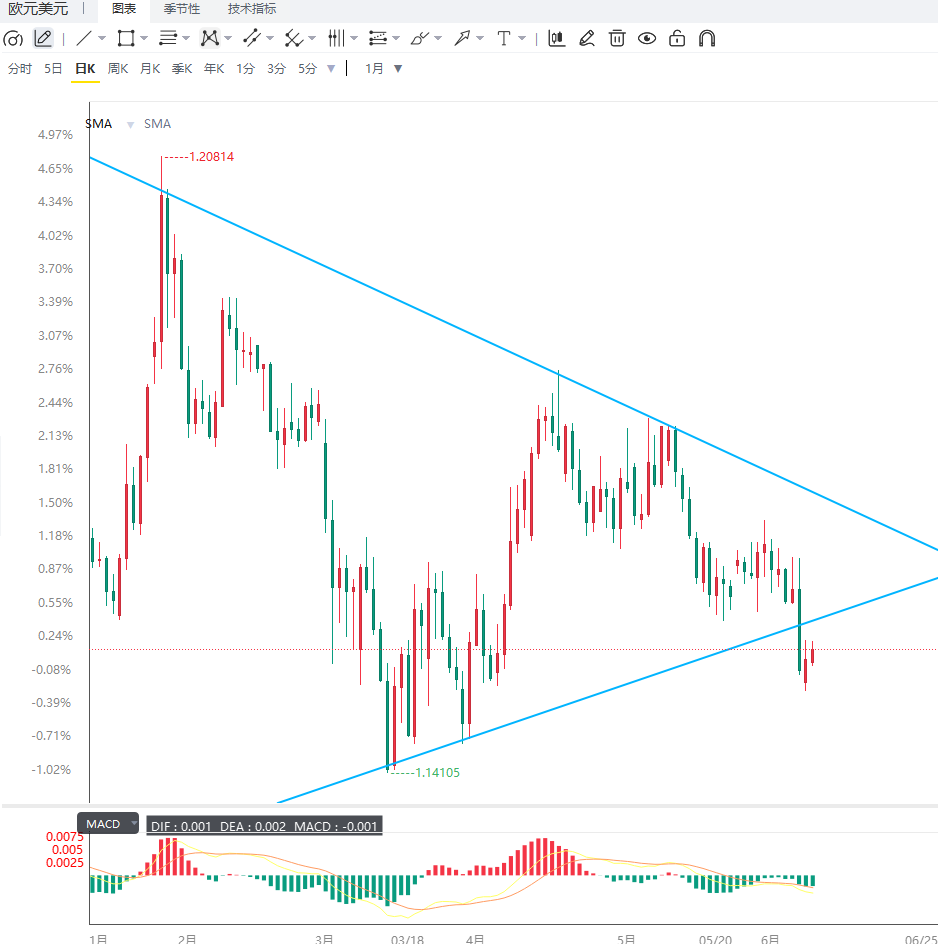
From a daily chart perspective, the EUR/USD pair continued its pullback after breaking below the lower edge of its consolidation range. The current rebound is more of a correction from oversold conditions and hasn't changed the overall bearish trend. The price remains below key resistance levels, indicating the downtrend structure remains intact. While the MACD indicator shows signs of recovery from low levels, it's still near the zero line, suggesting limited upward momentum. The RSI indicator has rebounded from oversold territory, indicating a short-term technical correction is needed. The key resistance level to watch is 1.1600; if the price fails to hold above this level, there is still a risk of further decline. Support levels to watch are 1.1480 and 1.1400; a break below 1.1480 could trigger a new round of accelerated declines.
From a 4-hour chart perspective, the euro/dollar pair has seen a slight increase in short-term rebound strength, but it remains within a downward channel overall. The MACD indicator maintains its rebound structure, but bullish momentum is slowing, indicating insufficient upward drive. The RSI indicator is hovering around 50, showing a clear neutral-to-weak characteristic. If the rebound is capped near 1.1600, the bears may regain dominance; conversely, only a decisive break and hold above 1.1600 could alleviate the current downward pressure. A break below the 1.1480 support level could open up further downside potential, potentially targeting 1.1400 and lower levels. Overall, the short-term rebound has not yet reversed the downtrend, and the market still needs to be wary of the risk of further weakness.
Editor's Summary : German industrial production data for April released positive signals, indicating that industrial activity in Europe's largest economy is gradually recovering from its previous slump. Although year-on-year growth remains negative, the decline has narrowed significantly, reflecting an improved manufacturing environment. For the euro market, the combination of recovering industrial production and persistently high inflation strengthens market expectations for further tightening by the European Central Bank. However, the key factors determining the euro's future direction remain US inflation data and the policy differences between the US and European central banks. If European economic data continues to improve and the ECB maintains a hawkish stance, the euro is likely to receive further support; conversely, if the US economy and inflation remain strong, the dollar's advantage may regain its dominance.
Year-on-year data shows that German industrial output fell 0.5% in April, remaining in negative territory, but a significant improvement from the revised 3.4% decline in March, reflecting a gradual easing of downward pressure on German manufacturing. As the Eurozone's largest economy, German industrial performance has long been considered a key indicator of European economic health. Over the past year, German industrial activity has been under pressure due to factors such as slowing global demand, fluctuating energy costs, and weak manufacturing orders. However, the latest data shows that industrial production has begun to show signs of stabilization, providing a positive signal for the market to assess the European economic outlook.
The euro received a modest boost after the data release. The market believes that improved industrial activity helps strengthen investor confidence in the eurozone's economic recovery. With the European Central Bank (ECB) about to announce its latest interest rate decision, the improved German industrial data further reinforces market expectations that the ECB will maintain a hawkish stance.
The market widely expects the European Central Bank (ECB) to raise interest rates by 25 basis points at its meeting this week. Previously released data showed that the eurozone inflation rate had risen to 3.2%, significantly higher than the ECB's long-term target. Given the continued inflationary pressures, the improving economic data undoubtedly provides the ECB with more room to further tighten policy.
Meanwhile, investors are also closely watching the upcoming US Consumer Price Index (CPI) data. Since US inflation performance will directly influence the Federal Reserve's future policy path, the future movement of the euro against the dollar will not only be affected by European economic data but will also be dominated by the overall performance of the US dollar.
Market reaction was mixed; after the release of German industrial production data, the euro rose slightly against the dollar to around 1.1545, a daily increase of approximately 0.11%. While the increase was limited, it indicates a positive market sentiment regarding the improving European economy. However, with US inflation data and the European Central Bank meeting approaching, investors remained cautious overall.
Analysts believe that if German industrial production continues to improve in the coming months, it will help alleviate market concerns about a slowdown in European economic growth and further support the performance of euro-denominated assets. However, if global demand recovers slower than expected, German manufacturing may still face some pressure.
From a daily chart perspective, the EUR/USD pair continued its pullback after breaking below the lower edge of its consolidation range. The current rebound is more of a correction from oversold conditions and hasn't changed the overall bearish trend. The price remains below key resistance levels, indicating the downtrend structure remains intact. While the MACD indicator shows signs of recovery from low levels, it's still near the zero line, suggesting limited upward momentum. The RSI indicator has rebounded from oversold territory, indicating a short-term technical correction is needed. The key resistance level to watch is 1.1600; if the price fails to hold above this level, there is still a risk of further decline. Support levels to watch are 1.1480 and 1.1400; a break below 1.1480 could trigger a new round of accelerated declines.
From a 4-hour chart perspective, the euro/dollar pair has seen a slight increase in short-term rebound strength, but it remains within a downward channel overall. The MACD indicator maintains its rebound structure, but bullish momentum is slowing, indicating insufficient upward drive. The RSI indicator is hovering around 50, showing a clear neutral-to-weak characteristic. If the rebound is capped near 1.1600, the bears may regain dominance; conversely, only a decisive break and hold above 1.1600 could alleviate the current downward pressure. A break below the 1.1480 support level could open up further downside potential, potentially targeting 1.1400 and lower levels. Overall, the short-term rebound has not yet reversed the downtrend, and the market still needs to be wary of the risk of further weakness.
Editor's Summary : German industrial production data for April released positive signals, indicating that industrial activity in Europe's largest economy is gradually recovering from its previous slump. Although year-on-year growth remains negative, the decline has narrowed significantly, reflecting an improved manufacturing environment. For the euro market, the combination of recovering industrial production and persistently high inflation strengthens market expectations for further tightening by the European Central Bank. However, the key factors determining the euro's future direction remain US inflation data and the policy differences between the US and European central banks. If European economic data continues to improve and the ECB maintains a hawkish stance, the euro is likely to receive further support; conversely, if the US economy and inflation remain strong, the dollar's advantage may regain its dominance.
- Risk Warning and Disclaimer
- The market involves risk, and trading may not be suitable for all investors. This article is for reference only and does not constitute personal investment advice, nor does it take into account certain users’ specific investment objectives, financial situation, or other needs. Any investment decisions made based on this information are at your own risk.