Improved German industrial data boosted the euro, causing it to rebound slightly against the yen.
2026-06-09 15:48:15
The euro rose against the yen (EUR/JPY) for a second consecutive trading day in Asian trading on Tuesday, reaching around 184.90. Solid German industrial production and trade data provided support for the euro, while market confidence in the prospects for a European economic recovery improved.

Data shows that German industrial output rose 0.4% month-on-month in April, in line with market expectations and a significant improvement from the revised 0.1% decline in March. Year-on-year, German industrial output fell 0.5%, a significant narrowing from the previous 3.4% decline, indicating that manufacturing activity is gradually stabilizing.
Meanwhile, Germany's trade surplus in April reached €14.5 billion, lower than the market expectation of €15 billion and also lower than the revised €14.7 billion in March. However, exports remained strong. Data showed that German exports rose 0.9% month-on-month in April, far better than the market expectation of a 0.3% decline, and reached their highest level in about three and a half years. Imports rose 1.2%, reaching the highest level since November 2022, reflecting improved domestic demand. As the Eurozone's largest economy, Germany's industrial and export data have always been regarded as important indicators of the health of the European economy. After the release of this data, market concerns about a slowdown in the European economy eased, boosting the euro with buying support.
However, the upside potential for the euro against the yen remains limited by the yen factor. The recent decline in international oil prices has eased market concerns about further surges in energy prices, somewhat alleviating imported inflation pressures on Japan. Meanwhile, expectations for the Bank of Japan to normalize its policy continue to rise.
Market research indicates that the Bank of Japan is expected to further tighten its monetary policy at its mid-June monetary policy meeting, with the market widely anticipating a potential increase in short-term interest rates from 0.75% to 1.0%. Furthermore, the Bank of Japan may also assess its future bond-buying tapering program, suggesting that the exit from its ultra-loose monetary policy is underway.
For the Japanese yen, both expectations of interest rate hikes and adjustments to the scale of bond purchases are positive factors. As Japanese government bond yields gradually rise, some international funds may flow back into yen-denominated assets, thus providing support for the yen.
This week, the market will also focus on the results of the Japanese 30-year government bond auction. As the market assesses bond demand in a higher-interest-rate environment, the auction results could provide important guidance for the Bank of Japan's future policy direction and may also influence the short-term exchange rate of the yen.
Overall, the euro is currently benefiting from improved German economic data, while the yen is supported by expectations of a normalization in the Bank of Japan's policy. Ahead of key inflation data from Europe and the US, and the European Central Bank meeting, the euro/yen exchange rate is expected to maintain a high-level consolidation pattern.
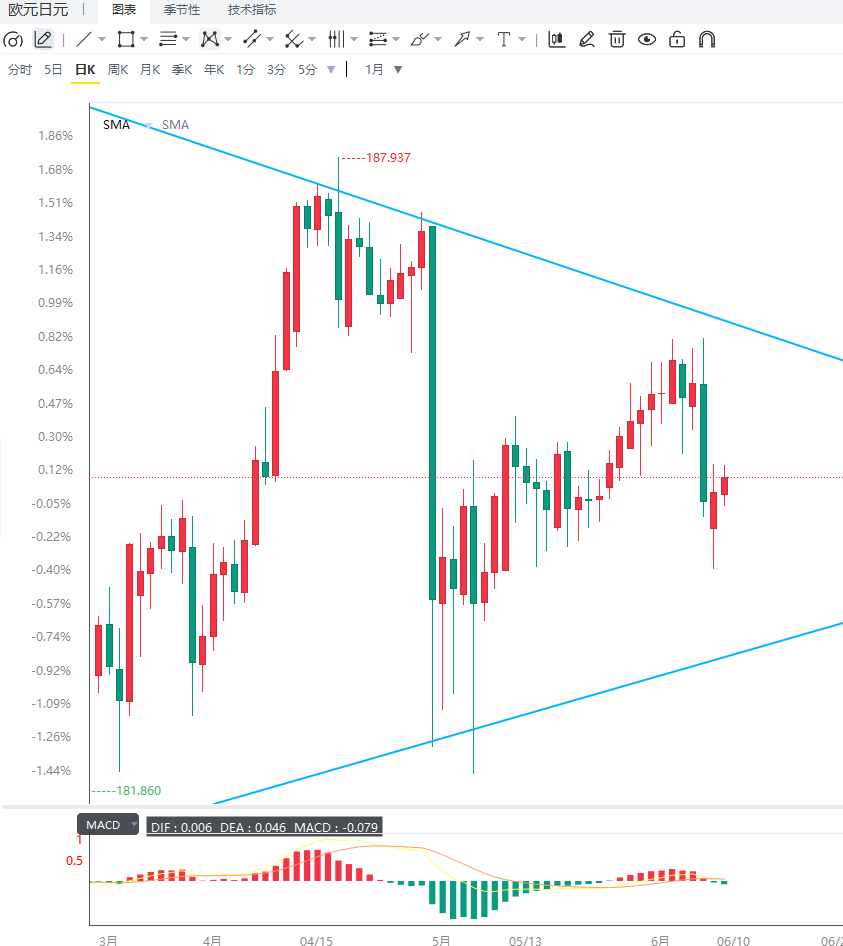
From a daily chart perspective, the EUR/JPY pair is currently in a consolidation phase, with prices fluctuating within a narrow range. Short-term volatility is further narrowing, and the market direction is unclear. The MACD indicator is hovering near the zero line, with the momentum bars continuing to shrink, indicating a near balance between bullish and bearish forces. The RSI indicator is near the neutral zone, reflecting a strong wait-and-see attitude in the market. The key resistance level to watch is 185.00; if this level cannot be broken, a further pullback is possible. On the downside, the key support level is around 183.00; a breach of this level could open up further downside potential.
From a 4-hour chart perspective, the exchange rate is maintaining range-bound trading, lacking a clear short-term trend. The MACD indicator is converging, indicating insufficient short-term momentum, while the RSI indicator is hovering around 50, also reflecting a consolidation phase. In the short term, 185.00 remains a key resistance level; only a decisive break above this level could open up new upside potential. On the downside, 183.00 is a crucial support level for the bulls; a break below this level could lead to further downside support. Overall, a range-bound trading strategy is recommended, focusing on the breakout direction from the 183.00 to 185.00 range.
Editor's Summary : Improved German industrial production and export data provided fundamental support for the euro, reflecting that the core economies of the Eurozone are gradually emerging from their previous slump. However, the euro's rise is not without resistance. The Bank of Japan's accelerated normalization of monetary policy will continue to enhance the yen's attractiveness. The future euro/yen exchange rate will largely depend on whether European economic data continues to improve and whether the Bank of Japan releases further hawkish signals. In the short term, the exchange rate is expected to remain high, but as the Japanese interest rate environment gradually changes, bulls should be wary of the risk of a pullback from these high levels.
Data shows that German industrial output rose 0.4% month-on-month in April, in line with market expectations and a significant improvement from the revised 0.1% decline in March. Year-on-year, German industrial output fell 0.5%, a significant narrowing from the previous 3.4% decline, indicating that manufacturing activity is gradually stabilizing.
Meanwhile, Germany's trade surplus in April reached €14.5 billion, lower than the market expectation of €15 billion and also lower than the revised €14.7 billion in March. However, exports remained strong. Data showed that German exports rose 0.9% month-on-month in April, far better than the market expectation of a 0.3% decline, and reached their highest level in about three and a half years. Imports rose 1.2%, reaching the highest level since November 2022, reflecting improved domestic demand. As the Eurozone's largest economy, Germany's industrial and export data have always been regarded as important indicators of the health of the European economy. After the release of this data, market concerns about a slowdown in the European economy eased, boosting the euro with buying support.
However, the upside potential for the euro against the yen remains limited by the yen factor. The recent decline in international oil prices has eased market concerns about further surges in energy prices, somewhat alleviating imported inflation pressures on Japan. Meanwhile, expectations for the Bank of Japan to normalize its policy continue to rise.
Market research indicates that the Bank of Japan is expected to further tighten its monetary policy at its mid-June monetary policy meeting, with the market widely anticipating a potential increase in short-term interest rates from 0.75% to 1.0%. Furthermore, the Bank of Japan may also assess its future bond-buying tapering program, suggesting that the exit from its ultra-loose monetary policy is underway.
For the Japanese yen, both expectations of interest rate hikes and adjustments to the scale of bond purchases are positive factors. As Japanese government bond yields gradually rise, some international funds may flow back into yen-denominated assets, thus providing support for the yen.
This week, the market will also focus on the results of the Japanese 30-year government bond auction. As the market assesses bond demand in a higher-interest-rate environment, the auction results could provide important guidance for the Bank of Japan's future policy direction and may also influence the short-term exchange rate of the yen.
Overall, the euro is currently benefiting from improved German economic data, while the yen is supported by expectations of a normalization in the Bank of Japan's policy. Ahead of key inflation data from Europe and the US, and the European Central Bank meeting, the euro/yen exchange rate is expected to maintain a high-level consolidation pattern.
From a daily chart perspective, the EUR/JPY pair is currently in a consolidation phase, with prices fluctuating within a narrow range. Short-term volatility is further narrowing, and the market direction is unclear. The MACD indicator is hovering near the zero line, with the momentum bars continuing to shrink, indicating a near balance between bullish and bearish forces. The RSI indicator is near the neutral zone, reflecting a strong wait-and-see attitude in the market. The key resistance level to watch is 185.00; if this level cannot be broken, a further pullback is possible. On the downside, the key support level is around 183.00; a breach of this level could open up further downside potential.
From a 4-hour chart perspective, the exchange rate is maintaining range-bound trading, lacking a clear short-term trend. The MACD indicator is converging, indicating insufficient short-term momentum, while the RSI indicator is hovering around 50, also reflecting a consolidation phase. In the short term, 185.00 remains a key resistance level; only a decisive break above this level could open up new upside potential. On the downside, 183.00 is a crucial support level for the bulls; a break below this level could lead to further downside support. Overall, a range-bound trading strategy is recommended, focusing on the breakout direction from the 183.00 to 185.00 range.
Editor's Summary : Improved German industrial production and export data provided fundamental support for the euro, reflecting that the core economies of the Eurozone are gradually emerging from their previous slump. However, the euro's rise is not without resistance. The Bank of Japan's accelerated normalization of monetary policy will continue to enhance the yen's attractiveness. The future euro/yen exchange rate will largely depend on whether European economic data continues to improve and whether the Bank of Japan releases further hawkish signals. In the short term, the exchange rate is expected to remain high, but as the Japanese interest rate environment gradually changes, bulls should be wary of the risk of a pullback from these high levels.
- Risk Warning and Disclaimer
- The market involves risk, and trading may not be suitable for all investors. This article is for reference only and does not constitute personal investment advice, nor does it take into account certain users’ specific investment objectives, financial situation, or other needs. Any investment decisions made based on this information are at your own risk.