US-led trade war in Israel and Lebanon becomes an agreement; oil prices test.
2026-06-09 15:51:47
Since the ceasefire agreement reached between the US and Iran in April 2026, the situation in the Middle East has once again descended into turmoil after a brief period of calm.
On Tuesday (June 9), during the Asian and European trading sessions, international oil prices retreated, with WTI crude oil falling 1.47% to trade around $89.95. Although Israel has not stopped its bombing of Lebanon, the United States has begun to sever ties with this wartime ally.
U.S. Vice President Vance said on the 8th that the United States will continue to push for an agreement with Iran, regardless of Israel's wishes, and that the U.S. interests in pushing for an agreement with Iran may differ from Israel's.
Vance stated that Israel may or may not like the agreement, but the United States believes it is in its best interests and will therefore continue to push it forward. When asked if he was being "played" by Iran, he responded that all parties are trying to influence each other and gain the upper hand.
US media pointed out that Vance's remarks highlight the differences between the Trump administration and the Israeli government on how to handle the Iran issue and future agreement arrangements: the US is more focused on ending the conflict diplomatically, while Israel emphasizes continuing to exert military pressure on Iran.
The recent direct clashes between Israel and Iran not only broke the two-month ceasefire agreement, but also thoroughly exposed the growing strategic differences between the United States and Israel, their allies. Although the two sides recently reached a ceasefire agreement, Israel has not stopped fighting on the battlefield in Lebanon.
Market sources say Israel has launched airstrikes on the towns of Deir Kanon, Ain, Ramadhi and Qafersel in southern Lebanon.
The trigger for this escalation of the conflict was Israel's surprise attack on Beirut, Lebanon.
Despite previous warnings from US President Trump against attacking Beirut, Israeli Prime Minister Netanyahu, eager to solidify his support in the upcoming elections, insisted on military action to completely eliminate the threat posed by the Iranian-backed Hezbollah and demonstrate the victory to domestic voters.
Behind the outbreak of war are the core demands that Trump and Netanyahu have completely different views on.
For Trump, the Republican Party is about to face congressional elections, and the ongoing Middle East conflict has led to soaring gasoline prices and high inflationary pressures in the United States, severely dragging down his poll numbers.
Therefore, he was eager to push for an agreement between the US and Iran to reopen the Strait of Hormuz in order to stabilize energy prices and solidify his election campaign. He even publicly stated that "blockade is more effective than bombing" and claimed that the US and Iran were close to reaching a "strong and powerful agreement".
Iran, on the other hand, has made a comprehensive ceasefire in Lebanon a prerequisite for negotiations, a condition that has been tacitly approved by Trump.
But Netanyahu faces domestic discontent with a "victory that seems far off"—the shadow of the 2023 Hamas attack has not yet faded, Hezbollah rocket attacks continue, and the Iranian regime and nuclear program, though severely damaged, have not collapsed. This forces him to insist on "fighting on two fronts" and refuse to tie the Lebanese issue to the Iran agreement, even at the cost of public conflict with Trump.
Israel's military operation in Lebanon is not only focused on eliminating the Hezbollah threat, but also conceals an intention to control Lebanon's core water resources.
As a country in the Middle East with extremely scarce water resources, Israel receives an average annual rainfall of only 200 millimeters. Seawater desalination can only meet 28% of its water demand, with the remainder heavily reliant on water supplies from occupied territories.
The Litani River, the longest river in Lebanon, has an annual runoff of about 900 million cubic meters, supplying 45% of the country's agricultural water and 30% of its drinking water. Its downstream section is only 29 kilometers from the Israeli border. Controlling the river would directly meet 40% of Israel's water needs, making it a strategic target and a way to appease voters in the upcoming election.
This disagreement has erupted more than once. Back in March, Netanyahu's insistence on striking a key Iranian gas field triggered Iranian retaliation, directly pushing up oil prices and impacting global markets. At that time, Trump publicly expressed strong dissatisfaction.
During the conflict, Trump angrily denounced Netanyahu as "crazy" in a phone call, condemned his attack on Beirut for undermining the overall US-Iran negotiations, and emphasized that "all decisions are made under my control." However, Israel still bombed Iran hours later.
Although officials from both sides have deliberately downplayed the impact of their differences, and experts believe that the foundation of the alliance has not been shaken, this open strategic confrontation has continued to disrupt the geopolitical landscape of the Middle East and global market expectations.
Currently, both Israel and Iran have signaled de-escalation and lifted some security controls—most closed schools in Israel have resumed classes, Iran has opened its airspace for civilian flights, and regional countries such as Egypt, Saudi Arabia, and Turkey are also actively mediating to bring both sides back to the negotiating table.
Iran's ambassador to the United Nations stated that Iran and the United States are still advancing peace agreement negotiations and are expected to reach a consensus in the near future; Trump also reiterated that Iran's "economy is in trouble and an agreement must be reached," while the US military continues to exert pressure by blocking Iranian ports.
However, the core contradictions remain unresolved during the ceasefire window: Iran still firmly controls the Strait of Hormuz, a global energy choke point, which is expected to handle approximately 15 million barrels of oil per day by 2025, accounting for 34% of global seaborne crude oil trade, and its navigation status directly affects global energy supply; Israel continues its military operations in Lebanon and has not given up its attacks on Hezbollah.
The US has openly severed its resolve to reach an agreement with Iran on behalf of Israel, while Israel's accelerated offensive to weaken Hezbollah is seen as an attempt to prolong Netanyahu's political career. The focus of observation has now shifted to the battlefield between Israel and Lebanon.
Here's a counterintuitive point: if Israel's offensive weakens, it means the US and Israel are on the defensive. But if Israel continues to fight Hezbollah, Iran will be at a disadvantage in the US-Iran power struggle. This situation would actually make it easier to reach an agreement that satisfies the US, thus opening the Strait of Hormuz.
Israel and Lebanon are currently at war again, yet oil prices have begun to fall, suggesting that the US and Iran may indeed reach an agreement that would allow the US to give its people some explanation.
The logic is that the higher Iran's tolerance for Israel's attacks on Hezbollah, the worse its domestic situation is, and the more preoccupied it is with its own problems.
To determine which side has the upper hand, we can observe the current state of the conflict between Israel and Lebanon.
As mentioned yesterday, the technical analysis shows that oil prices continue to pull back, with current support around 87.
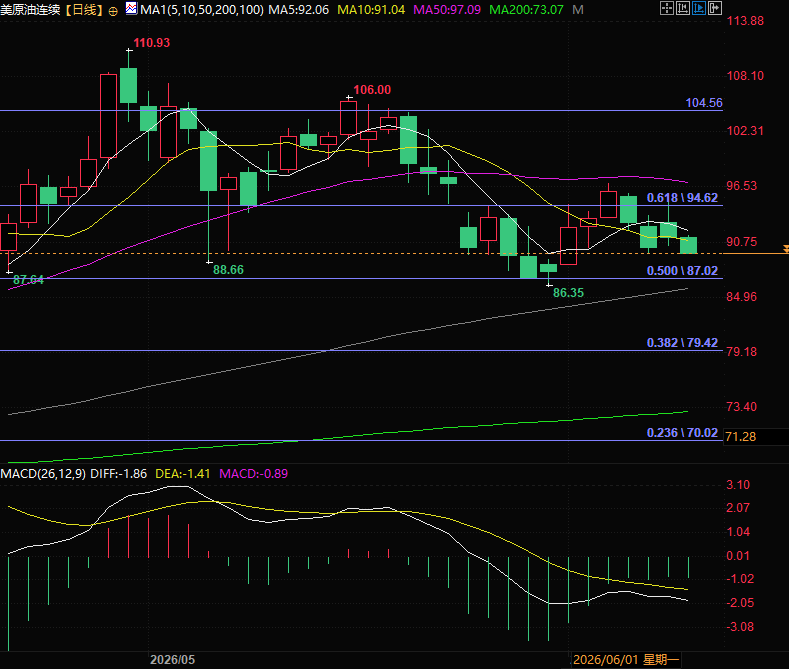
(WTI futures daily chart, source: EasyForex)
At 15:48 Beijing time, WTI futures were trading at $89.33 per barrel.
On Tuesday (June 9), during the Asian and European trading sessions, international oil prices retreated, with WTI crude oil falling 1.47% to trade around $89.95. Although Israel has not stopped its bombing of Lebanon, the United States has begun to sever ties with this wartime ally.
U.S. Vice President Vance said on the 8th that the United States will continue to push for an agreement with Iran, regardless of Israel's wishes, and that the U.S. interests in pushing for an agreement with Iran may differ from Israel's.
Vance stated that Israel may or may not like the agreement, but the United States believes it is in its best interests and will therefore continue to push it forward. When asked if he was being "played" by Iran, he responded that all parties are trying to influence each other and gain the upper hand.
US media pointed out that Vance's remarks highlight the differences between the Trump administration and the Israeli government on how to handle the Iran issue and future agreement arrangements: the US is more focused on ending the conflict diplomatically, while Israel emphasizes continuing to exert military pressure on Iran.
The recent direct clashes between Israel and Iran not only broke the two-month ceasefire agreement, but also thoroughly exposed the growing strategic differences between the United States and Israel, their allies. Although the two sides recently reached a ceasefire agreement, Israel has not stopped fighting on the battlefield in Lebanon.
Market sources say Israel has launched airstrikes on the towns of Deir Kanon, Ain, Ramadhi and Qafersel in southern Lebanon.
The attack on Hezbollah headquarters by Israel sparked the escalation of the conflict.
The trigger for this escalation of the conflict was Israel's surprise attack on Beirut, Lebanon.
Despite previous warnings from US President Trump against attacking Beirut, Israeli Prime Minister Netanyahu, eager to solidify his support in the upcoming elections, insisted on military action to completely eliminate the threat posed by the Iranian-backed Hezbollah and demonstrate the victory to domestic voters.
Core Demands Diverge: Election Games and Strategic Differences Between US and Israeli Leaders
Behind the outbreak of war are the core demands that Trump and Netanyahu have completely different views on.
For Trump, the Republican Party is about to face congressional elections, and the ongoing Middle East conflict has led to soaring gasoline prices and high inflationary pressures in the United States, severely dragging down his poll numbers.
Therefore, he was eager to push for an agreement between the US and Iran to reopen the Strait of Hormuz in order to stabilize energy prices and solidify his election campaign. He even publicly stated that "blockade is more effective than bombing" and claimed that the US and Iran were close to reaching a "strong and powerful agreement".
Iran, on the other hand, has made a comprehensive ceasefire in Lebanon a prerequisite for negotiations, a condition that has been tacitly approved by Trump.
But Netanyahu faces domestic discontent with a "victory that seems far off"—the shadow of the 2023 Hamas attack has not yet faded, Hezbollah rocket attacks continue, and the Iranian regime and nuclear program, though severely damaged, have not collapsed. This forces him to insist on "fighting on two fronts" and refuse to tie the Lebanese issue to the Iran agreement, even at the cost of public conflict with Trump.
Israel's military operation in Lebanon is not only focused on eliminating the Hezbollah threat, but also conceals an intention to control Lebanon's core water resources.
As a country in the Middle East with extremely scarce water resources, Israel receives an average annual rainfall of only 200 millimeters. Seawater desalination can only meet 28% of its water demand, with the remainder heavily reliant on water supplies from occupied territories.
The Litani River, the longest river in Lebanon, has an annual runoff of about 900 million cubic meters, supplying 45% of the country's agricultural water and 30% of its drinking water. Its downstream section is only 29 kilometers from the Israeli border. Controlling the river would directly meet 40% of Israel's water needs, making it a strategic target and a way to appease voters in the upcoming election.
This is not the first time there has been a disagreement: tensions within the alliance behind the open confrontation.
This disagreement has erupted more than once. Back in March, Netanyahu's insistence on striking a key Iranian gas field triggered Iranian retaliation, directly pushing up oil prices and impacting global markets. At that time, Trump publicly expressed strong dissatisfaction.
During the conflict, Trump angrily denounced Netanyahu as "crazy" in a phone call, condemned his attack on Beirut for undermining the overall US-Iran negotiations, and emphasized that "all decisions are made under my control." However, Israel still bombed Iran hours later.
Although officials from both sides have deliberately downplayed the impact of their differences, and experts believe that the foundation of the alliance has not been shaken, this open strategic confrontation has continued to disrupt the geopolitical landscape of the Middle East and global market expectations.
Signals of de-escalation released: Core contradictions remain unresolved during the ceasefire window.
Currently, both Israel and Iran have signaled de-escalation and lifted some security controls—most closed schools in Israel have resumed classes, Iran has opened its airspace for civilian flights, and regional countries such as Egypt, Saudi Arabia, and Turkey are also actively mediating to bring both sides back to the negotiating table.
Iran's ambassador to the United Nations stated that Iran and the United States are still advancing peace agreement negotiations and are expected to reach a consensus in the near future; Trump also reiterated that Iran's "economy is in trouble and an agreement must be reached," while the US military continues to exert pressure by blocking Iranian ports.
However, the core contradictions remain unresolved during the ceasefire window: Iran still firmly controls the Strait of Hormuz, a global energy choke point, which is expected to handle approximately 15 million barrels of oil per day by 2025, accounting for 34% of global seaborne crude oil trade, and its navigation status directly affects global energy supply; Israel continues its military operations in Lebanon and has not given up its attacks on Hezbollah.
Summary and Technical Analysis:
The US has openly severed its resolve to reach an agreement with Iran on behalf of Israel, while Israel's accelerated offensive to weaken Hezbollah is seen as an attempt to prolong Netanyahu's political career. The focus of observation has now shifted to the battlefield between Israel and Lebanon.
Here's a counterintuitive point: if Israel's offensive weakens, it means the US and Israel are on the defensive. But if Israel continues to fight Hezbollah, Iran will be at a disadvantage in the US-Iran power struggle. This situation would actually make it easier to reach an agreement that satisfies the US, thus opening the Strait of Hormuz.
Israel and Lebanon are currently at war again, yet oil prices have begun to fall, suggesting that the US and Iran may indeed reach an agreement that would allow the US to give its people some explanation.
The logic is that the higher Iran's tolerance for Israel's attacks on Hezbollah, the worse its domestic situation is, and the more preoccupied it is with its own problems.
To determine which side has the upper hand, we can observe the current state of the conflict between Israel and Lebanon.
As mentioned yesterday, the technical analysis shows that oil prices continue to pull back, with current support around 87.
(WTI futures daily chart, source: EasyForex)
At 15:48 Beijing time, WTI futures were trading at $89.33 per barrel.
- Risk Warning and Disclaimer
- The market involves risk, and trading may not be suitable for all investors. This article is for reference only and does not constitute personal investment advice, nor does it take into account certain users’ specific investment objectives, financial situation, or other needs. Any investment decisions made based on this information are at your own risk.