Rising expectations of a European Central Bank interest rate hike supported a euro rebound.
2026-06-09 16:23:19
As inflationary pressures in the Eurozone intensify again, market expectations for further monetary tightening by the European Central Bank (ECB) continue to strengthen. Björn Orr, an economist at German Apobank, stated in his latest report that the ECB is highly likely to raise interest rates by 25 basis points at its monetary policy meeting this week, and is expected to raise rates again in September, eventually bringing the deposit rate to 2.5%.

Since March of this year, the inflationary environment in the Eurozone has changed significantly. Affected by the continued tensions in the Middle East and rising energy prices, energy costs in the Eurozone have climbed again, pushing up overall price pressures. Rising energy prices not only directly push up the Consumer Price Index but also increase business production costs, slowing the decline in core inflation.
Against this backdrop, the European Central Bank (ECB) faces pressure to control inflation. Although Eurozone economic growth remains weak, policymakers are more concerned about inflation expectations spiraling out of control again, making further interest rate hikes a more reasonable policy option at present. According to Apobank's forecast, after the two rate hikes this week and in September, the ECB's deposit rate will reach 2.5%, which will be a significant high point in this policy cycle. A higher interest rate environment helps to curb demand growth and alleviate inflationary pressures, while also increasing the attractiveness of euro assets.
However, the agency does not believe that high interest rates will persist indefinitely. The report points out that the main driver of inflation remains the energy price shock, rather than excessive demand. Once geopolitical risks ease and energy prices fall, inflationary pressures in the Eurozone are expected to decline significantly. Furthermore, the outlook for European economic growth remains weak. The longer the high-interest-rate environment lasts, the more pronounced its dampening effect on business investment and household consumption will be. As economic activity gradually cools, Eurozone inflation is expected to fall back to near the European Central Bank's 2% target level.
Based on this assessment, Apobank predicts that the European Central Bank (ECB) will initiate a rate-cutting cycle in the first half of 2027, lowering the deposit rate from 2.5% to 2.0% in two phases. This implies that the current rate-hiking cycle may be more of a phase of policy adjustment than the start of a prolonged period of high interest rates. From a market perspective, the ECB's continued hawkish signals have supported the euro. Meanwhile, changes in the divergence between the monetary policy paths of the US and Europe will also influence the euro's exchange rate against the US dollar. If the ECB's rate hikes meet expectations, and US economic growth shows signs of slowing, the euro is likely to maintain relative strength in the short term.
Investors are currently focused on the upcoming European Central Bank (ECB) policy meeting and subsequent remarks by ECB President Christine Lagarde. The market hopes to glean clues about the future policy path to determine whether the ECB will maintain its hawkish stance.
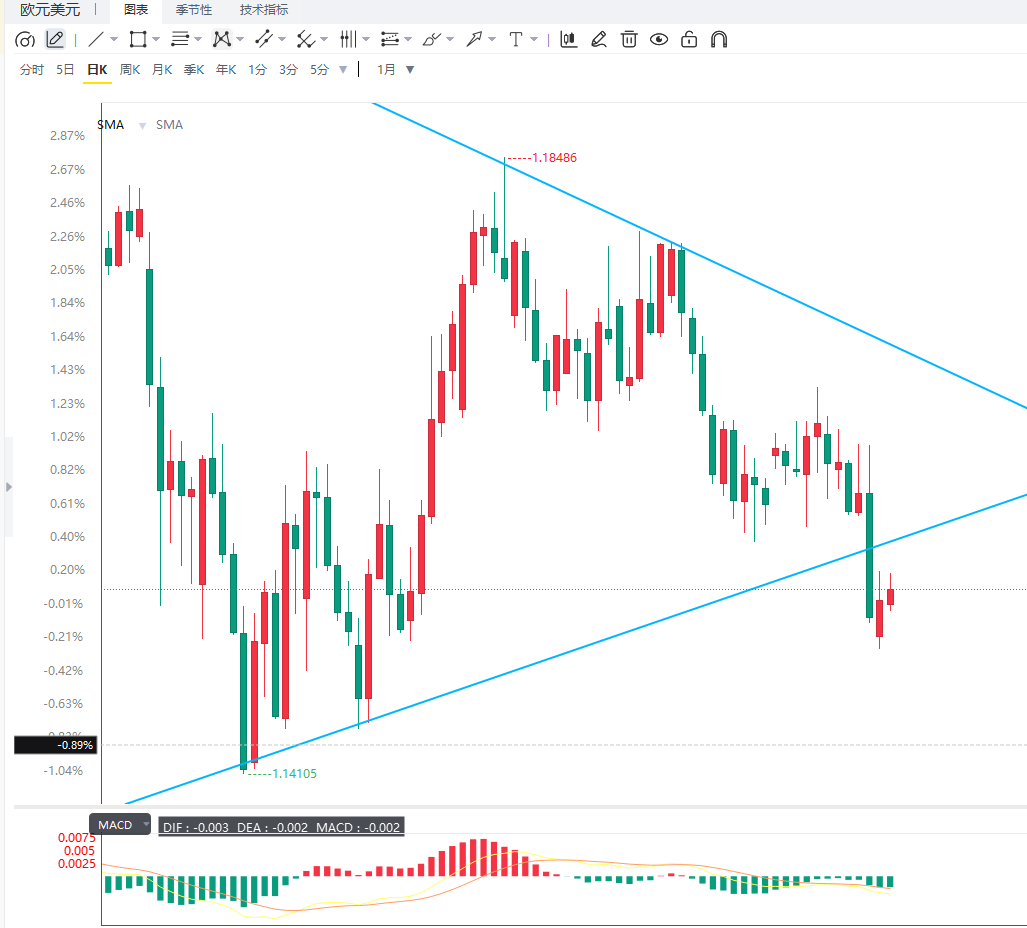
From a daily chart perspective, the euro/dollar pair had previously broken below its consolidation range, indicating a weakening overall technical pattern. Currently, the exchange rate is experiencing a temporary rebound, but this is more likely a correction after an oversold condition, and a trend reversal has not yet been confirmed. The MACD indicator remains near the zero line, suggesting that bearish momentum has weakened but not completely dissipated. The RSI indicator has rebounded from its lows to around 50, indicating some easing of short-term selling pressure. Key resistance levels to watch are 1.1600, 1.1650, and 1.1700; key support levels are 1.1500, 1.1450, and 1.1400.
From a 4-hour chart perspective, the exchange rate has rebounded from its lows, but it remains in a correction phase following the previous decline. The MACD indicator has formed a golden cross, indicating increased short-term rebound momentum, although further confirmation is needed to confirm this upward strength. The RSI indicator is hovering around 55, suggesting improved market sentiment but not yet entering a strong uptrend. If the exchange rate fails to break through the key resistance level of 1.1600, a further decline after the rebound cannot be ruled out; if it breaks below the 1.1500 support level, it may test the 1.1450 area. Short-term movements will continue to be influenced by the outcome of the ECB meeting and future interest rate guidance.
Editor's Summary : Expectations of interest rate hikes by the European Central Bank are becoming a significant factor supporting the euro. Rising energy prices have reignited inflation risks in the Eurozone, forcing policymakers to continue tightening measures. If the anticipated rate hikes this week and in September materialize, the euro is likely to continue to receive short-term support. However, from a longer-term perspective, the market has begun to focus on the possibility of future rate cuts. With slowing economic growth and gradually declining inflation, a high-interest-rate environment may be difficult to sustain in the long term. Therefore, the current euro's rise is largely driven by policy expectations, while its medium- to long-term trend will depend on improvements in economic fundamentals and changes in inflation trends.
Since March of this year, the inflationary environment in the Eurozone has changed significantly. Affected by the continued tensions in the Middle East and rising energy prices, energy costs in the Eurozone have climbed again, pushing up overall price pressures. Rising energy prices not only directly push up the Consumer Price Index but also increase business production costs, slowing the decline in core inflation.
Against this backdrop, the European Central Bank (ECB) faces pressure to control inflation. Although Eurozone economic growth remains weak, policymakers are more concerned about inflation expectations spiraling out of control again, making further interest rate hikes a more reasonable policy option at present. According to Apobank's forecast, after the two rate hikes this week and in September, the ECB's deposit rate will reach 2.5%, which will be a significant high point in this policy cycle. A higher interest rate environment helps to curb demand growth and alleviate inflationary pressures, while also increasing the attractiveness of euro assets.
However, the agency does not believe that high interest rates will persist indefinitely. The report points out that the main driver of inflation remains the energy price shock, rather than excessive demand. Once geopolitical risks ease and energy prices fall, inflationary pressures in the Eurozone are expected to decline significantly. Furthermore, the outlook for European economic growth remains weak. The longer the high-interest-rate environment lasts, the more pronounced its dampening effect on business investment and household consumption will be. As economic activity gradually cools, Eurozone inflation is expected to fall back to near the European Central Bank's 2% target level.
Based on this assessment, Apobank predicts that the European Central Bank (ECB) will initiate a rate-cutting cycle in the first half of 2027, lowering the deposit rate from 2.5% to 2.0% in two phases. This implies that the current rate-hiking cycle may be more of a phase of policy adjustment than the start of a prolonged period of high interest rates. From a market perspective, the ECB's continued hawkish signals have supported the euro. Meanwhile, changes in the divergence between the monetary policy paths of the US and Europe will also influence the euro's exchange rate against the US dollar. If the ECB's rate hikes meet expectations, and US economic growth shows signs of slowing, the euro is likely to maintain relative strength in the short term.
Investors are currently focused on the upcoming European Central Bank (ECB) policy meeting and subsequent remarks by ECB President Christine Lagarde. The market hopes to glean clues about the future policy path to determine whether the ECB will maintain its hawkish stance.
From a daily chart perspective, the euro/dollar pair had previously broken below its consolidation range, indicating a weakening overall technical pattern. Currently, the exchange rate is experiencing a temporary rebound, but this is more likely a correction after an oversold condition, and a trend reversal has not yet been confirmed. The MACD indicator remains near the zero line, suggesting that bearish momentum has weakened but not completely dissipated. The RSI indicator has rebounded from its lows to around 50, indicating some easing of short-term selling pressure. Key resistance levels to watch are 1.1600, 1.1650, and 1.1700; key support levels are 1.1500, 1.1450, and 1.1400.
From a 4-hour chart perspective, the exchange rate has rebounded from its lows, but it remains in a correction phase following the previous decline. The MACD indicator has formed a golden cross, indicating increased short-term rebound momentum, although further confirmation is needed to confirm this upward strength. The RSI indicator is hovering around 55, suggesting improved market sentiment but not yet entering a strong uptrend. If the exchange rate fails to break through the key resistance level of 1.1600, a further decline after the rebound cannot be ruled out; if it breaks below the 1.1500 support level, it may test the 1.1450 area. Short-term movements will continue to be influenced by the outcome of the ECB meeting and future interest rate guidance.
Editor's Summary : Expectations of interest rate hikes by the European Central Bank are becoming a significant factor supporting the euro. Rising energy prices have reignited inflation risks in the Eurozone, forcing policymakers to continue tightening measures. If the anticipated rate hikes this week and in September materialize, the euro is likely to continue to receive short-term support. However, from a longer-term perspective, the market has begun to focus on the possibility of future rate cuts. With slowing economic growth and gradually declining inflation, a high-interest-rate environment may be difficult to sustain in the long term. Therefore, the current euro's rise is largely driven by policy expectations, while its medium- to long-term trend will depend on improvements in economic fundamentals and changes in inflation trends.
- Risk Warning and Disclaimer
- The market involves risk, and trading may not be suitable for all investors. This article is for reference only and does not constitute personal investment advice, nor does it take into account certain users’ specific investment objectives, financial situation, or other needs. Any investment decisions made based on this information are at your own risk.