Geopolitical risks ease vs. hawkish rate hike expectations: USD/CAD edge lower, awaiting US inflation data.
2026-06-09 16:27:02
On Tuesday (June 9) during Asian trading hours, the US dollar edged lower against the Canadian dollar and is currently trading around 1.3940.
Iran and Israel announced a cessation of attacks on each other, supporting global risk sentiment and dragging the safe-haven dollar down from a two-month high, which became the main factor suppressing the dollar against the Canadian dollar.
However, the long-term uncertainty surrounding the situation in the Middle East, the hawkish expectations of the Federal Reserve, and weak oil prices have collectively limited the downside potential of the exchange rate.
Iran and Israel announced on Monday that they would cease attacks on each other, less than 24 hours after clashes resumed, quickly boosting global risk sentiment.
Previously, the two countries launched multiple strikes against each other over the weekend—Iran fired several missiles at Israel in retaliation for the Israeli military's attack on the southern outskirts of Beirut, Lebanon; Israel, in turn, carried out airstrikes on military targets in western and central Iran, with explosions heard in Isfahan, Tehran and other places.
The market was once worried that this cycle of "attack-retaliation" could escalate into a wider regional war, and even affect the shipping security of the Strait of Hormuz—which carries about one-fifth of the world's oil shipments, and a complete blockade of it would have a catastrophic impact on global energy supplies.
With both sides subsequently stating their intention to "cease attacks," investor panic regarding geopolitical risks has noticeably subsided. President Trump's intervention is considered a key factor in facilitating this brief ceasefire.
According to reports, Trump called Israeli Prime Minister Netanyahu on Sunday, urging him not to immediately retaliate against the Iranian missile attack, emphasizing that "my word is law." After Netanyahu agreed to wait and see, Iran subsequently announced the end of its military operations.
As a result, the safe-haven dollar retreated from a two-month high. The dollar index had previously surged above 100.20 due to tensions in the Middle East and strong non-farm payroll data, but after the ceasefire news broke, some funds began to flow out of traditional safe-haven assets such as the dollar and into risk-sensitive currencies and assets.
However, market optimism remains limited, and the downside for the dollar may not be extensive.
First, the US and Iran have major differences on Iran's nuclear program and the Strait of Hormuz. The ceasefire between the two sides is more like a tactical respite than a fundamental reconciliation.
The Iranian military has issued a clear warning that it will take a “more severe and destructive response” if Israel resumes military operations; Israeli Prime Minister Netanyahu has also declared that the war with Iran and Hezbollah is “not over.”
This means that geopolitical risks have not been completely eliminated, and any accidental clash could reignite risk aversion and drive a rebound in the US dollar.
Secondly, market expectations for a hawkish stance from the Federal Reserve remain strong.
Traders are currently pricing in a greater than 70% probability of a Fed rate hike in 2026, and last Friday's much stronger-than-expected non-farm payroll data—with 172,000 new jobs added and the previous figure revised upward by 93,000—further solidified this expectation.
This report has fundamentally changed the market's assessment of the Federal Reserve's policy path: a few weeks ago, the mainstream expectation was to keep interest rates unchanged or even cut them this year, but now at least one rate hike before the end of the year has become the basic scenario.
Against this backdrop, it is difficult for dollar bears to make aggressive bets. Once the exchange rate experiences a significant pullback, bargain hunters may quickly enter the market, providing support for the dollar.
Meanwhile, easing geopolitical tensions are putting downward pressure on oil prices. Oil prices surged about 4% in early trading on Monday, but gradually fell back to near Friday's closing level as news of a ceasefire emerged.
As Canada's most important export commodity, crude oil prices are highly positively correlated with the Canadian dollar exchange rate. Falling oil prices mean reduced energy export revenue for Canada, thus weakening the commodity-linked Canadian dollar. This helps limit the downside potential of the US dollar against the Canadian dollar—even if the US dollar corrects, a weaker Canadian dollar will offset the decline to some extent, keeping the exchange rate relatively high.
Overall, the USD/CAD pair may experience short-term volatility, but the downside is expected to be limited.
This week, market attention will be focused on the US May Consumer Price Index (CPI) and Producer Price Index (PPI) reports, to be released on Wednesday and Thursday, respectively. These two key inflation data points will play a significant role in influencing market expectations regarding the Federal Reserve's future policy path and directly driving demand for the US dollar.
The market generally expects the overall CPI to rise to 4.2% year-on-year in May, the highest level in more than three years, and to increase by about 0.5% month-on-month. The core CPI, excluding energy and food, is expected to remain around 2.9% year-on-year and increase by 0.3% month-on-month.
If inflation data continues to rise, it will further solidify market expectations for a Fed rate hike—traders are currently pricing in a greater than 70% probability of a rate hike in 2026, and a 42% probability of a single rate hike in December. This could push the dollar index above the current resistance zone around 100.20, moving towards 100.65. Conversely, if inflation unexpectedly weakens, it could prompt investors to reverse their previous hawkish pricing, opening up room for a dollar pullback.
Thursday's PPI data will provide further clues about the impact of the Middle East conflict on supply chains. Economists are closely watching the PPI component, which reflects the Federal Reserve's preferred inflation gauge—the Personal Consumption Expenditures (PCE) price index—in preparation for the PCE data later this month.
Furthermore, the developments in the Middle East crisis and the dynamics of oil prices will provide important trading guidance for the USD/CAD exchange rate. While Iran and Israel have announced a cessation of mutual attacks, both sides have reserved the right to retaliate, making the ceasefire agreement quite fragile. If tensions escalate again, oil prices could surge, pushing up the commodity-linked Canadian dollar and simultaneously boosting the safe-haven US dollar. The combined effect of these two factors will further complicate the USD/CAD exchange rate movement.
Traders need to pay close attention to the alternating effects of geopolitical news and inflation data, and adjust their positions flexibly.
The USD/CAD pair is currently showing a strong upward trend on the daily chart, with the price approaching the previous key high of 1.3966, and the bullish trend is expected to continue.
In terms of price, the current price is trading around 1.3940. The 20-day, 50-day, 100-day, and 200-day moving averages (MA20, MA50, MA100, MA200) are in a bullish alignment, with support levels gradually moving upwards. The moving averages are providing strong support to the price. The previous high of around 1.3960 is a short-term resistance level, while support levels below are seen at the 20-day moving average (MA20) (1.3817) and the 1.3792 level.
The indicators are bullish: the MACD indicator's DIFF and DEA have formed a golden cross above the zero line and continue to rise, with the red bars increasing in volume, indicating strong bullish momentum; the RSI indicator is around 72.14, approaching the overbought zone, so caution is needed regarding the risk of a short-term pullback, but there are no obvious signs of a reversal, and the upward trend is still continuing.
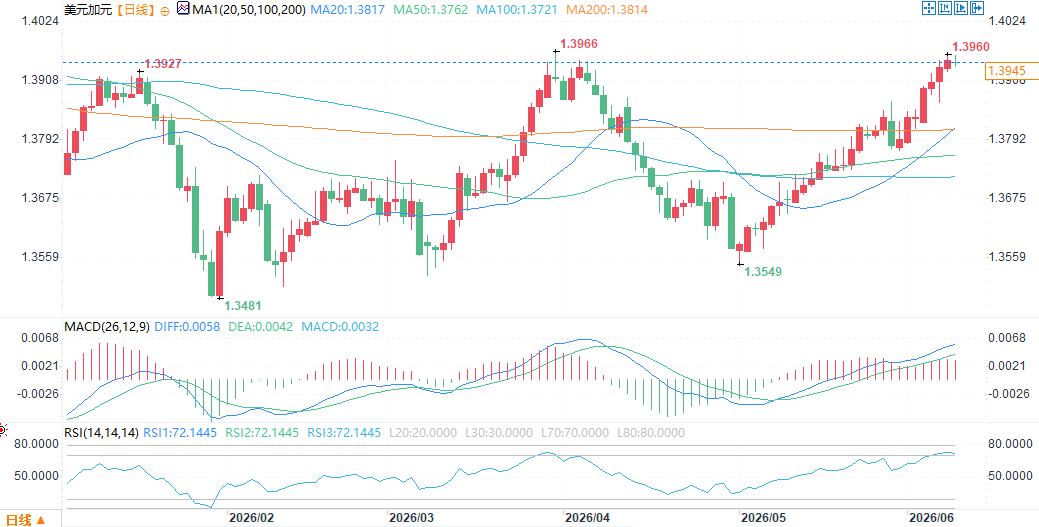
(USD/CAD daily chart, source: EasyForex)
At 15:30 Beijing time on June 9, the USD/CAD exchange rate was 1.3936/37.
Iran and Israel announced a cessation of attacks on each other, supporting global risk sentiment and dragging the safe-haven dollar down from a two-month high, which became the main factor suppressing the dollar against the Canadian dollar.
However, the long-term uncertainty surrounding the situation in the Middle East, the hawkish expectations of the Federal Reserve, and weak oil prices have collectively limited the downside potential of the exchange rate.
Geopolitical risks ease, putting pressure on the US dollar.
Iran and Israel announced on Monday that they would cease attacks on each other, less than 24 hours after clashes resumed, quickly boosting global risk sentiment.
Previously, the two countries launched multiple strikes against each other over the weekend—Iran fired several missiles at Israel in retaliation for the Israeli military's attack on the southern outskirts of Beirut, Lebanon; Israel, in turn, carried out airstrikes on military targets in western and central Iran, with explosions heard in Isfahan, Tehran and other places.
The market was once worried that this cycle of "attack-retaliation" could escalate into a wider regional war, and even affect the shipping security of the Strait of Hormuz—which carries about one-fifth of the world's oil shipments, and a complete blockade of it would have a catastrophic impact on global energy supplies.
With both sides subsequently stating their intention to "cease attacks," investor panic regarding geopolitical risks has noticeably subsided. President Trump's intervention is considered a key factor in facilitating this brief ceasefire.
According to reports, Trump called Israeli Prime Minister Netanyahu on Sunday, urging him not to immediately retaliate against the Iranian missile attack, emphasizing that "my word is law." After Netanyahu agreed to wait and see, Iran subsequently announced the end of its military operations.
As a result, the safe-haven dollar retreated from a two-month high. The dollar index had previously surged above 100.20 due to tensions in the Middle East and strong non-farm payroll data, but after the ceasefire news broke, some funds began to flow out of traditional safe-haven assets such as the dollar and into risk-sensitive currencies and assets.
Multiple factors limit the decline in exchange rate
However, market optimism remains limited, and the downside for the dollar may not be extensive.
First, the US and Iran have major differences on Iran's nuclear program and the Strait of Hormuz. The ceasefire between the two sides is more like a tactical respite than a fundamental reconciliation.
The Iranian military has issued a clear warning that it will take a “more severe and destructive response” if Israel resumes military operations; Israeli Prime Minister Netanyahu has also declared that the war with Iran and Hezbollah is “not over.”
This means that geopolitical risks have not been completely eliminated, and any accidental clash could reignite risk aversion and drive a rebound in the US dollar.
Secondly, market expectations for a hawkish stance from the Federal Reserve remain strong.
Traders are currently pricing in a greater than 70% probability of a Fed rate hike in 2026, and last Friday's much stronger-than-expected non-farm payroll data—with 172,000 new jobs added and the previous figure revised upward by 93,000—further solidified this expectation.
This report has fundamentally changed the market's assessment of the Federal Reserve's policy path: a few weeks ago, the mainstream expectation was to keep interest rates unchanged or even cut them this year, but now at least one rate hike before the end of the year has become the basic scenario.
Against this backdrop, it is difficult for dollar bears to make aggressive bets. Once the exchange rate experiences a significant pullback, bargain hunters may quickly enter the market, providing support for the dollar.
Meanwhile, easing geopolitical tensions are putting downward pressure on oil prices. Oil prices surged about 4% in early trading on Monday, but gradually fell back to near Friday's closing level as news of a ceasefire emerged.
As Canada's most important export commodity, crude oil prices are highly positively correlated with the Canadian dollar exchange rate. Falling oil prices mean reduced energy export revenue for Canada, thus weakening the commodity-linked Canadian dollar. This helps limit the downside potential of the US dollar against the Canadian dollar—even if the US dollar corrects, a weaker Canadian dollar will offset the decline to some extent, keeping the exchange rate relatively high.
Overall, the USD/CAD pair may experience short-term volatility, but the downside is expected to be limited.
This week's focus: US inflation data
This week, market attention will be focused on the US May Consumer Price Index (CPI) and Producer Price Index (PPI) reports, to be released on Wednesday and Thursday, respectively. These two key inflation data points will play a significant role in influencing market expectations regarding the Federal Reserve's future policy path and directly driving demand for the US dollar.
The market generally expects the overall CPI to rise to 4.2% year-on-year in May, the highest level in more than three years, and to increase by about 0.5% month-on-month. The core CPI, excluding energy and food, is expected to remain around 2.9% year-on-year and increase by 0.3% month-on-month.
If inflation data continues to rise, it will further solidify market expectations for a Fed rate hike—traders are currently pricing in a greater than 70% probability of a rate hike in 2026, and a 42% probability of a single rate hike in December. This could push the dollar index above the current resistance zone around 100.20, moving towards 100.65. Conversely, if inflation unexpectedly weakens, it could prompt investors to reverse their previous hawkish pricing, opening up room for a dollar pullback.
Thursday's PPI data will provide further clues about the impact of the Middle East conflict on supply chains. Economists are closely watching the PPI component, which reflects the Federal Reserve's preferred inflation gauge—the Personal Consumption Expenditures (PCE) price index—in preparation for the PCE data later this month.
Furthermore, the developments in the Middle East crisis and the dynamics of oil prices will provide important trading guidance for the USD/CAD exchange rate. While Iran and Israel have announced a cessation of mutual attacks, both sides have reserved the right to retaliate, making the ceasefire agreement quite fragile. If tensions escalate again, oil prices could surge, pushing up the commodity-linked Canadian dollar and simultaneously boosting the safe-haven US dollar. The combined effect of these two factors will further complicate the USD/CAD exchange rate movement.
Traders need to pay close attention to the alternating effects of geopolitical news and inflation data, and adjust their positions flexibly.
Technical Analysis
The USD/CAD pair is currently showing a strong upward trend on the daily chart, with the price approaching the previous key high of 1.3966, and the bullish trend is expected to continue.
In terms of price, the current price is trading around 1.3940. The 20-day, 50-day, 100-day, and 200-day moving averages (MA20, MA50, MA100, MA200) are in a bullish alignment, with support levels gradually moving upwards. The moving averages are providing strong support to the price. The previous high of around 1.3960 is a short-term resistance level, while support levels below are seen at the 20-day moving average (MA20) (1.3817) and the 1.3792 level.
The indicators are bullish: the MACD indicator's DIFF and DEA have formed a golden cross above the zero line and continue to rise, with the red bars increasing in volume, indicating strong bullish momentum; the RSI indicator is around 72.14, approaching the overbought zone, so caution is needed regarding the risk of a short-term pullback, but there are no obvious signs of a reversal, and the upward trend is still continuing.
(USD/CAD daily chart, source: EasyForex)
At 15:30 Beijing time on June 9, the USD/CAD exchange rate was 1.3936/37.
- Risk Warning and Disclaimer
- The market involves risk, and trading may not be suitable for all investors. This article is for reference only and does not constitute personal investment advice, nor does it take into account certain users’ specific investment objectives, financial situation, or other needs. Any investment decisions made based on this information are at your own risk.