A ceasefire between Iran and Israel, but no reconciliation: Gold gains a breather but struggles to rise, awaiting CPI guidance.
2026-06-09 16:50:38
On Tuesday (June 9), during the European session, gold prices continued their volatile trend, currently trading around $4,335 per ounce.
Iran and Israel announced a cessation of attacks on each other, causing the safe-haven dollar to fall from a more than two-month high, providing some support for gold.
However, fundamental differences between the US and Iran over their nuclear programs and the Strait of Hormuz have perpetuated geopolitical risk premiums. Coupled with strong market expectations for a Fed rate hike this year and persistently high US Treasury yields, these factors have limited the upside potential for gold.
Investors are awaiting U.S. inflation data to be released this week for further guidance.

Following President Trump's appeal, Iran and Israel announced a cessation of attacks on each other on Monday, bringing a brief respite to the Middle East following a weekend of intense fighting. This followed Iran's missile strikes in retaliation for an Israeli attack on the southern outskirts of Beirut, Lebanon, while Israel launched airstrikes against Iranian military targets in the west and central regions. Markets had feared the conflict could escalate into a wider regional war, potentially even impacting shipping safety in the Strait of Hormuz. With both sides announcing a cessation of attacks, risk aversion eased, and the dollar index retreated from a more than two-month high, falling to near the 100 mark.
A weaker dollar is a direct benefit to gold, which is priced in dollars. Since gold and the dollar typically have a negative correlation—when the dollar depreciates, it becomes cheaper for investors holding other currencies to buy gold, thus boosting demand. This recent dollar pullback has provided some breathing room for gold, with prices finding support after hitting their lowest level since March 23, temporarily halting the previous downward trend.
However, diplomatic engagement between the US and Iran remains stalled due to significant disagreements on key issues such as Iran's nuclear program. The Trump administration has made it clear that any peace agreement must ensure Iran cannot develop nuclear weapons, a non-negotiable red line for the US. The US demands that Iran accept strict and verifiable nuclear restrictions, including allowing the International Atomic Energy Agency to conduct comprehensive inspections of its nuclear facilities.
Meanwhile, Iran's demands were equally firm. Iran put forward a series of conditions: the international community must formally recognize Iran's sovereign rights; Iran should permanently control shipping traffic in the Strait of Hormuz—which carries about one-fifth of the world's oil shipments; all international sanctions must be lifted; and frozen Iranian assets overseas must be unfrozen. These demands involve core U.S. security interests and the global economic lifeline, making a compromise between the two sides highly unlikely in the short term.
The deep disagreements between the two sides on key issues have perpetuated the geopolitical risk premium. Any breakdown in negotiations or miscalculation could trigger a new round of military confrontation, and even affect shipping safety in the Strait of Hormuz. This ongoing uncertainty is likely to continue to support demand for the safe-haven dollar—funds tend to flow into traditional safe-haven assets like the dollar whenever tensions rise.
For gold, this means its upside potential will be significantly limited. On one hand, safe-haven demand is supporting the US dollar, suppressing gold's rebound momentum; on the other hand, even with escalating geopolitical risks, the market is more inclined to buy the dollar than gold, which differs from conventional wisdom. Unless the situation in the Middle East deteriorates sharply or there is a fundamental shift in the Federal Reserve's policy expectations, any meaningful rise in gold will face resistance. Investors need to closely monitor the progress of US-Iran negotiations and the navigation status of the Strait of Hormuz.
The Strait of Hormuz, a crucial global oil shipping route, carries approximately 20% of the world's oil supply daily. Due to the ongoing US-Iran standoff, shipping through the strait remains severely restricted, and tanker passage faces significant uncertainty. This has resulted in high volatility in the energy market, with crude oil prices consistently remaining above $90 per barrel. High oil prices are gradually passed on to end-consumer goods through gasoline, electricity, and transportation costs, further exacerbating inflation concerns in the market.
Rising inflationary pressures have, in turn, reinforced market expectations that major central banks, including the Federal Reserve, will adopt a more hawkish policy. According to data from the CME FedWatch tool, investors now expect a greater than 70% probability of a Fed rate hike before the end of the year, significantly higher than a month ago. This expectation has provided support for persistently high US Treasury yields—the 10-year Treasury yield recently approached 4.7%.
High yields increase the attractiveness of holding dollar assets, which may deter dollar short sellers from making aggressive bets, thus limiting the dollar's downside. For gold, a non-interest-bearing asset, this means its holding cost (opportunity cost) remains high, suppressing investors' willingness to hold gold and thus limiting its upside potential. Unless inflation data unexpectedly weakens or the situation in the Middle East escalates sharply, gold will continue to face pressure in the short term.
Investors may choose to wait for the U.S. inflation data to be released this week for clearer guidance.
The highly anticipated U.S. May Consumer Price Index (CPI) and Producer Price Index (PPI) reports will be released on Wednesday and Thursday, respectively.
These key data will help market participants determine the Federal Reserve's monetary policy path, thereby driving demand for the US dollar.
In addition, geopolitical news may continue to trigger market volatility and provide some trading guidance for gold.
The current daily chart for spot gold shows a weak trend, with significant downward pressure in the short term. The price has broken below the 20-day, 50-day, and 100-day moving averages, indicating clear downward pressure in the short term. Support levels are seen at the previous lows of 4268.42 and 4099.02, while resistance lies at the moving average resistance level around 4485.84.
The indicators are bearish: the MACD indicator's DIFF and DEA are running below the zero axis, and the green bars continue to expand, indicating that the bearish momentum is still ongoing; the RSI indicator has fallen back to 35, which is close to the oversold zone. Although there are signs of exhaustion in the downward momentum, there has been no clear signal of a turnaround and stabilization.
Overall, the moving average system is in a bearish alignment, and the price rebound has been weak after breaking through key support. Coupled with the MACD and RSI indicators both releasing weak signals, gold is likely to continue its downward trend in the short term. The effectiveness of the support level around 4268 needs to be closely monitored. If it breaks down, further downside potential will open up; if it stabilizes, a technical rebound opportunity may emerge.
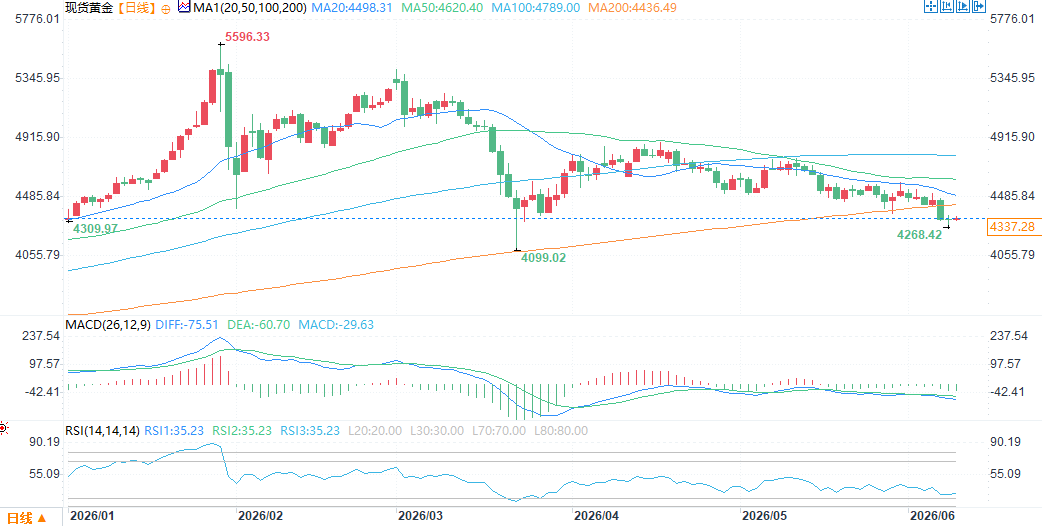
(Spot gold daily chart, source: FX678)
At 16:40 Beijing time on June 9, spot gold was trading at $4334.15 per ounce.
Iran and Israel announced a cessation of attacks on each other, causing the safe-haven dollar to fall from a more than two-month high, providing some support for gold.
However, fundamental differences between the US and Iran over their nuclear programs and the Strait of Hormuz have perpetuated geopolitical risk premiums. Coupled with strong market expectations for a Fed rate hike this year and persistently high US Treasury yields, these factors have limited the upside potential for gold.
Investors are awaiting U.S. inflation data to be released this week for further guidance.
Easing geopolitical risks weighed on the dollar, giving gold a breather.
Following President Trump's appeal, Iran and Israel announced a cessation of attacks on each other on Monday, bringing a brief respite to the Middle East following a weekend of intense fighting. This followed Iran's missile strikes in retaliation for an Israeli attack on the southern outskirts of Beirut, Lebanon, while Israel launched airstrikes against Iranian military targets in the west and central regions. Markets had feared the conflict could escalate into a wider regional war, potentially even impacting shipping safety in the Strait of Hormuz. With both sides announcing a cessation of attacks, risk aversion eased, and the dollar index retreated from a more than two-month high, falling to near the 100 mark.
A weaker dollar is a direct benefit to gold, which is priced in dollars. Since gold and the dollar typically have a negative correlation—when the dollar depreciates, it becomes cheaper for investors holding other currencies to buy gold, thus boosting demand. This recent dollar pullback has provided some breathing room for gold, with prices finding support after hitting their lowest level since March 23, temporarily halting the previous downward trend.
Geopolitical differences persist, and risk premiums support the US dollar.
However, diplomatic engagement between the US and Iran remains stalled due to significant disagreements on key issues such as Iran's nuclear program. The Trump administration has made it clear that any peace agreement must ensure Iran cannot develop nuclear weapons, a non-negotiable red line for the US. The US demands that Iran accept strict and verifiable nuclear restrictions, including allowing the International Atomic Energy Agency to conduct comprehensive inspections of its nuclear facilities.
Meanwhile, Iran's demands were equally firm. Iran put forward a series of conditions: the international community must formally recognize Iran's sovereign rights; Iran should permanently control shipping traffic in the Strait of Hormuz—which carries about one-fifth of the world's oil shipments; all international sanctions must be lifted; and frozen Iranian assets overseas must be unfrozen. These demands involve core U.S. security interests and the global economic lifeline, making a compromise between the two sides highly unlikely in the short term.
The deep disagreements between the two sides on key issues have perpetuated the geopolitical risk premium. Any breakdown in negotiations or miscalculation could trigger a new round of military confrontation, and even affect shipping safety in the Strait of Hormuz. This ongoing uncertainty is likely to continue to support demand for the safe-haven dollar—funds tend to flow into traditional safe-haven assets like the dollar whenever tensions rise.
For gold, this means its upside potential will be significantly limited. On one hand, safe-haven demand is supporting the US dollar, suppressing gold's rebound momentum; on the other hand, even with escalating geopolitical risks, the market is more inclined to buy the dollar than gold, which differs from conventional wisdom. Unless the situation in the Middle East deteriorates sharply or there is a fundamental shift in the Federal Reserve's policy expectations, any meaningful rise in gold will face resistance. Investors need to closely monitor the progress of US-Iran negotiations and the navigation status of the Strait of Hormuz.
Interest rate hike expectations and high yields are suppressing gold's upward movement.
The Strait of Hormuz, a crucial global oil shipping route, carries approximately 20% of the world's oil supply daily. Due to the ongoing US-Iran standoff, shipping through the strait remains severely restricted, and tanker passage faces significant uncertainty. This has resulted in high volatility in the energy market, with crude oil prices consistently remaining above $90 per barrel. High oil prices are gradually passed on to end-consumer goods through gasoline, electricity, and transportation costs, further exacerbating inflation concerns in the market.
Rising inflationary pressures have, in turn, reinforced market expectations that major central banks, including the Federal Reserve, will adopt a more hawkish policy. According to data from the CME FedWatch tool, investors now expect a greater than 70% probability of a Fed rate hike before the end of the year, significantly higher than a month ago. This expectation has provided support for persistently high US Treasury yields—the 10-year Treasury yield recently approached 4.7%.
High yields increase the attractiveness of holding dollar assets, which may deter dollar short sellers from making aggressive bets, thus limiting the dollar's downside. For gold, a non-interest-bearing asset, this means its holding cost (opportunity cost) remains high, suppressing investors' willingness to hold gold and thus limiting its upside potential. Unless inflation data unexpectedly weakens or the situation in the Middle East escalates sharply, gold will continue to face pressure in the short term.
Market focus shifts to US inflation data
Investors may choose to wait for the U.S. inflation data to be released this week for clearer guidance.
The highly anticipated U.S. May Consumer Price Index (CPI) and Producer Price Index (PPI) reports will be released on Wednesday and Thursday, respectively.
These key data will help market participants determine the Federal Reserve's monetary policy path, thereby driving demand for the US dollar.
In addition, geopolitical news may continue to trigger market volatility and provide some trading guidance for gold.
Technical Analysis
The current daily chart for spot gold shows a weak trend, with significant downward pressure in the short term. The price has broken below the 20-day, 50-day, and 100-day moving averages, indicating clear downward pressure in the short term. Support levels are seen at the previous lows of 4268.42 and 4099.02, while resistance lies at the moving average resistance level around 4485.84.
The indicators are bearish: the MACD indicator's DIFF and DEA are running below the zero axis, and the green bars continue to expand, indicating that the bearish momentum is still ongoing; the RSI indicator has fallen back to 35, which is close to the oversold zone. Although there are signs of exhaustion in the downward momentum, there has been no clear signal of a turnaround and stabilization.
Overall, the moving average system is in a bearish alignment, and the price rebound has been weak after breaking through key support. Coupled with the MACD and RSI indicators both releasing weak signals, gold is likely to continue its downward trend in the short term. The effectiveness of the support level around 4268 needs to be closely monitored. If it breaks down, further downside potential will open up; if it stabilizes, a technical rebound opportunity may emerge.
(Spot gold daily chart, source: FX678)
At 16:40 Beijing time on June 9, spot gold was trading at $4334.15 per ounce.
- Risk Warning and Disclaimer
- The market involves risk, and trading may not be suitable for all investors. This article is for reference only and does not constitute personal investment advice, nor does it take into account certain users’ specific investment objectives, financial situation, or other needs. Any investment decisions made based on this information are at your own risk.