After the US dollar index climbed above 100, it suddenly cooled down. Where has the real focus shifted?
2026-06-09 17:57:34
On Tuesday, June 9th, the main trading driver for the US dollar index shifted from simple safe-haven demand to the repricing of interest rate expectations. The dollar index is currently trading around 99.85, down about 0.15% intraday, but still near its recent highs, having risen about 1.98% over the past month. The daily chart shows the index briefly touched 100.2099 before falling back below the 100 mark, remaining close to the upper Bollinger Band. Stronger-than-expected employment data, Goldman Sachs delaying its Fed rate cut forecast, and inflation data remaining above target are the core factors driving the dollar index's movement.
The key to Goldman Sachs' latest adjustment lies not in a single change in forecasts, but in the reordering of market narratives. Previously, some funds were still betting on a Federal Reserve rate cut this year, but Goldman Sachs has postponed its next rate cut expectation to June and December 2027, arguing that the job market is stronger than expected, with the unemployment rate likely to rise only slightly to 4.4%, insufficient to force the Fed to rush into a dovish stance. Its assessment emphasizes that falling inflation, the impact of tariffs, external conflicts, and cooling AI demand all require more time to digest.
This means the pricing anchor for the US dollar index has shifted from "when interest rates will be cut" to "how long interest rates will remain high." The current target range for the federal funds rate remains 3.50%-3.75%, with the upper limit at 3.75%. The two-year Treasury yield is around 4.15%, and the ten-year Treasury yield is around 4.56%. The short-term yields being higher than the upper limit of the policy rate indicates that the interest rate market has re-incorporated a higher policy premium.
U.S. nonfarm payrolls increased by 172,000 in May, the unemployment rate remained at 4.3%, and average hourly earnings rose 0.3% month-over-month and 3.4% year-over-year. More importantly, the combined March and April employment figures were revised upward by 93,000, weakening previous market assumptions about a rapid cooling of the labor force. Job growth was primarily driven by the leisure and hospitality industry, local government, and healthcare, while financial activity employment declined by 22,000, indicating an uneven expansion of the labor force, but overall sufficient to leave the Federal Reserve with little reason to cut interest rates immediately.
For the US dollar index, the impact of strong employment is not simply positive, but rather transmitted through three paths. First, wage growth remains sluggish, making it more difficult to cool inflation in core services. Second, upward revisions to employment figures reduce the recession premium, strengthening the dollar's cost advantage as a high-interest currency. Third, if the market shifts from expectations of rate cuts to expectations of a low-probability rate hike, the dollar index will receive further support from short-term interest rates. Recent interest rate futures have already indicated that the probability of a rate hike this year has been raised again to around 70%. This is not the baseline scenario, but it is enough to change the structure of foreign exchange volatility.
US CPI rose 3.8% year-on-year in April, up from 3.3% in March; core CPI, excluding food and energy, rose 2.8% year-on-year. PCE data, which is more closely watched by the Federal Reserve, showed that overall PCE rose 3.8% year-on-year in April, while core PCE rose 3.3% year-on-year, both significantly higher than the 2% target. The inflation data did not provide conditions for easing monetary policy; instead, it made it more difficult for the Federal Reserve to release dovish signals.
However, inflation doesn't have a one-way impact on the dollar. When energy prices, transportation costs, and external conflicts push up inflation, if this simultaneously suppresses real consumer purchasing power, the dollar index may experience a tug-of-war between strong interest rate support and weak growth expectations. A New York Fed survey shows that the one-year inflation expectation in May was 3.5%, while the three-year and five-year expectations were 3.1% and 3.0% respectively. Inflation expectations are not yet out of control, but there is still a significant gap from the policy target. Kansas City Fed President Schmid recently stated that the policy choice is oscillating between "waiting patiently" and "raising interest rates to curb inflation," a statement that limits the dollar's downside potential.
From a daily chart perspective, the US dollar index has recovered from a low of around 97.6229 to around 100. The Bollinger Band middle line is at 99.0034, and the upper line is around 100.1884. The latest price has pulled back after approaching the upper line, indicating that the short-term upward momentum has encountered the first layer of resistance. In the MACD indicator, the DIFF is 0.2901, the DEA is 0.2021, and the histogram is still positive, indicating that the trend has not yet weakened. However, the pullback after the expansion of the histogram suggests that the momentum is shifting from a rapid rise to high-level consolidation.
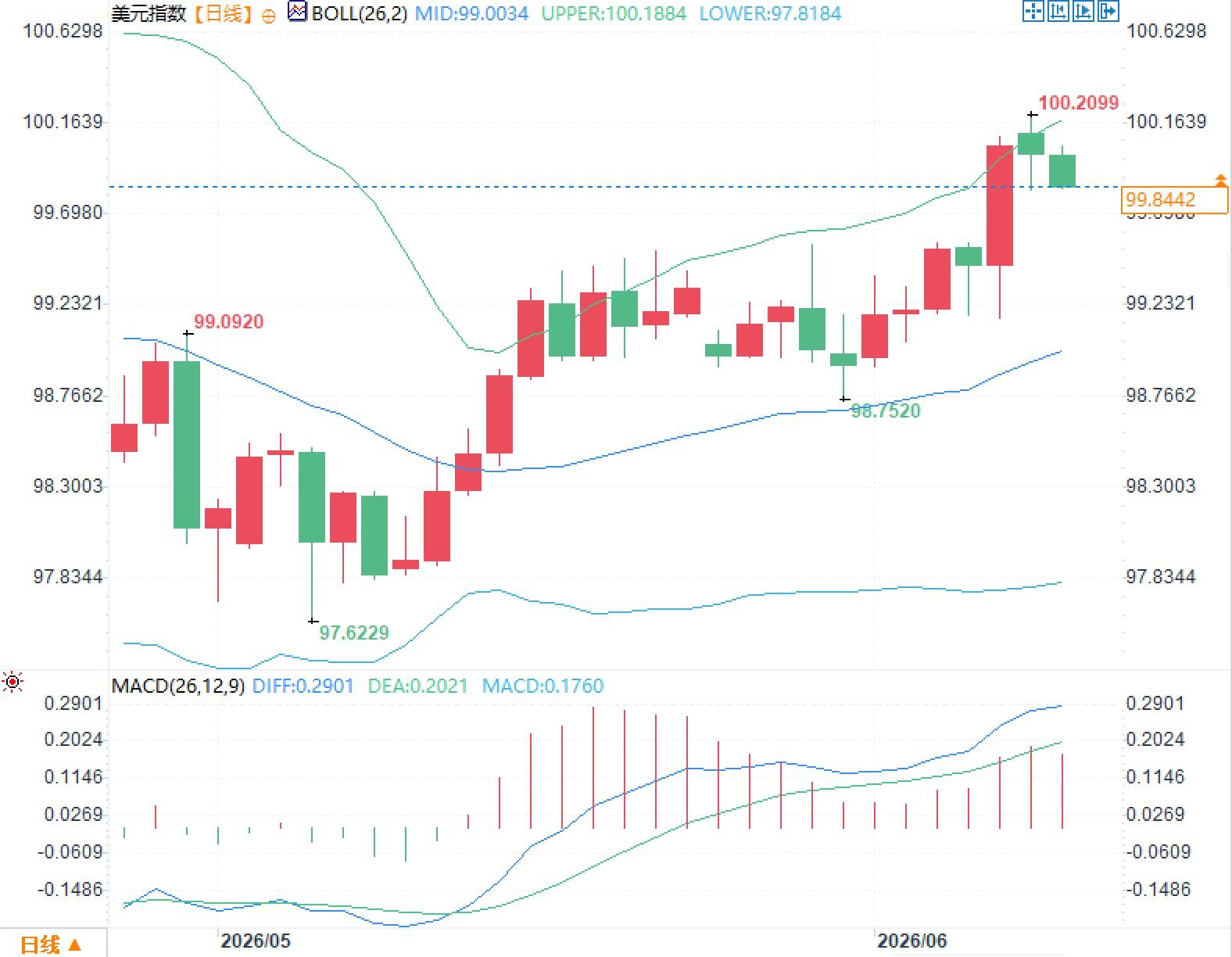
The significance of the 100 level lies not in the integer itself, but in the fact that it corresponds to a recent high, the upper Bollinger Band, and a concentrated trading area for interest rate repricing. If the index continues to remain between 99.70 and 100.20, it indicates that the market is awaiting further confirmation of direction from inflation data and the Federal Reserve meeting. A return to the middle Bollinger Band around 99.00 suggests that the upward momentum from the employment data has been partially digested.
Rate cut trade recedes
The key to Goldman Sachs' latest adjustment lies not in a single change in forecasts, but in the reordering of market narratives. Previously, some funds were still betting on a Federal Reserve rate cut this year, but Goldman Sachs has postponed its next rate cut expectation to June and December 2027, arguing that the job market is stronger than expected, with the unemployment rate likely to rise only slightly to 4.4%, insufficient to force the Fed to rush into a dovish stance. Its assessment emphasizes that falling inflation, the impact of tariffs, external conflicts, and cooling AI demand all require more time to digest.
This means the pricing anchor for the US dollar index has shifted from "when interest rates will be cut" to "how long interest rates will remain high." The current target range for the federal funds rate remains 3.50%-3.75%, with the upper limit at 3.75%. The two-year Treasury yield is around 4.15%, and the ten-year Treasury yield is around 4.56%. The short-term yields being higher than the upper limit of the policy rate indicates that the interest rate market has re-incorporated a higher policy premium.
The employment situation is not a single strong point, but rather a chain of evidence weakening the urgency for easing.
U.S. nonfarm payrolls increased by 172,000 in May, the unemployment rate remained at 4.3%, and average hourly earnings rose 0.3% month-over-month and 3.4% year-over-year. More importantly, the combined March and April employment figures were revised upward by 93,000, weakening previous market assumptions about a rapid cooling of the labor force. Job growth was primarily driven by the leisure and hospitality industry, local government, and healthcare, while financial activity employment declined by 22,000, indicating an uneven expansion of the labor force, but overall sufficient to leave the Federal Reserve with little reason to cut interest rates immediately.
For the US dollar index, the impact of strong employment is not simply positive, but rather transmitted through three paths. First, wage growth remains sluggish, making it more difficult to cool inflation in core services. Second, upward revisions to employment figures reduce the recession premium, strengthening the dollar's cost advantage as a high-interest currency. Third, if the market shifts from expectations of rate cuts to expectations of a low-probability rate hike, the dollar index will receive further support from short-term interest rates. Recent interest rate futures have already indicated that the probability of a rate hike this year has been raised again to around 70%. This is not the baseline scenario, but it is enough to change the structure of foreign exchange volatility.
Inflation remains the policy ceiling, and dollar bulls are not without pressure.
US CPI rose 3.8% year-on-year in April, up from 3.3% in March; core CPI, excluding food and energy, rose 2.8% year-on-year. PCE data, which is more closely watched by the Federal Reserve, showed that overall PCE rose 3.8% year-on-year in April, while core PCE rose 3.3% year-on-year, both significantly higher than the 2% target. The inflation data did not provide conditions for easing monetary policy; instead, it made it more difficult for the Federal Reserve to release dovish signals.
However, inflation doesn't have a one-way impact on the dollar. When energy prices, transportation costs, and external conflicts push up inflation, if this simultaneously suppresses real consumer purchasing power, the dollar index may experience a tug-of-war between strong interest rate support and weak growth expectations. A New York Fed survey shows that the one-year inflation expectation in May was 3.5%, while the three-year and five-year expectations were 3.1% and 3.0% respectively. Inflation expectations are not yet out of control, but there is still a significant gap from the policy target. Kansas City Fed President Schmid recently stated that the policy choice is oscillating between "waiting patiently" and "raising interest rates to curb inflation," a statement that limits the dollar's downside potential.
The technical picture is entering a critical test; the 100 level is more than just a psychological barrier.
From a daily chart perspective, the US dollar index has recovered from a low of around 97.6229 to around 100. The Bollinger Band middle line is at 99.0034, and the upper line is around 100.1884. The latest price has pulled back after approaching the upper line, indicating that the short-term upward momentum has encountered the first layer of resistance. In the MACD indicator, the DIFF is 0.2901, the DEA is 0.2021, and the histogram is still positive, indicating that the trend has not yet weakened. However, the pullback after the expansion of the histogram suggests that the momentum is shifting from a rapid rise to high-level consolidation.
The significance of the 100 level lies not in the integer itself, but in the fact that it corresponds to a recent high, the upper Bollinger Band, and a concentrated trading area for interest rate repricing. If the index continues to remain between 99.70 and 100.20, it indicates that the market is awaiting further confirmation of direction from inflation data and the Federal Reserve meeting. A return to the middle Bollinger Band around 99.00 suggests that the upward momentum from the employment data has been partially digested.
- Risk Warning and Disclaimer
- The market involves risk, and trading may not be suitable for all investors. This article is for reference only and does not constitute personal investment advice, nor does it take into account certain users’ specific investment objectives, financial situation, or other needs. Any investment decisions made based on this information are at your own risk.