Did Trump's peace promise hypnotize the oil market?
2026-06-09 19:38:28
Over the past few weeks, fighting has continued on the Middle East front, with clashes ongoing in Iran and Lebanon. However, international oil prices have fluctuated and declined amidst a series of diplomatic pronouncements. Global capital markets, swayed by optimism, have deliberately created a false impression of impending peace. The interplay of short-term capital flows, quantitative algorithms, and political rhetoric has fostered a one-sided optimism, causing asset pricing to become severely disconnected from real geopolitical risks. The market has clearly underestimated the complexity of the current situation.
Washington's Ceasefire Script
Even with ongoing ground conflicts in Gaza and Lebanon, and Iran's attacks on Israeli military bases, oil prices and global stock markets quickly recovered after a brief period of panic. Traders' willingness to shed geopolitical risk premiums stemmed not from a substantial ceasefire on the front lines, but from the White House's continuous release of positive signals regarding negotiations.
Capital markets are inherently averse to uncertainty. When the US frequently made statements such as "negotiations are in their final stages" and "key shipping lanes are about to reopen," quantitative trading programs and short-term funds quickly repriced according to the logic of "de-escalation of the conflict." However, the market clearly confused politicians' diplomatic statements with the harsh reality of the battlefield, blindly chasing superficial signals of reconciliation while selectively ignoring past failed ceasefire agreements, gradually losing its judgment in the peaceful atmosphere created by public opinion.
Behind the nominal ceasefire: the erosion of the battlefield and the final game
Looking beyond the financial markets to examine the Middle East situation reveals that expectations of peace have been severely overestimated. Under the existing ceasefire framework, Israel has not ceased its de facto control and positional advances in the Gaza Strip, gradually expanding its control through zoned operations, with the core objective of completely dismantling its opponent's military and governance capabilities. Negotiations based on "complete demilitarization" inherently lack room for compromise; the temporary calm is merely a tactical lull for all parties to regroup and prepare for the next offensive.
The situation in Lebanon and Iran is even more perilous, with multiple parties engaging in direct firefights, completely shattering the original strategic balance. The current ceasefire agreement has significant loopholes, allowing Israel to launch unilateral counterattacks when it perceives a threat, turning the so-called ceasefire into a mere facade of conflict. The Lebanese armed forces still possess the capability to retaliate, and with Iran's deep and direct involvement, the parties have not only failed to de-escalate but have instead used the temporary calm to amass strength, continuously escalating the risk of large-scale conflict.
Political logic dominates: Conflict is difficult to truly de-escalate
The market generally hopes that external forces will forcefully suppress military action and push the Middle East toward peace, but this assessment ignores Israel's core internal political logic. For the current government, abandoning a hardline military approach is essentially tantamount to the collapse of the cabinet. Faced with domestic public opinion pressure and constraints from the right wing, maintaining a state of war and continuing military operations is a crucial choice for the ruling team to consolidate its position.
When internal political survival demands clash with external peace frameworks, external diplomatic pressure is unlikely to alter the existing trajectory. This also means that the probability of achieving a comprehensive ceasefire solely through diplomatic mediation is extremely low, and the situation could escalate suddenly again at any time.
Risk Correction and Market Outlook
The mismatch between asset prices and geopolitical risks has created a rare contrarian observation window. The situation in the Middle East has not substantially improved, and the market's fervent expectation of peace is ultimately just a bubble on paper. Currently, funds are trading based on the de-escalation of conflict, the resumption of shipping, and weakening inflation, ignoring the ever-accumulating geopolitical risks, much like watching a volcano on the verge of eruption.
Market rallies fueled by sentiment are often fragile. Once localized tensions escalate and ceasefire agreements completely collapse, the market will face a sharp correction. Global efforts to combat inflation will be jeopardized, and capital markets will be plunged into a new wave of panic. Historical experience repeatedly demonstrates that markets often succumb to collective optimism before risks materialize. Only by seeing through appearances and avoiding being hypnotized by public opinion can one grasp the true direction of the market amidst geopolitical shifts.
Technical Analysis
From the market trend, this round of oil price decline is mainly driven by sentiment, and the fundamentals have not changed fundamentally. Currently, oil prices have fallen back to a short-term trading range, with the high point formed by the previous conflict acting as a strong resistance level, and the geopolitical risk premium range providing effective support below.
Long positions in the futures market continued to decline, market risk aversion fell to a relatively low level, and the willingness to hedge was clearly insufficient. Considering geopolitical patterns, a decline driven by sentiment is unlikely to be sustained until geopolitical tensions are fully resolved. If news of further military conflict emerges, oil prices are likely to rebound quickly, and overall volatility will further increase. Traders should be wary of sudden market movements.
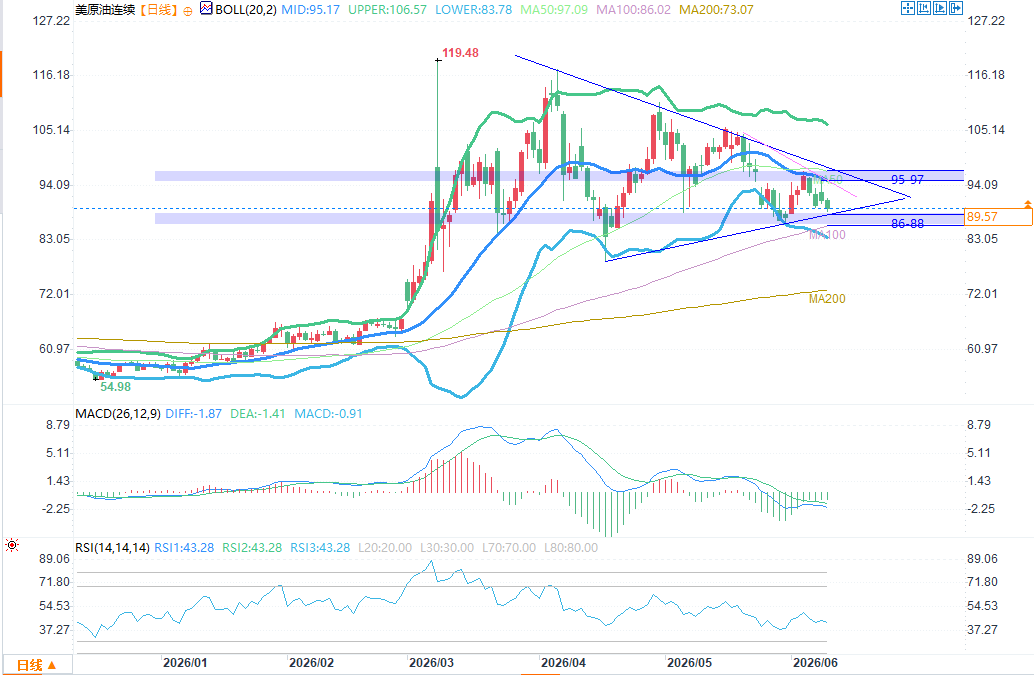
(WTI crude oil daily chart source: FX678)
From a daily chart perspective, US crude oil is currently trading at the end of a converging triangle formed by the upper trendline of a downtrend, the lower horizontal support line, and multiple moving averages, and is about to face a crucial directional choice. Previously, driven by the narrative of "peaceful de-escalation," the market attempted a downward breakout, but the price has now fallen to near the lower trendline of the triangle and is clearly consolidating within the 86-97 range in the short term.
Within the range, the area around 97 presents multiple resistance levels, including the upper trendline of the triangle pattern, the middle Bollinger Band, and the 50-day moving average, forming a strong resistance zone for any short-term rebound. On the other hand, the area around 86 offers support from the previous consolidation platform, the lower Bollinger Band, and the medium-term moving average, creating a safety cushion for any short-term downside. Currently, the price is approaching the lower edge of the range, at a critical turning point at the end of the pattern. Market sentiment and capital flows have reached a fever pitch, and a directional decision is likely imminent.
From a technical perspective, the downward momentum has been weakening, the MACD histogram is shortening significantly, and there is a potential signal of a golden cross at a low level. The RSI indicator has fallen back to the lower neutral range, approaching the oversold edge, indicating significant short-term oversold conditions. The Bollinger Bands are also narrowing, suggesting that a correction window is opening at a swing trading level, and the probability of the price breaking out of the current narrow range is increasing.
More importantly, a clear divergence has emerged between fundamentals and technicals: the market has already priced in the optimistic expectation of peace, while the actual risks of the Middle East conflict have not been substantially alleviated. If the geopolitical situation recurs, the undervalued risk premium could easily push prices above the upper limit of the range, forming a rapid rebound, and subsequently, it is highly likely to challenge and break through the MA50 moving average resistance level.
In summary, current prices are significantly lower than potential geopolitical risks, and the technical indicators also suggest conditions for an upward correction. The apex of the triangle pattern is more likely to break out upwards than to retest the bottom.
Washington's Ceasefire Script
Even with ongoing ground conflicts in Gaza and Lebanon, and Iran's attacks on Israeli military bases, oil prices and global stock markets quickly recovered after a brief period of panic. Traders' willingness to shed geopolitical risk premiums stemmed not from a substantial ceasefire on the front lines, but from the White House's continuous release of positive signals regarding negotiations.
Capital markets are inherently averse to uncertainty. When the US frequently made statements such as "negotiations are in their final stages" and "key shipping lanes are about to reopen," quantitative trading programs and short-term funds quickly repriced according to the logic of "de-escalation of the conflict." However, the market clearly confused politicians' diplomatic statements with the harsh reality of the battlefield, blindly chasing superficial signals of reconciliation while selectively ignoring past failed ceasefire agreements, gradually losing its judgment in the peaceful atmosphere created by public opinion.
Behind the nominal ceasefire: the erosion of the battlefield and the final game
Looking beyond the financial markets to examine the Middle East situation reveals that expectations of peace have been severely overestimated. Under the existing ceasefire framework, Israel has not ceased its de facto control and positional advances in the Gaza Strip, gradually expanding its control through zoned operations, with the core objective of completely dismantling its opponent's military and governance capabilities. Negotiations based on "complete demilitarization" inherently lack room for compromise; the temporary calm is merely a tactical lull for all parties to regroup and prepare for the next offensive.
The situation in Lebanon and Iran is even more perilous, with multiple parties engaging in direct firefights, completely shattering the original strategic balance. The current ceasefire agreement has significant loopholes, allowing Israel to launch unilateral counterattacks when it perceives a threat, turning the so-called ceasefire into a mere facade of conflict. The Lebanese armed forces still possess the capability to retaliate, and with Iran's deep and direct involvement, the parties have not only failed to de-escalate but have instead used the temporary calm to amass strength, continuously escalating the risk of large-scale conflict.
Political logic dominates: Conflict is difficult to truly de-escalate
The market generally hopes that external forces will forcefully suppress military action and push the Middle East toward peace, but this assessment ignores Israel's core internal political logic. For the current government, abandoning a hardline military approach is essentially tantamount to the collapse of the cabinet. Faced with domestic public opinion pressure and constraints from the right wing, maintaining a state of war and continuing military operations is a crucial choice for the ruling team to consolidate its position.
When internal political survival demands clash with external peace frameworks, external diplomatic pressure is unlikely to alter the existing trajectory. This also means that the probability of achieving a comprehensive ceasefire solely through diplomatic mediation is extremely low, and the situation could escalate suddenly again at any time.
Risk Correction and Market Outlook
The mismatch between asset prices and geopolitical risks has created a rare contrarian observation window. The situation in the Middle East has not substantially improved, and the market's fervent expectation of peace is ultimately just a bubble on paper. Currently, funds are trading based on the de-escalation of conflict, the resumption of shipping, and weakening inflation, ignoring the ever-accumulating geopolitical risks, much like watching a volcano on the verge of eruption.
Market rallies fueled by sentiment are often fragile. Once localized tensions escalate and ceasefire agreements completely collapse, the market will face a sharp correction. Global efforts to combat inflation will be jeopardized, and capital markets will be plunged into a new wave of panic. Historical experience repeatedly demonstrates that markets often succumb to collective optimism before risks materialize. Only by seeing through appearances and avoiding being hypnotized by public opinion can one grasp the true direction of the market amidst geopolitical shifts.
Technical Analysis
From the market trend, this round of oil price decline is mainly driven by sentiment, and the fundamentals have not changed fundamentally. Currently, oil prices have fallen back to a short-term trading range, with the high point formed by the previous conflict acting as a strong resistance level, and the geopolitical risk premium range providing effective support below.
Long positions in the futures market continued to decline, market risk aversion fell to a relatively low level, and the willingness to hedge was clearly insufficient. Considering geopolitical patterns, a decline driven by sentiment is unlikely to be sustained until geopolitical tensions are fully resolved. If news of further military conflict emerges, oil prices are likely to rebound quickly, and overall volatility will further increase. Traders should be wary of sudden market movements.
(WTI crude oil daily chart source: FX678)
From a daily chart perspective, US crude oil is currently trading at the end of a converging triangle formed by the upper trendline of a downtrend, the lower horizontal support line, and multiple moving averages, and is about to face a crucial directional choice. Previously, driven by the narrative of "peaceful de-escalation," the market attempted a downward breakout, but the price has now fallen to near the lower trendline of the triangle and is clearly consolidating within the 86-97 range in the short term.
Within the range, the area around 97 presents multiple resistance levels, including the upper trendline of the triangle pattern, the middle Bollinger Band, and the 50-day moving average, forming a strong resistance zone for any short-term rebound. On the other hand, the area around 86 offers support from the previous consolidation platform, the lower Bollinger Band, and the medium-term moving average, creating a safety cushion for any short-term downside. Currently, the price is approaching the lower edge of the range, at a critical turning point at the end of the pattern. Market sentiment and capital flows have reached a fever pitch, and a directional decision is likely imminent.
From a technical perspective, the downward momentum has been weakening, the MACD histogram is shortening significantly, and there is a potential signal of a golden cross at a low level. The RSI indicator has fallen back to the lower neutral range, approaching the oversold edge, indicating significant short-term oversold conditions. The Bollinger Bands are also narrowing, suggesting that a correction window is opening at a swing trading level, and the probability of the price breaking out of the current narrow range is increasing.
More importantly, a clear divergence has emerged between fundamentals and technicals: the market has already priced in the optimistic expectation of peace, while the actual risks of the Middle East conflict have not been substantially alleviated. If the geopolitical situation recurs, the undervalued risk premium could easily push prices above the upper limit of the range, forming a rapid rebound, and subsequently, it is highly likely to challenge and break through the MA50 moving average resistance level.
In summary, current prices are significantly lower than potential geopolitical risks, and the technical indicators also suggest conditions for an upward correction. The apex of the triangle pattern is more likely to break out upwards than to retest the bottom.
- Risk Warning and Disclaimer
- The market involves risk, and trading may not be suitable for all investors. This article is for reference only and does not constitute personal investment advice, nor does it take into account certain users’ specific investment objectives, financial situation, or other needs. Any investment decisions made based on this information are at your own risk.