The US dollar came under pressure and corrected, while the British pound rebounded after hitting a low against the US dollar.
2026-01-19 10:17:37
The British pound strengthened against the US dollar (GBP/USD) during Monday's Asian trading session, rising to around 1.3400. The dollar index weakened overall as US President Trump's latest tariff statements regarding Europe triggered risk aversion in the market, providing upward momentum for the pound.
The day coincided with Martin Luther King Jr. Day holiday in the United States, resulting in a market closure and relatively thin liquidity. Exchange rate fluctuations were more driven by policy news. The United States plans to impose an additional 10% tariff on goods from Denmark, Norway, Sweden, France, Germany, the Netherlands, Finland, and the United Kingdom, starting February 1, until the United States is authorized to purchase Greenland.
This news is seen as a new source of uncertainty in EU-US trade relations, prompting investors to reassess the risk pricing of dollar assets. The EU responded swiftly. EU ambassadors reached a broad consensus on Sunday on strengthening communication and discouraging tariff measures, with France even proposing a series of previously unused economic retaliatory measures.
The news put downward pressure on the dollar, with markets worried that the US policy stance could weaken the dollar's long-term appeal. Khoon Goh, head of Asia research at ANZ Bank, said that while the tariffs ostensibly threaten the European economy, the dollar is actually the first to be affected, as the market is pricing in a higher political risk premium for the dollar.
From a funding perspective, investors are becoming more cautious about their long dollar positions. The tariff dispute could not only drag down trade between the US and Europe, but also exacerbate the contradiction between domestic inflation and economic growth in the US, making the Federal Reserve's future policy path more complex.
This uncertainty has weakened the relative advantage of the US dollar in the short term. UK data will be key in the next phase. This week, the UK will release a series of employment market and consumer price index (CPI) data, which will directly affect the Bank of England's policy expectations.
If inflation and wages perform better than expected, the market may further reduce its bets on a Bank of England rate cut, thus providing new upward momentum for the pound; conversely, if the data is weak, the pound may come under renewed pressure against the dollar.
Market sentiment regarding the UK economic outlook remains divided. On one hand, the resilience of the service sector and fiscal policy support are providing a floor for the pound; on the other hand, slowing external demand and uncertainty in the European economy could still drag down growth expectations. A sustained rebound in the pound requires fundamental support, rather than simply relying on a weaker dollar.
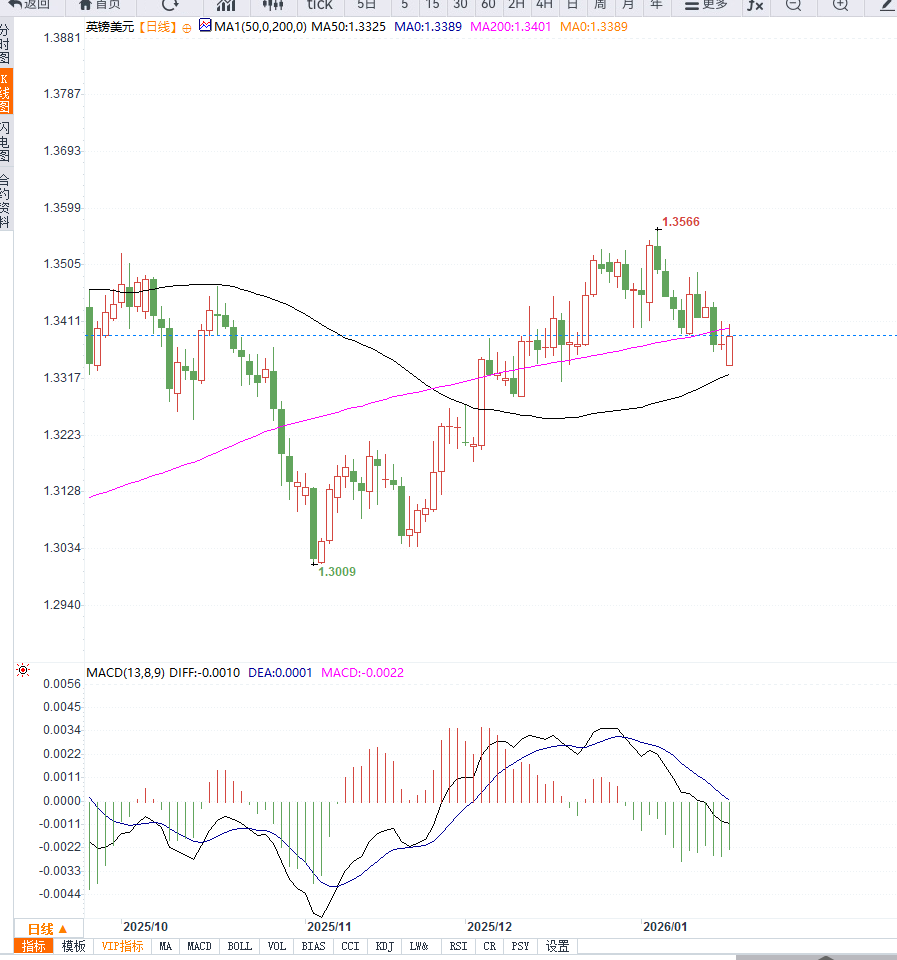
From the daily chart, the rebound of GBP/USD near 1.3400 indicates that the short-term pattern has shifted from a correction to stabilization, with the bulls finding solid support around 1.3250, and the price returning to the upper edge of the trading range.
The moving average system shows signs of repair, with the 5-day moving average turning upward and crossing the 10-day moving average to form a preliminary golden cross. The 20-day moving average is located around 1.3320, providing medium-term support. As long as the exchange rate remains above this level, the overall trend remains one of oscillation with a slight upward bias.
In terms of indicators, the MACD has diverged upwards again near the zero line, and the RSI has rebounded to the 55-60 range, indicating that momentum is improving, but it has not yet entered a strong trend phase. The short-term resistance levels are 1.3420 and 1.3480, with 1.3550 being a key resistance zone; on the downside, 1.3350 and 1.3320 form support, with 1.3250 being an important defensive level.
In summary, if the price can effectively hold above 1.3420, the bulls are expected to continue pushing towards 1.3480-1.3550. Conversely, if it falls below 1.3320, it may return to a range-bound consolidation.
Editor's Note:
The recent rebound in the pound is more driven by risk repricing in the dollar than by the strength of the UK itself. The trade friction between the US and Europe has led the market to question the policy stability premium of the dollar, resulting in a temporary rebalancing of funds, which is the core logic behind the currency rebound.
Technically, the daily chart shows that the recovery from the previous decline has been completed, but a true bullish trend has not yet begun. The focus remains on UK economic data and the Bank of England's statements. If employment and inflation remain robust, the pound could extend further towards the 1.35 area; if the data falls short of expectations, the area above 1.34 may become a temporary high.
The day coincided with Martin Luther King Jr. Day holiday in the United States, resulting in a market closure and relatively thin liquidity. Exchange rate fluctuations were more driven by policy news. The United States plans to impose an additional 10% tariff on goods from Denmark, Norway, Sweden, France, Germany, the Netherlands, Finland, and the United Kingdom, starting February 1, until the United States is authorized to purchase Greenland.
This news is seen as a new source of uncertainty in EU-US trade relations, prompting investors to reassess the risk pricing of dollar assets. The EU responded swiftly. EU ambassadors reached a broad consensus on Sunday on strengthening communication and discouraging tariff measures, with France even proposing a series of previously unused economic retaliatory measures.
The news put downward pressure on the dollar, with markets worried that the US policy stance could weaken the dollar's long-term appeal. Khoon Goh, head of Asia research at ANZ Bank, said that while the tariffs ostensibly threaten the European economy, the dollar is actually the first to be affected, as the market is pricing in a higher political risk premium for the dollar.
From a funding perspective, investors are becoming more cautious about their long dollar positions. The tariff dispute could not only drag down trade between the US and Europe, but also exacerbate the contradiction between domestic inflation and economic growth in the US, making the Federal Reserve's future policy path more complex.
This uncertainty has weakened the relative advantage of the US dollar in the short term. UK data will be key in the next phase. This week, the UK will release a series of employment market and consumer price index (CPI) data, which will directly affect the Bank of England's policy expectations.
If inflation and wages perform better than expected, the market may further reduce its bets on a Bank of England rate cut, thus providing new upward momentum for the pound; conversely, if the data is weak, the pound may come under renewed pressure against the dollar.
Market sentiment regarding the UK economic outlook remains divided. On one hand, the resilience of the service sector and fiscal policy support are providing a floor for the pound; on the other hand, slowing external demand and uncertainty in the European economy could still drag down growth expectations. A sustained rebound in the pound requires fundamental support, rather than simply relying on a weaker dollar.
From the daily chart, the rebound of GBP/USD near 1.3400 indicates that the short-term pattern has shifted from a correction to stabilization, with the bulls finding solid support around 1.3250, and the price returning to the upper edge of the trading range.
The moving average system shows signs of repair, with the 5-day moving average turning upward and crossing the 10-day moving average to form a preliminary golden cross. The 20-day moving average is located around 1.3320, providing medium-term support. As long as the exchange rate remains above this level, the overall trend remains one of oscillation with a slight upward bias.
In terms of indicators, the MACD has diverged upwards again near the zero line, and the RSI has rebounded to the 55-60 range, indicating that momentum is improving, but it has not yet entered a strong trend phase. The short-term resistance levels are 1.3420 and 1.3480, with 1.3550 being a key resistance zone; on the downside, 1.3350 and 1.3320 form support, with 1.3250 being an important defensive level.
In summary, if the price can effectively hold above 1.3420, the bulls are expected to continue pushing towards 1.3480-1.3550. Conversely, if it falls below 1.3320, it may return to a range-bound consolidation.
Editor's Note:
The recent rebound in the pound is more driven by risk repricing in the dollar than by the strength of the UK itself. The trade friction between the US and Europe has led the market to question the policy stability premium of the dollar, resulting in a temporary rebalancing of funds, which is the core logic behind the currency rebound.
Technically, the daily chart shows that the recovery from the previous decline has been completed, but a true bullish trend has not yet begun. The focus remains on UK economic data and the Bank of England's statements. If employment and inflation remain robust, the pound could extend further towards the 1.35 area; if the data falls short of expectations, the area above 1.34 may become a temporary high.
- Risk Warning and Disclaimer
- The market involves risk, and trading may not be suitable for all investors. This article is for reference only and does not constitute personal investment advice, nor does it take into account certain users’ specific investment objectives, financial situation, or other needs. Any investment decisions made based on this information are at your own risk.