Did Trump's sudden remarks suppress the dollar? The euro stabilized temporarily after five consecutive days of decline; tonight's data will be key.
2026-03-31 10:29:32
On Tuesday (March 31) during Asian trading hours, the euro traded in a narrow range around 1.1475 against the US dollar, after falling for five consecutive trading days. Although the decline has temporarily halted, upside potential remains limited. Continued geopolitical uncertainty in the Middle East is driving up demand for the US dollar as a safe haven, becoming the main factor suppressing the euro against the dollar.

The euro halted its five-day losing streak against the dollar, mainly due to a pullback in the dollar after five consecutive days of gains. During Tuesday's Asian session, the dollar index touched a ten-month high of 100.64 before fluctuating downwards, currently trading at 100.40. However, ongoing tensions in the Middle East may reignite demand for the dollar as a safe-haven asset, limiting further euro gains.
The Wall Street Journal reports that US President Trump is open to ending the war with Iran, even if the Strait of Hormuz remains unreopened. This signal suggests a potential shift in US priorities, but the continued deployment of US troops to the Middle East indicates a mixed message in policy, and the risks to global energy flows have not been eliminated.
Trump's latest remarks suggest he is willing to end the war without reopening the Strait of Hormuz, but the continued deployment of US troops contrasts with this, highlighting policy uncertainty. How the market interprets this mixed signal will directly influence the strength of safe-haven demand for the US dollar.
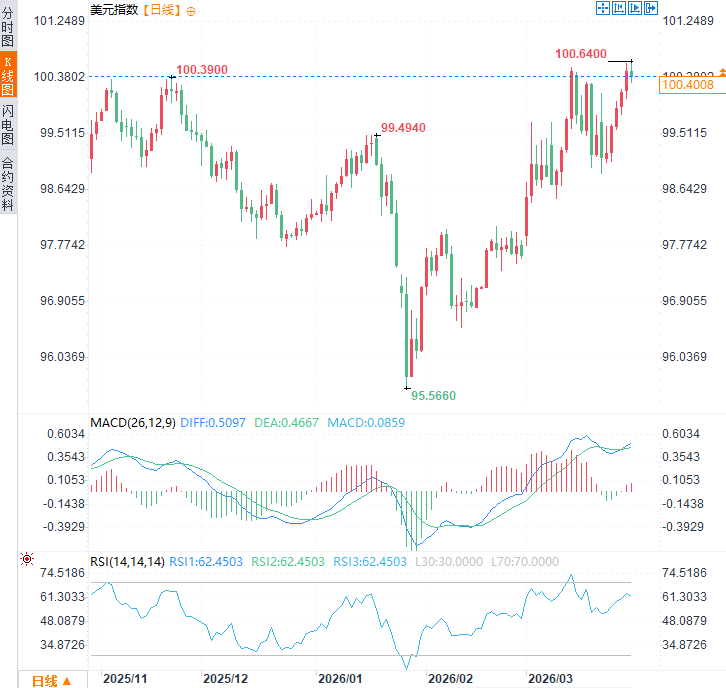
(US Dollar Index Daily Chart, Source: FX678)
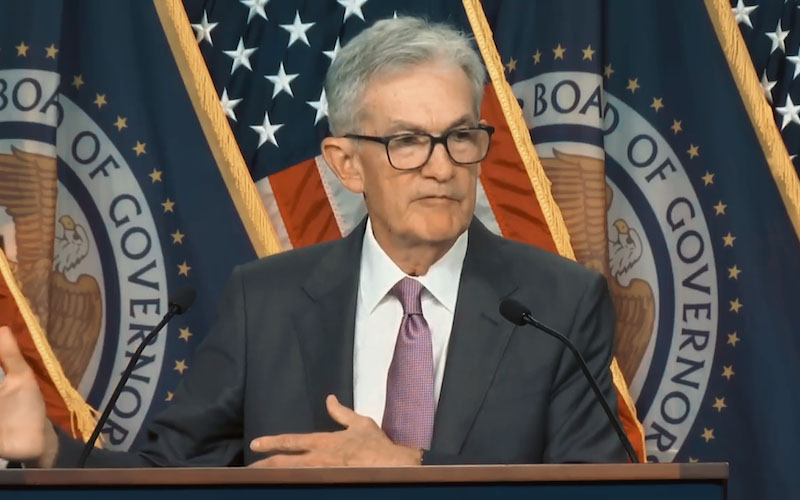
Federal Reserve Chairman Jerome Powell said on Monday that despite increased uncertainty in the Middle East, long-term U.S. inflation expectations remain well anchored, and the Fed’s current policy stance allows officials to assess the economic impact of the conflict in Iran.
New York Fed President John Williams said monetary policy is prepared for any exceptional circumstances, noting that the job market is still sending mixed signals.
French central bank governor François Villeroy de Galhau said on Monday that European Central Bank policymakers are prepared to act should energy-driven inflation spread. He also noted that the energy shock related to the Iran war is likely to be inflationary in the short term, but the ECB cannot prevent the initial price increase.
This statement highlights the European Central Bank's vigilance regarding persistently high energy prices, and also reflects the significant constraints on its policy space due to geopolitical risks .
The euro rebounded against the US dollar from a low of around 1.1468 in November 2025, reaching a high of 1.2081 in early February 2026. A significant pullback followed, and the price has now fallen to around 1.1477, approaching the previous support level. Overall, the price has fallen more than 600 pips from its high, entering a clear mid-term correction phase, currently in its later stages.
MACD: After the DIFF and DEA crossed near the zero axis, they flattened out again. Currently, the MACD histogram is close to the zero axis, indicating weak bullish and bearish momentum, and the market is in a wait-and-see state.
RSI(14): The RSI is currently in the neutral to weak range (30-50) and has not yet entered the oversold zone, indicating that the downward momentum has weakened, but the rebound strength is still insufficient.
The EUR/USD pair is currently consolidating above the strong support zone of 1.1410-1.1470. If it holds above this level, a short-term rebound is possible, with the first target at 1.1570-1.1700. A break below 1.1410 could lead to further testing of the lower support level of 1.1200-1.1300.
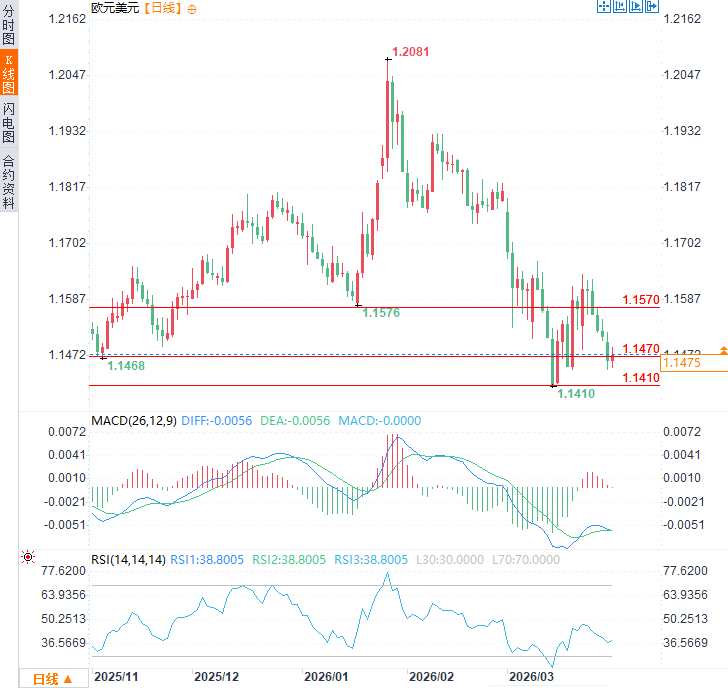
(Euro/USD daily chart, source: FX678)
The market is focused on German retail sales data for February and unemployment figures, as well as the Eurozone's preliminary Harmonized Index of Consumer Prices (HICP) for March, due later on Tuesday. These data will provide the latest clues about the state of the European economic recovery and inflationary pressures, directly impacting the euro's short-term trajectory.
Strong retail sales data or higher-than-expected HICP inflation could provide a temporary boost to the euro; conversely, weak data would exacerbate market concerns about a slowdown in the European economy.
At 10:29 Beijing time, the euro was trading at 1.1475/76 against the US dollar.
US Dollar Trends and Geopolitical Safe-Haven Demand
The euro halted its five-day losing streak against the dollar, mainly due to a pullback in the dollar after five consecutive days of gains. During Tuesday's Asian session, the dollar index touched a ten-month high of 100.64 before fluctuating downwards, currently trading at 100.40. However, ongoing tensions in the Middle East may reignite demand for the dollar as a safe-haven asset, limiting further euro gains.
The Wall Street Journal reports that US President Trump is open to ending the war with Iran, even if the Strait of Hormuz remains unreopened. This signal suggests a potential shift in US priorities, but the continued deployment of US troops to the Middle East indicates a mixed message in policy, and the risks to global energy flows have not been eliminated.
Trump's latest remarks suggest he is willing to end the war without reopening the Strait of Hormuz, but the continued deployment of US troops contrasts with this, highlighting policy uncertainty. How the market interprets this mixed signal will directly influence the strength of safe-haven demand for the US dollar.
(US Dollar Index Daily Chart, Source: FX678)
Latest views from Federal Reserve Chairman Powell and Williams
Federal Reserve Chairman Jerome Powell said on Monday that despite increased uncertainty in the Middle East, long-term U.S. inflation expectations remain well anchored, and the Fed’s current policy stance allows officials to assess the economic impact of the conflict in Iran.
New York Fed President John Williams said monetary policy is prepared for any exceptional circumstances, noting that the job market is still sending mixed signals.
French central bank governor Villeroy makes a statement
French central bank governor François Villeroy de Galhau said on Monday that European Central Bank policymakers are prepared to act should energy-driven inflation spread. He also noted that the energy shock related to the Iran war is likely to be inflationary in the short term, but the ECB cannot prevent the initial price increase.
This statement highlights the European Central Bank's vigilance regarding persistently high energy prices, and also reflects the significant constraints on its policy space due to geopolitical risks .
Technical Analysis
The euro rebounded against the US dollar from a low of around 1.1468 in November 2025, reaching a high of 1.2081 in early February 2026. A significant pullback followed, and the price has now fallen to around 1.1477, approaching the previous support level. Overall, the price has fallen more than 600 pips from its high, entering a clear mid-term correction phase, currently in its later stages.
MACD: After the DIFF and DEA crossed near the zero axis, they flattened out again. Currently, the MACD histogram is close to the zero axis, indicating weak bullish and bearish momentum, and the market is in a wait-and-see state.
RSI(14): The RSI is currently in the neutral to weak range (30-50) and has not yet entered the oversold zone, indicating that the downward momentum has weakened, but the rebound strength is still insufficient.
The EUR/USD pair is currently consolidating above the strong support zone of 1.1410-1.1470. If it holds above this level, a short-term rebound is possible, with the first target at 1.1570-1.1700. A break below 1.1410 could lead to further testing of the lower support level of 1.1200-1.1300.
(Euro/USD daily chart, source: FX678)
Key data to watch in the future
The market is focused on German retail sales data for February and unemployment figures, as well as the Eurozone's preliminary Harmonized Index of Consumer Prices (HICP) for March, due later on Tuesday. These data will provide the latest clues about the state of the European economic recovery and inflationary pressures, directly impacting the euro's short-term trajectory.
Strong retail sales data or higher-than-expected HICP inflation could provide a temporary boost to the euro; conversely, weak data would exacerbate market concerns about a slowdown in the European economy.
At 10:29 Beijing time, the euro was trading at 1.1475/76 against the US dollar.
- Risk Warning and Disclaimer
- The market involves risk, and trading may not be suitable for all investors. This article is for reference only and does not constitute personal investment advice, nor does it take into account certain users’ specific investment objectives, financial situation, or other needs. Any investment decisions made based on this information are at your own risk.