The pound has seen a slight rebound, but the overall downward trend has not yet reversed.
2026-04-02 11:28:25
The pound rose 0.57% against the dollar on Wednesday to 1.3298, reflecting what the market calls "moderate trading." Those with dollar payment needs should consider whether to act immediately or place exchange rate orders to capture potential further appreciation.
For traders who need to pay in US dollars, yesterday's exchange rate movement provided some improvement, but the trend throughout March shows that such gains tend to reverse quickly.
This potential shift is largely driven by narrative: US President Trump has moved from rhetoric escalating the conflict to suggesting a deal may be imminent. The Iranian government had previously expressed a willingness to end the war, but only under certain conditions, a claim it quickly denied.
Nevertheless, there are enough signs of easing in the market to prompt investors to shift towards risk-on trading: the dollar is weakening and the pound is strengthening.
When asked, “How should investors weigh major news events in front of them?” Marko Papic, chief strategist at BCA Research, replied, “Stick to the facts.”
Papich pointed out: "The first fact we want to emphasize is that shipping volumes through the Strait of Hormuz have clearly rebounded in the past few days. To say we are on the road to normal would be a cruel joke; but it would also be incorrect to say there has been no perceptible improvement in shipping volumes."
He stated, "The market will react to the second derivative, which is an improvement in the rate of change." One specific manifestation of this improvement is the rise in the pound sterling against the dollar.
However, this optimism about weakening the dollar still needs to face reality: the fundamentals on the ground have not changed fundamentally, and the attacks from both sides continue.
The Iranian Islamic Revolutionary Guard Corps has confirmed that the Strait of Hormuz remains under its "decisive and dominant" control; the United Arab Emirates and Saudi Arabia are unlikely to accept this status quo indefinitely.
Papich believes that "the United Arab Emirates is seeking to use force to reopen the Straits. In our view, even if the United States eventually withdraws its involvement, there will still be further pain in the future (at least in terms of oil prices and related interest rates), because most of the concessions will be made by the United States, especially relinquishing control of the Straits to an angry Iran."
Therefore, there remains sufficient tension and uncertainty, which will limit the downside for the dollar and curb further gains in the pound against the dollar.
While the risk-reward ratio favors moderate trading in the short term, it's worth remembering a similar false breakout in March, where each instance of optimism was followed by a sharp pullback, further extending the downtrend. This suggests that the current market is more likely in a consolidation phase or a period of easing, rather than a genuine trend reversal.
For anyone who needs to manage dollar payments—whether buying property, settling invoices, or making remittances—this two-way volatility is precisely the environment in which market orders or exchange rate alerts can play a role. It is advisable to consider working with a dedicated trader to place orders at target exchange rate levels, rather than simply waiting and watching.
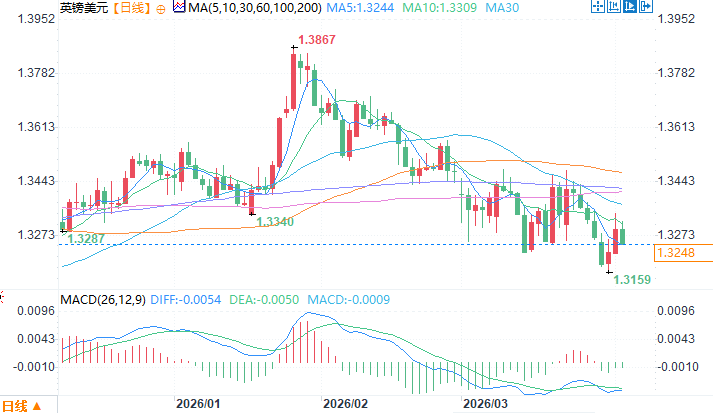
GBP/USD daily chart source: FX678
At 11:27 AM Beijing time on April 2nd, the British pound was trading at 1.3243/44 against the US dollar.
For traders who need to pay in US dollars, yesterday's exchange rate movement provided some improvement, but the trend throughout March shows that such gains tend to reverse quickly.
This potential shift is largely driven by narrative: US President Trump has moved from rhetoric escalating the conflict to suggesting a deal may be imminent. The Iranian government had previously expressed a willingness to end the war, but only under certain conditions, a claim it quickly denied.
Nevertheless, there are enough signs of easing in the market to prompt investors to shift towards risk-on trading: the dollar is weakening and the pound is strengthening.
When asked, “How should investors weigh major news events in front of them?” Marko Papic, chief strategist at BCA Research, replied, “Stick to the facts.”
Papich pointed out: "The first fact we want to emphasize is that shipping volumes through the Strait of Hormuz have clearly rebounded in the past few days. To say we are on the road to normal would be a cruel joke; but it would also be incorrect to say there has been no perceptible improvement in shipping volumes."
He stated, "The market will react to the second derivative, which is an improvement in the rate of change." One specific manifestation of this improvement is the rise in the pound sterling against the dollar.
However, this optimism about weakening the dollar still needs to face reality: the fundamentals on the ground have not changed fundamentally, and the attacks from both sides continue.
The Iranian Islamic Revolutionary Guard Corps has confirmed that the Strait of Hormuz remains under its "decisive and dominant" control; the United Arab Emirates and Saudi Arabia are unlikely to accept this status quo indefinitely.
Papich believes that "the United Arab Emirates is seeking to use force to reopen the Straits. In our view, even if the United States eventually withdraws its involvement, there will still be further pain in the future (at least in terms of oil prices and related interest rates), because most of the concessions will be made by the United States, especially relinquishing control of the Straits to an angry Iran."
Therefore, there remains sufficient tension and uncertainty, which will limit the downside for the dollar and curb further gains in the pound against the dollar.
While the risk-reward ratio favors moderate trading in the short term, it's worth remembering a similar false breakout in March, where each instance of optimism was followed by a sharp pullback, further extending the downtrend. This suggests that the current market is more likely in a consolidation phase or a period of easing, rather than a genuine trend reversal.
For anyone who needs to manage dollar payments—whether buying property, settling invoices, or making remittances—this two-way volatility is precisely the environment in which market orders or exchange rate alerts can play a role. It is advisable to consider working with a dedicated trader to place orders at target exchange rate levels, rather than simply waiting and watching.
GBP/USD daily chart source: FX678
At 11:27 AM Beijing time on April 2nd, the British pound was trading at 1.3243/44 against the US dollar.
- Risk Warning and Disclaimer
- The market involves risk, and trading may not be suitable for all investors. This article is for reference only and does not constitute personal investment advice, nor does it take into account certain users’ specific investment objectives, financial situation, or other needs. Any investment decisions made based on this information are at your own risk.