Trump signals major ceasefire! Oil prices plummet, Asian stock markets rallied.
2026-04-08 11:21:01
Asian markets breathed a sigh of relief on Wednesday (April 8) after US President Trump announced a temporary ceasefire agreement with Iran. Trump stated that he agreed to suspend military attacks on Iran for two weeks on the condition that Iran immediately reopen the Strait of Hormuz.
Iran’s Supreme National Security Council has agreed to allow ships to “pass safely” through the strait and said negotiations with the United States will begin this Friday, quickly easing market concerns about a long-term energy supply disruption.
Asian stock markets saw a significant relief rally following the ceasefire announcement. Risk appetite improved markedly, with Japan's Nikkei index rising 4.7% in early trading, South Korea's KOSPI index gaining approximately 5.5% (led by chip stocks), and Australia's S&P/ASX 200 index rising nearly 3%.
Market participants have been anticipating any positive signs for weeks, and the ceasefire announcement was seen as a concrete step toward de-escalation, driving risk assets sharply higher.
Oil prices have fallen sharply, with WTI crude oil down about 15% and currently trading around $95.77 per barrel; Brent crude oil down about 13.6% and currently trading around $95 per barrel, both falling below the $100 mark.
Analysts point out that the drop in oil prices has directly eased consumers' energy cost pressures, eased inflation expectations, and removed one of the biggest obstacles that has weighed on the stock market in recent weeks.
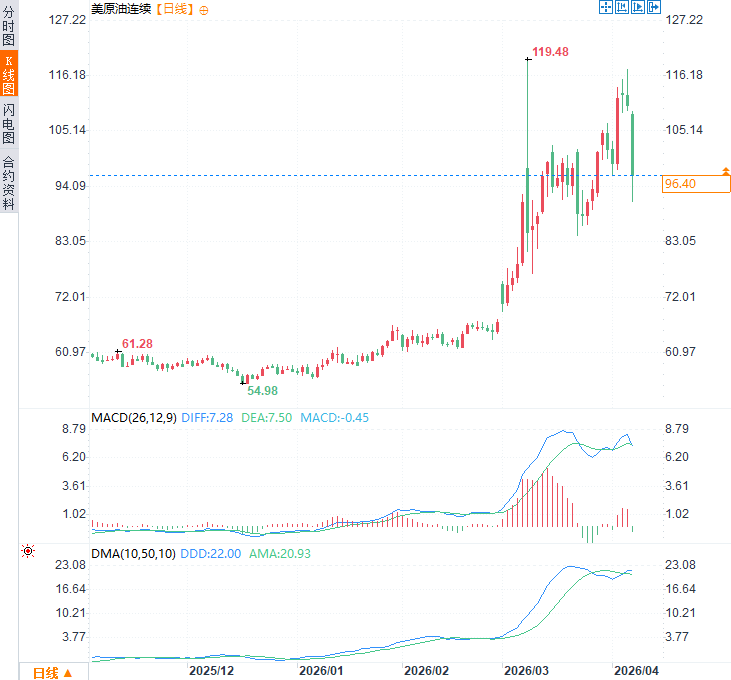
(US crude oil daily chart, source: FX678)
Asian government bond prices rose (yields fell), with the yield on 10-year Japanese government bonds falling 4.5 basis points to 2.360%; the yield on 10-year Australian sovereign bonds falling 10 basis points to 4.8880%; and the yield on 10-year New Zealand government bonds falling 9 basis points to 4.6330%.
Most Asian currencies strengthened against the US dollar. The US dollar fell about 0.8% against the Japanese yen to around 158.35; the US dollar fell about 1.4% against the South Korean won to around 1476.06; the Australian dollar rose about 1% against the US dollar to around 0.7045; and the New Zealand dollar rose about 1.4% against the US dollar to around 0.5800.
Despite the positive market reaction, analysts remain generally cautious. "These developments are clearly constructive, but the bigger test is whether this will evolve into a lasting agreement or just a fragile pause," said Charle Chanana of Saxo Bank.
eToro's Josh Gilbert warned: "If two weeks pass without an agreement, this relief rally is expected to reverse sharply and relentlessly."
Michael Brown of Pepperstone also pointed out that market participants are eager to see concrete steps to de-escalate the situation, and what we are seeing now are only initial positive signs.
Trump's announcement of a two-week temporary ceasefire with Iran and his demand for the immediate reopening of the Strait of Hormuz quickly boosted Asian stock markets and pushed oil prices sharply lower. Oil prices fell below the $100 mark, and risk appetite rebounded significantly. However, analysts cautioned that this ceasefire is only a two-week window, and the possibility of a lasting agreement remains uncertain. If the strait fails to reopen substantially or the agreement breaks down, the market rebound could quickly reverse, and the global energy and economic growth outlook will continue to face challenges.
At 11:20 Beijing time, US crude oil futures were trading at $95.70 per barrel.
Iran’s Supreme National Security Council has agreed to allow ships to “pass safely” through the strait and said negotiations with the United States will begin this Friday, quickly easing market concerns about a long-term energy supply disruption.
Asian stocks rebounded strongly.
Asian stock markets saw a significant relief rally following the ceasefire announcement. Risk appetite improved markedly, with Japan's Nikkei index rising 4.7% in early trading, South Korea's KOSPI index gaining approximately 5.5% (led by chip stocks), and Australia's S&P/ASX 200 index rising nearly 3%.
Market participants have been anticipating any positive signs for weeks, and the ceasefire announcement was seen as a concrete step toward de-escalation, driving risk assets sharply higher.
Oil prices fell sharply
Oil prices have fallen sharply, with WTI crude oil down about 15% and currently trading around $95.77 per barrel; Brent crude oil down about 13.6% and currently trading around $95 per barrel, both falling below the $100 mark.
Analysts point out that the drop in oil prices has directly eased consumers' energy cost pressures, eased inflation expectations, and removed one of the biggest obstacles that has weighed on the stock market in recent weeks.
(US crude oil daily chart, source: FX678)
Bond and money market performance
Asian government bond prices rose (yields fell), with the yield on 10-year Japanese government bonds falling 4.5 basis points to 2.360%; the yield on 10-year Australian sovereign bonds falling 10 basis points to 4.8880%; and the yield on 10-year New Zealand government bonds falling 9 basis points to 4.6330%.
Most Asian currencies strengthened against the US dollar. The US dollar fell about 0.8% against the Japanese yen to around 158.35; the US dollar fell about 1.4% against the South Korean won to around 1476.06; the Australian dollar rose about 1% against the US dollar to around 0.7045; and the New Zealand dollar rose about 1.4% against the US dollar to around 0.5800.
Analysts are cautiously optimistic
Despite the positive market reaction, analysts remain generally cautious. "These developments are clearly constructive, but the bigger test is whether this will evolve into a lasting agreement or just a fragile pause," said Charle Chanana of Saxo Bank.
eToro's Josh Gilbert warned: "If two weeks pass without an agreement, this relief rally is expected to reverse sharply and relentlessly."
Michael Brown of Pepperstone also pointed out that market participants are eager to see concrete steps to de-escalate the situation, and what we are seeing now are only initial positive signs.
Editor's Summary
Trump's announcement of a two-week temporary ceasefire with Iran and his demand for the immediate reopening of the Strait of Hormuz quickly boosted Asian stock markets and pushed oil prices sharply lower. Oil prices fell below the $100 mark, and risk appetite rebounded significantly. However, analysts cautioned that this ceasefire is only a two-week window, and the possibility of a lasting agreement remains uncertain. If the strait fails to reopen substantially or the agreement breaks down, the market rebound could quickly reverse, and the global energy and economic growth outlook will continue to face challenges.
At 11:20 Beijing time, US crude oil futures were trading at $95.70 per barrel.
- Risk Warning and Disclaimer
- The market involves risk, and trading may not be suitable for all investors. This article is for reference only and does not constitute personal investment advice, nor does it take into account certain users’ specific investment objectives, financial situation, or other needs. Any investment decisions made based on this information are at your own risk.