Strong US retail sales coupled with ongoing tensions in the Middle East kept the US dollar index in a strong and volatile state.
2026-04-22 11:22:09
The US dollar index remained stable during Wednesday's Asian trading session, hovering around 98.40. After a slight rise in the previous session, the dollar's overall performance remained robust, with market sentiment balanced between fundamental support and geopolitical uncertainty.

From a context perspective, the situation in the Middle East remains a crucial variable for the current market. The US has indicated it will extend the ceasefire to buy time for negotiations, but will maintain its blockade of the relevant waters, leaving the situation in a state of "coexistence of de-escalation and tension." Meanwhile, negotiations have stalled, and some diplomatic arrangements have been cancelled, causing the market to remain cautious about future developments. This uncertainty continues to support safe-haven demand, thus providing some support for the US dollar.
Furthermore, statements from the military have further exacerbated market tensions. Strong signals from relevant parties suggest that the risk of conflict has not yet been eliminated, making it difficult for the market to fully shift to a risk-averse environment. Against this backdrop, the US dollar, as the world's primary reserve currency, has once again demonstrated its safe-haven appeal. This demand for safe-haven assets provides a floor for the dollar index , keeping it relatively strong amidst volatility.
From a macroeconomic perspective, the performance of the US economy remains a significant support factor for the US dollar. Market surveys show that US retail sales rose 1.7% month-on-month in March, significantly higher than the market expectation of 1.4% and also higher than the revised 0.7% of the previous month. Year-on-year, retail sales grew by 4.0% , indicating that consumer demand remains robust. Strong consumer data reinforces market assessments of the resilience of the US economy and, to some extent, enhances the attractiveness of the US dollar.
From a market perspective, the US dollar is currently driven by two factors. On the one hand, geopolitical uncertainty is increasing demand for safe-haven assets; on the other hand, strong economic data is supporting fundamentals. This combination gives the dollar a relative advantage in the current environment. However, it should be noted that if the situation in the Middle East eases significantly, or if market expectations for Federal Reserve policy change, the dollar's momentum may be affected.
From a technical perspective, the daily chart shows that the US dollar index has entered a consolidation phase after rebounding from its previous lows, with the overall structure gradually stabilizing. The 98.00 level forms an important support level , having been tested multiple times and found support, indicating relatively solid buying pressure below. Resistance is concentrated around 99.00, an area that has previously limited gains. Looking at the moving average structure, short-term moving averages are beginning to flatten, while medium-term moving averages are still trending downwards, reflecting that the market is in a correction phase rather than a trending upward movement.
From a 4-hour chart perspective, the US dollar index is exhibiting a sideways consolidation pattern, fluctuating between 98.20 and 98.60. Technically, the RSI remains around 50, indicating a relatively balanced power between buyers and sellers; the MACD is repeatedly crossing near the zero line, lacking a clear directional signal. If the price can break through and hold above 98.60, it may test the 99.00 area; conversely, if it breaks below the 98.00 support, it may fall back to around 97.60.
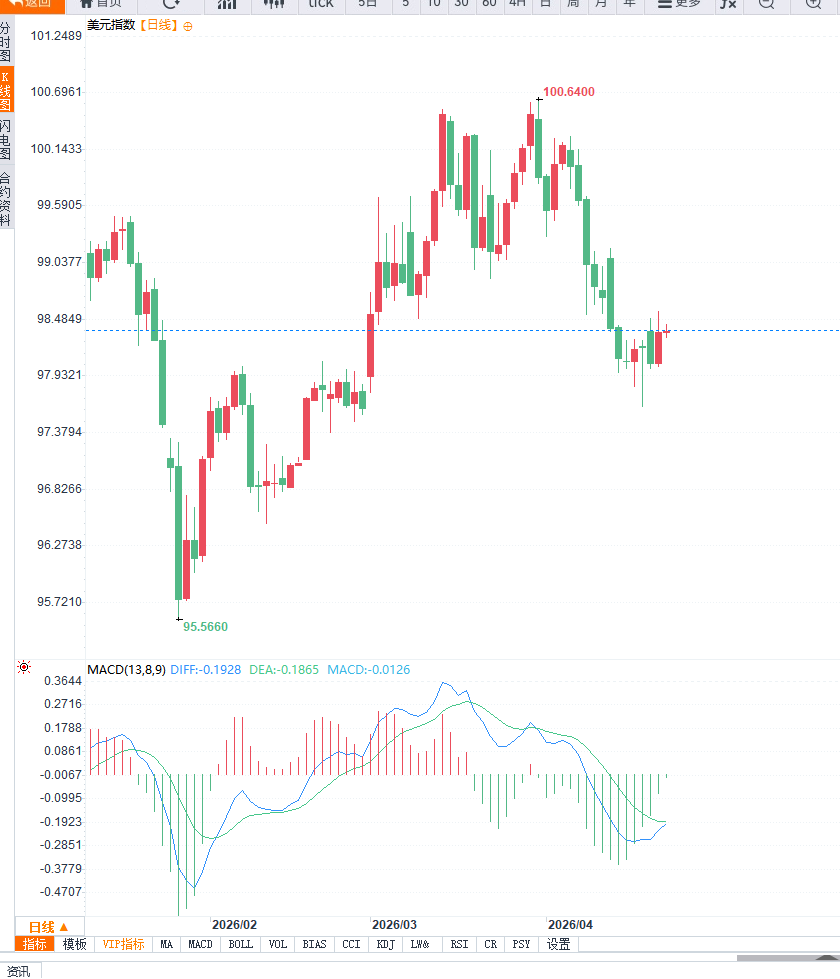
Overall, the US dollar index is currently in a state of equilibrium between "data support and risk aversion," and is likely to maintain a range-bound trading pattern in the short term.
Editor's Summary : The US dollar index is currently showing strong resilience, remaining stable supported by uncertainty in the Middle East and strong US economic data. In the short term, the dollar's trajectory will continue to be influenced by both geopolitical risks and macroeconomic data, with its direction remaining unclear. Going forward, close attention should be paid to developments in the situation and economic data performance. If risk sentiment persists, the dollar may maintain its strength; if uncertainty eases, it may enter a period of adjustment.
From a context perspective, the situation in the Middle East remains a crucial variable for the current market. The US has indicated it will extend the ceasefire to buy time for negotiations, but will maintain its blockade of the relevant waters, leaving the situation in a state of "coexistence of de-escalation and tension." Meanwhile, negotiations have stalled, and some diplomatic arrangements have been cancelled, causing the market to remain cautious about future developments. This uncertainty continues to support safe-haven demand, thus providing some support for the US dollar.
Furthermore, statements from the military have further exacerbated market tensions. Strong signals from relevant parties suggest that the risk of conflict has not yet been eliminated, making it difficult for the market to fully shift to a risk-averse environment. Against this backdrop, the US dollar, as the world's primary reserve currency, has once again demonstrated its safe-haven appeal. This demand for safe-haven assets provides a floor for the dollar index , keeping it relatively strong amidst volatility.
From a macroeconomic perspective, the performance of the US economy remains a significant support factor for the US dollar. Market surveys show that US retail sales rose 1.7% month-on-month in March, significantly higher than the market expectation of 1.4% and also higher than the revised 0.7% of the previous month. Year-on-year, retail sales grew by 4.0% , indicating that consumer demand remains robust. Strong consumer data reinforces market assessments of the resilience of the US economy and, to some extent, enhances the attractiveness of the US dollar.
From a market perspective, the US dollar is currently driven by two factors. On the one hand, geopolitical uncertainty is increasing demand for safe-haven assets; on the other hand, strong economic data is supporting fundamentals. This combination gives the dollar a relative advantage in the current environment. However, it should be noted that if the situation in the Middle East eases significantly, or if market expectations for Federal Reserve policy change, the dollar's momentum may be affected.
From a technical perspective, the daily chart shows that the US dollar index has entered a consolidation phase after rebounding from its previous lows, with the overall structure gradually stabilizing. The 98.00 level forms an important support level , having been tested multiple times and found support, indicating relatively solid buying pressure below. Resistance is concentrated around 99.00, an area that has previously limited gains. Looking at the moving average structure, short-term moving averages are beginning to flatten, while medium-term moving averages are still trending downwards, reflecting that the market is in a correction phase rather than a trending upward movement.
From a 4-hour chart perspective, the US dollar index is exhibiting a sideways consolidation pattern, fluctuating between 98.20 and 98.60. Technically, the RSI remains around 50, indicating a relatively balanced power between buyers and sellers; the MACD is repeatedly crossing near the zero line, lacking a clear directional signal. If the price can break through and hold above 98.60, it may test the 99.00 area; conversely, if it breaks below the 98.00 support, it may fall back to around 97.60.
Overall, the US dollar index is currently in a state of equilibrium between "data support and risk aversion," and is likely to maintain a range-bound trading pattern in the short term.
Editor's Summary : The US dollar index is currently showing strong resilience, remaining stable supported by uncertainty in the Middle East and strong US economic data. In the short term, the dollar's trajectory will continue to be influenced by both geopolitical risks and macroeconomic data, with its direction remaining unclear. Going forward, close attention should be paid to developments in the situation and economic data performance. If risk sentiment persists, the dollar may maintain its strength; if uncertainty eases, it may enter a period of adjustment.
- Risk Warning and Disclaimer
- The market involves risk, and trading may not be suitable for all investors. This article is for reference only and does not constitute personal investment advice, nor does it take into account certain users’ specific investment objectives, financial situation, or other needs. Any investment decisions made based on this information are at your own risk.