Safe-haven demand is supporting the dollar to remain range-bound, awaiting stabilization.
2026-05-01 11:50:22
The US dollar index rose slightly during Friday's Asian trading session, hovering around 98.15. Its overall movement was influenced by two forces: hawkish signals from the Federal Reserve and a resurgence in safe-haven demand due to geopolitical tensions in the Middle East.

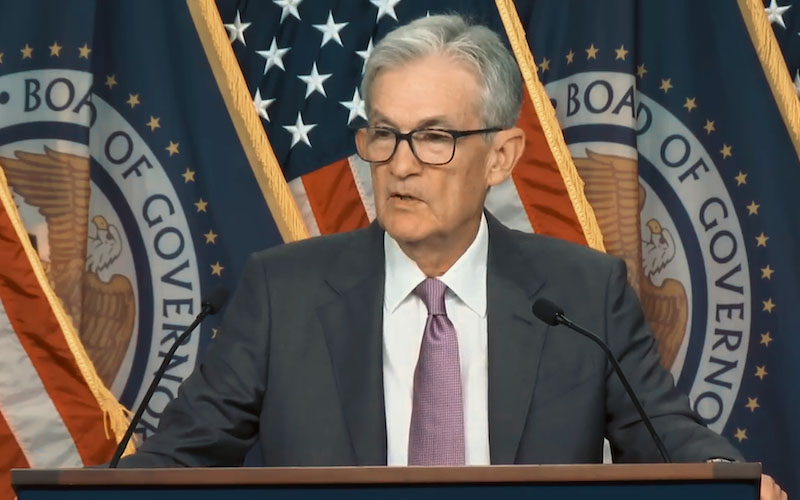
From a monetary policy perspective, the Federal Reserve maintained interest rates at 3.5% to 3.75% at its latest meeting, marking the third consecutive pause in rate hikes. In his speech, Powell emphasized the high degree of uncertainty surrounding the economic outlook and pointed out that the situation in the Middle East is impacting the inflation path, leaving the policy path open to both rate hikes and cuts. This "flexible two-way policy" stance was interpreted by the market as a hawkish position, strengthening short-term support for the US dollar.
Meanwhile, several Federal Reserve officials emphasized that current policy is in a "good range," but the secondary impact of energy prices on inflation still needs to be observed. This has further cooled market expectations for short-term interest rate cuts, thus supporting the dollar's continued strength.
Geopolitically, continued tensions in the Middle East, particularly the uncertainty surrounding key shipping routes, have increased market demand for safe-haven assets. The US dollar, as one of the world's major safe-haven assets, has attracted short-term capital inflows, further boosting the index. However, this support is largely driven by sentiment, and its sustainability remains to be seen.
From a fundamental perspective, US economic data has put some downward pressure on the dollar. First-quarter GDP growth was 2.0%, lower than the market expectation of 2.3%. Although this was an improvement over the previous figure, it still indicates a marginal slowdown in economic momentum. The contradiction between growth and inflation has limited the dollar's upside potential.
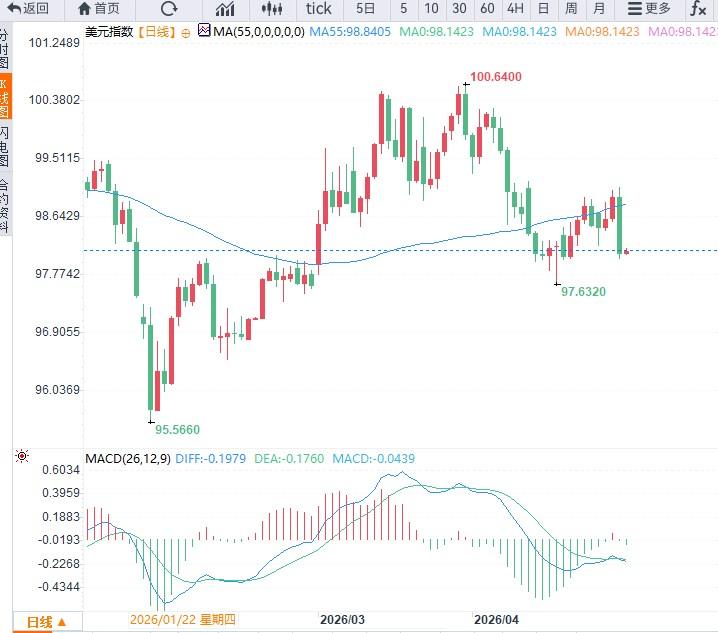
From a technical perspective, the US dollar index is showing a high-level consolidation pattern on the daily chart. After finding support around 97.50, the price rebounded and is currently trading above the 98 level, indicating that the bulls still hold the upper hand in the short term. However, the 98.50-98.80 area forms a significant resistance zone, which has been tested multiple times without a decisive breakthrough, suggesting insufficient upward momentum.
In terms of indicators, the RSI remains in the neutral-to-strong zone, indicating that the momentum has not yet overheated; the MACD is above the zero line but the histogram is converging, indicating that the pace of the rise is slowing down. Overall, the trend is still strong, but it has entered a consolidation phase.
Editor's Viewpoint : The current US dollar trend exhibits a triple structure of "hawkish policy, safe-haven support, and slowing growth pressure." In the short term, the dollar remains resilient but lacks momentum for a trend breakout. If subsequent ISM manufacturing and non-farm payroll data continue to weaken, the dollar may enter a period of high-level consolidation or even a pullback; conversely, it may retest the 98.80 resistance area. The overall strategy remains range-bound, awaiting further guidance from fundamentals.
From a monetary policy perspective, the Federal Reserve maintained interest rates at 3.5% to 3.75% at its latest meeting, marking the third consecutive pause in rate hikes. In his speech, Powell emphasized the high degree of uncertainty surrounding the economic outlook and pointed out that the situation in the Middle East is impacting the inflation path, leaving the policy path open to both rate hikes and cuts. This "flexible two-way policy" stance was interpreted by the market as a hawkish position, strengthening short-term support for the US dollar.
Meanwhile, several Federal Reserve officials emphasized that current policy is in a "good range," but the secondary impact of energy prices on inflation still needs to be observed. This has further cooled market expectations for short-term interest rate cuts, thus supporting the dollar's continued strength.
Geopolitically, continued tensions in the Middle East, particularly the uncertainty surrounding key shipping routes, have increased market demand for safe-haven assets. The US dollar, as one of the world's major safe-haven assets, has attracted short-term capital inflows, further boosting the index. However, this support is largely driven by sentiment, and its sustainability remains to be seen.
From a fundamental perspective, US economic data has put some downward pressure on the dollar. First-quarter GDP growth was 2.0%, lower than the market expectation of 2.3%. Although this was an improvement over the previous figure, it still indicates a marginal slowdown in economic momentum. The contradiction between growth and inflation has limited the dollar's upside potential.
From a technical perspective, the US dollar index is showing a high-level consolidation pattern on the daily chart. After finding support around 97.50, the price rebounded and is currently trading above the 98 level, indicating that the bulls still hold the upper hand in the short term. However, the 98.50-98.80 area forms a significant resistance zone, which has been tested multiple times without a decisive breakthrough, suggesting insufficient upward momentum.
In terms of indicators, the RSI remains in the neutral-to-strong zone, indicating that the momentum has not yet overheated; the MACD is above the zero line but the histogram is converging, indicating that the pace of the rise is slowing down. Overall, the trend is still strong, but it has entered a consolidation phase.
Editor's Viewpoint : The current US dollar trend exhibits a triple structure of "hawkish policy, safe-haven support, and slowing growth pressure." In the short term, the dollar remains resilient but lacks momentum for a trend breakout. If subsequent ISM manufacturing and non-farm payroll data continue to weaken, the dollar may enter a period of high-level consolidation or even a pullback; conversely, it may retest the 98.80 resistance area. The overall strategy remains range-bound, awaiting further guidance from fundamentals.
- Risk Warning and Disclaimer
- The market involves risk, and trading may not be suitable for all investors. This article is for reference only and does not constitute personal investment advice, nor does it take into account certain users’ specific investment objectives, financial situation, or other needs. Any investment decisions made based on this information are at your own risk.