Alarm bells are ringing! The Reserve Bank of Australia is about to raise interest rates for the third consecutive time. What will become of the Australian dollar amid war-induced inflation?
2026-05-05 11:22:57
On Tuesday (May 5th) in Asian trading, global financial markets focused their attention on the Reserve Bank of Australia (RBA). The central bank was about to hold its highly anticipated monetary policy meeting and planned to officially announce its interest rate decision at 12:30 PM Beijing time on Tuesday. According to widespread market expectations, the RBA Board of Governors would announce a 25 basis point interest rate hike at this meeting. If this prediction comes true, it would be the bank's third consecutive rate hike. After the rate hike, Australia's official cash rate will rise from the current 4.1% to 4.35%. Although this change has been priced in by some market analysts, its actual impact on the economy and people's livelihoods should not be underestimated.
As with every major interest rate adjustment, the Reserve Bank of Australia (RBA) will release a detailed policy statement along with its decision. This document will reveal the core viewpoints, differing opinions, and the logical chain that ultimately led to the rate hike decision among the Board of Governors members during closed-door discussions.
Following the statement, President Michelle Bullock will personally host a press conference. Market analysts and journalists are closely watching her wording and statements during the Q&A session, as Bullock is highly likely to reveal more about officials' latest assessment of the current macroeconomic situation and their potential outlook for monetary policy in the coming months. This information is crucial for determining whether the current rate hike cycle is nearing its end or whether further tightening policies are on the horizon.
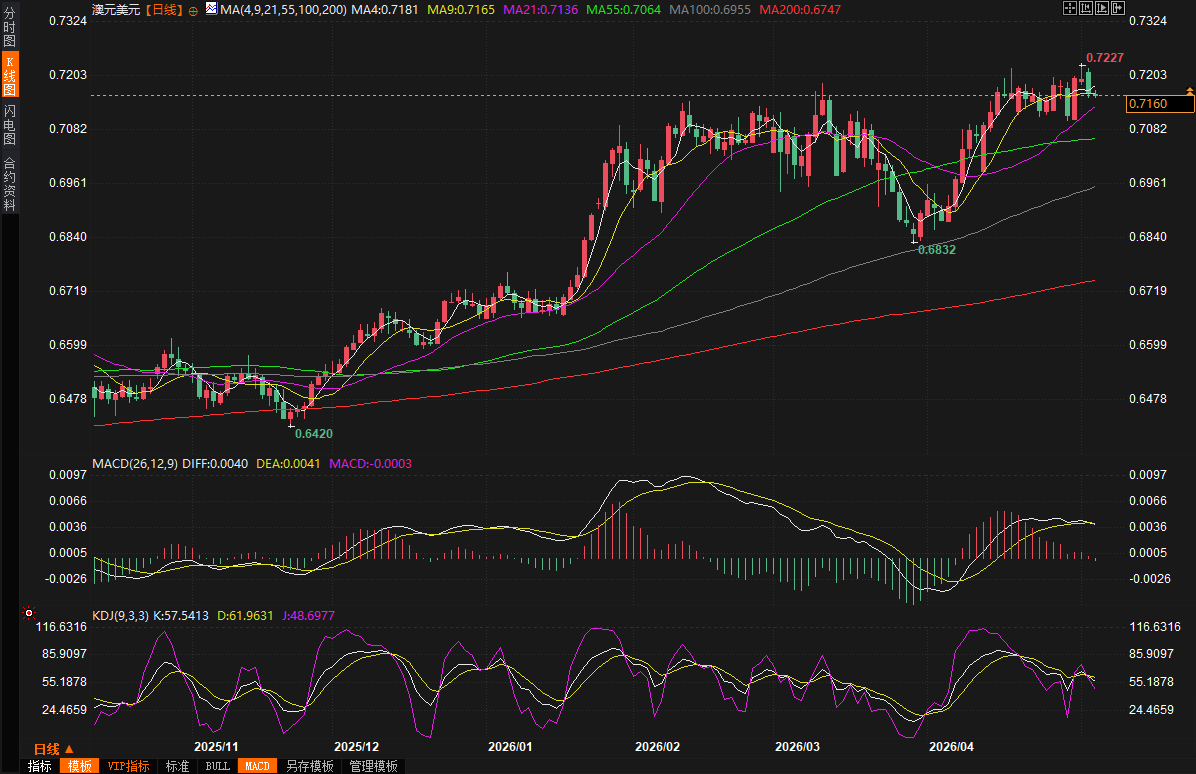
The Australian dollar's movement was significantly influenced by external geopolitical factors even before the official interest rate announcement. The Australian dollar is currently trading around 0.7160 against the US dollar, having touched 0.7227 on Friday, a new high since 2022, but fell sharply on Monday. As market concerns about a larger-scale conflict in Iran continue to escalate, many investors have chosen to sell relatively riskier assets and allocate funds to traditional safe-haven instruments. Against this backdrop, the Australian dollar has shown a weaker trend in trading this week. Although the Australian dollar exchange rate had previously hovered near multi-year highs, the bullish momentum has shown clear signs of weakening, and a strong breakout is unlikely in the short term.
To understand the inevitability of this round of interest rate hikes, it is essential to identify the primary driving force behind them—the wars and conflicts in the Middle East. In fact, this anticipated interest rate hike decision is highly correlated with the geopolitical situation.
Admittedly, the first rate hike in 2026 was indeed related to Australia's stubborn inflation and still tight labor market. At that time, policymakers generally expected price increases to remain above the target range for a considerable period of time.
However, what they failed to anticipate was that the outbreak of the war with Iran caused a sharp rise in international oil prices, which in turn pushed Australia's inflation rate to 4.6% year-on-year in March, the highest in more than two years. Faced with such severe price pressure, the Reserve Bank of Australia had almost no choice but to respond by raising interest rates.
However, it's worth considering that raising interest rates cannot fundamentally solve the energy supply shock caused by war. At the same time, the interest rate hike will impose higher repayment costs on millions of Australian families with mortgages. These families are already burdened by soaring gas prices, and the increased mortgage payments represent a double blow.
Even if the Reserve Bank of Australia raises interest rates at every monetary policy meeting in 2026, it won't truly solve the fundamental problem driving inflation upwards. On the contrary, continued tightening is likely to create even bigger problems, such as suppressing business investment, pushing up unemployment, and even triggering a recession, thus having a broader and more profound negative impact on the Australian economy. Ultimately, the February rate hike was primarily related to domestic inflationary pressures, but all rate hikes since then, including this one, are essentially a result of the external shock caused by the war with Iran. In other words, as long as the conflict in the Middle East continues, the shadow of high inflation will be difficult to dispel, and the Australian economy and ordinary households will find it hard to see the light at the end of the tunnel.
A research report from Commerzbank's strategy team indicates that overnight index swap pricing shows a 74% probability of the Reserve Bank of Australia (RBA) raising interest rates for the third consecutive time by 25 basis points. The market also anticipates a cumulative rate hike of 64 basis points by the end of the year. The team attributes this strong expectation to persistently high inflation. They expect inflation to remain above the official target range of 2% to 3% for some time, driven by rising fuel costs due to the war and continued strong domestic demand in Australia.
It's worth noting that if the Reserve Bank of Australia (RBA) raises interest rates while simultaneously issuing a policy statement with a significantly more hawkish tone, the Australian dollar may receive some support and experience a short-term upward trend. Ideally, the statement should reflect the Board's growing concern about the long-term impact of the war with Iran. Looking back at the minutes of the March meeting, officials noted that most members were worried that inflation expectations could lose their anchor if swift action wasn't taken. At that time, they agreed that further tightening of monetary policy would likely be necessary in the future. Therefore, if this statement continues or even strengthens this stance, Australian dollar bulls may have a chance to breathe.
According to technical analysis by Valeria Bednarik, chief analyst at FXStreet, the Australian dollar is currently trading around 0.7180 against the US dollar. This level is a pullback from the high of 0.7227 reached last week, which was the highest level since June 2022.
Bednarik points out that the US dollar has recently benefited temporarily from risk aversion due to the looming threat of a new Middle East conflict, but due to the volatile nature of related news, major currency pairs remain confined to relatively familiar trading ranges. Looking at short-term charts, the Australian dollar's bullish potential is gradually waning, but the likelihood of a significant decline is also limited. If the exchange rate tests the 21-day simple moving average currently around 0.7136, buyers are expected to enter the market. If this support level is broken, the Australian dollar may open a channel for further declines to the 0.7090 area, where the next wave of buyers will be waiting.
Conversely, if the Reserve Bank of Australia's (RBA) decision leans hawkish, the Australian dollar could potentially move back towards the aforementioned multi-year high of 0.7227 against the US dollar. A successful break above this level would expose the 0.7270 price range. However, Bednarik emphasizes that the RBA's interest rate decision alone is unlikely to generate sustained additional gains for the Australian dollar; the exchange rate's future direction will likely remain closely linked to war-related headlines.
In summary, the Reserve Bank of Australia's (RBA) upcoming third consecutive interest rate hike is both a reluctant continuation of its efforts to combat persistent inflation and a passive response to external geopolitical conflicts. For ordinary Australian households, this means higher mortgage costs and energy expenditures will simultaneously weigh on their shoulders. Regarding the Australian dollar's exchange rate, the rate hike itself has already been fully priced in by the market; the real variables lie in the hawkishness of the policy statement and the next developments in the Middle East. With the shadow of war still looming, both monetary policymakers and ordinary investors can only seek limited certainty amidst uncertainty.
Question 1: Why did the Reserve Bank of Australia have to raise interest rates for the third time in a row?
A: The core reason for the Reserve Bank of Australia's (RBA) continuous interest rate hikes is persistently high and higher-than-expected inflation. Initially, the rate hikes were mainly to address strong domestic demand and a tight labor market. However, the real trigger for the central bank's continued action was the surge in international oil prices caused by the Iran-Iraq War. After the outbreak of the war, Australia's inflation rate jumped to 4.6% year-on-year in March, the highest level in more than two years. Faced with such severe price pressures, the RBA had almost no other effective tools to quickly suppress inflation and could only choose to raise interest rates to curb aggregate demand. However, it should be clear that interest rate hikes cannot solve the energy supply shock caused by the war, so this is more like a passive and unavoidable response.
Question 2: How exactly do the Middle East wars affect Australia's inflation and interest rate decisions?
A: The Middle East war primarily impacted the Australian economy through energy price channels. Iran, as a major oil producer, became involved in the war, directly fueling international panic about potential supply disruptions and causing oil prices to surge. Although Australia is an energy exporter, its domestic fuel prices also fluctuate in line with international market prices. Higher fuel costs are first reflected in gasoline and diesel prices, then gradually spread to food, daily necessities, and various services through increased transportation costs. This caused Australia's inflation rate to rise even faster than before. Faced with this imported inflation, the Reserve Bank of Australia (RBA) judged that if it did not quickly raise interest rates, inflation expectations among businesses and the public might spiral out of control, creating a more persistent price spiral. Therefore, although the war did not occur on Australian soil, it profoundly influenced the RBA's interest rate decisions through energy price channels.
Question 3: What specific impacts will successive interest rate hikes have on ordinary Australian families?
A: The impact of successive interest rate hikes on ordinary families is mainly reflected in two aspects, forming a so-called double whammy. The first impact comes from the direct increase in mortgage costs. The vast majority of Australian homebuyers use floating-rate mortgages. When the Reserve Bank of Australia raises the cash rate, commercial banks quickly follow suit by adjusting mortgage rates, meaning that the monthly principal and interest payments will increase significantly. The second impact comes from soaring energy prices. Rising gas and petrol prices have already squeezed household daily expenses. The combination of these two factors has suddenly increased the financial pressure on many families. Funds that could have been used for consumption, savings, or investment now have to be used more for loan repayments and energy bill payments. This is particularly challenging for young families who have just bought a home and for low-income groups with slow income growth.
Question 4: What will happen to the Australian dollar exchange rate after the interest rate hike? Will it rise or fall?
A: The impact of interest rate hikes on the Australian dollar exchange rate is not one-way and clear. Since this rate hike has likely been priced in by the market in advance, the mere fact that the rate was raised by 25 basis points is unlikely to trigger significant fluctuations in the Australian dollar. The key factor truly determining the short-term direction of the Australian dollar lies in the overall tone of the Reserve Bank of Australia's policy statement and the governor's press conference. If the statement is clearly hawkish, for example, expressing high concerns about the inflation outlook or hinting at further room for rate hikes, the Australian dollar may find support and rise in the short term. Conversely, if the statement is dovish, for example, suggesting that this rate hike cycle is nearing its end, the Australian dollar may face some downward pressure. Furthermore, the medium-term trend of the Australian dollar will still be highly dependent on the development of the situation in the Middle East and changes in global risk sentiment.
Question 5: Besides raising interest rates, does the Reserve Bank of Australia have any other ways to deal with war-induced inflation?
A: Theoretically, the Reserve Bank of Australia (RBA) has more tools than just interest rate hikes to combat inflation. However, given the current context of energy inflation triggered by war, other tools have very limited effectiveness. For example, the central bank could use quantitative easing to reduce market liquidity, but this is essentially in line with interest rate hikes and is more complex to implement. Alternatively, the central bank could choose to remain on hold, hoping the war will end on its own and oil prices will fall, but this passive waiting strategy is extremely risky because if inflation expectations get out of control, it will require a much greater economic cost to reverse the situation. As for fiscal policy measures, such as reducing fuel taxes or providing energy subsidies, these fall under the jurisdiction of the federal government and are not within the RBA's authority. Therefore, while interest rate hikes cannot fundamentally solve the energy supply problems caused by war, they are currently the most feasible tool within the RBA's mandate to prevent inflation expectations from spiraling out of control.
At 11:21 Beijing time, the Australian dollar is trading at 0.7160/62 against the US dollar.
Policy Details: Key Signals from the Statement and Press Conference
As with every major interest rate adjustment, the Reserve Bank of Australia (RBA) will release a detailed policy statement along with its decision. This document will reveal the core viewpoints, differing opinions, and the logical chain that ultimately led to the rate hike decision among the Board of Governors members during closed-door discussions.
Following the statement, President Michelle Bullock will personally host a press conference. Market analysts and journalists are closely watching her wording and statements during the Q&A session, as Bullock is highly likely to reveal more about officials' latest assessment of the current macroeconomic situation and their potential outlook for monetary policy in the coming months. This information is crucial for determining whether the current rate hike cycle is nearing its end or whether further tightening policies are on the horizon.
The Australian dollar is under short-term pressure under the shadow of conflict.
The Australian dollar's movement was significantly influenced by external geopolitical factors even before the official interest rate announcement. The Australian dollar is currently trading around 0.7160 against the US dollar, having touched 0.7227 on Friday, a new high since 2022, but fell sharply on Monday. As market concerns about a larger-scale conflict in Iran continue to escalate, many investors have chosen to sell relatively riskier assets and allocate funds to traditional safe-haven instruments. Against this backdrop, the Australian dollar has shown a weaker trend in trading this week. Although the Australian dollar exchange rate had previously hovered near multi-year highs, the bullish momentum has shown clear signs of weakening, and a strong breakout is unlikely in the short term.
The root cause of interest rate hikes: a helpless move driven by energy inflation.
To understand the inevitability of this round of interest rate hikes, it is essential to identify the primary driving force behind them—the wars and conflicts in the Middle East. In fact, this anticipated interest rate hike decision is highly correlated with the geopolitical situation.
Admittedly, the first rate hike in 2026 was indeed related to Australia's stubborn inflation and still tight labor market. At that time, policymakers generally expected price increases to remain above the target range for a considerable period of time.
However, what they failed to anticipate was that the outbreak of the war with Iran caused a sharp rise in international oil prices, which in turn pushed Australia's inflation rate to 4.6% year-on-year in March, the highest in more than two years. Faced with such severe price pressure, the Reserve Bank of Australia had almost no choice but to respond by raising interest rates.
However, it's worth considering that raising interest rates cannot fundamentally solve the energy supply shock caused by war. At the same time, the interest rate hike will impose higher repayment costs on millions of Australian families with mortgages. These families are already burdened by soaring gas prices, and the increased mortgage payments represent a double blow.
Deep-seated dilemma: The fundamental contradiction that interest rate hikes cannot resolve.
Even if the Reserve Bank of Australia raises interest rates at every monetary policy meeting in 2026, it won't truly solve the fundamental problem driving inflation upwards. On the contrary, continued tightening is likely to create even bigger problems, such as suppressing business investment, pushing up unemployment, and even triggering a recession, thus having a broader and more profound negative impact on the Australian economy. Ultimately, the February rate hike was primarily related to domestic inflationary pressures, but all rate hikes since then, including this one, are essentially a result of the external shock caused by the war with Iran. In other words, as long as the conflict in the Middle East continues, the shadow of high inflation will be difficult to dispel, and the Australian economy and ordinary households will find it hard to see the light at the end of the tunnel.
Institutional View: Market Pricing Reflects High Probability of Interest Rate Hikes
A research report from Commerzbank's strategy team indicates that overnight index swap pricing shows a 74% probability of the Reserve Bank of Australia (RBA) raising interest rates for the third consecutive time by 25 basis points. The market also anticipates a cumulative rate hike of 64 basis points by the end of the year. The team attributes this strong expectation to persistently high inflation. They expect inflation to remain above the official target range of 2% to 3% for some time, driven by rising fuel costs due to the war and continued strong domestic demand in Australia.
Australian Dollar Outlook: Hawkish Tone May Provide Short-Term Support
It's worth noting that if the Reserve Bank of Australia (RBA) raises interest rates while simultaneously issuing a policy statement with a significantly more hawkish tone, the Australian dollar may receive some support and experience a short-term upward trend. Ideally, the statement should reflect the Board's growing concern about the long-term impact of the war with Iran. Looking back at the minutes of the March meeting, officials noted that most members were worried that inflation expectations could lose their anchor if swift action wasn't taken. At that time, they agreed that further tightening of monetary policy would likely be necessary in the future. Therefore, if this statement continues or even strengthens this stance, Australian dollar bulls may have a chance to breathe.
Technical Analysis: Key Levels and Possible Paths for the Australian Dollar Against the US Dollar
According to technical analysis by Valeria Bednarik, chief analyst at FXStreet, the Australian dollar is currently trading around 0.7180 against the US dollar. This level is a pullback from the high of 0.7227 reached last week, which was the highest level since June 2022.
Bednarik points out that the US dollar has recently benefited temporarily from risk aversion due to the looming threat of a new Middle East conflict, but due to the volatile nature of related news, major currency pairs remain confined to relatively familiar trading ranges. Looking at short-term charts, the Australian dollar's bullish potential is gradually waning, but the likelihood of a significant decline is also limited. If the exchange rate tests the 21-day simple moving average currently around 0.7136, buyers are expected to enter the market. If this support level is broken, the Australian dollar may open a channel for further declines to the 0.7090 area, where the next wave of buyers will be waiting.
Conversely, if the Reserve Bank of Australia's (RBA) decision leans hawkish, the Australian dollar could potentially move back towards the aforementioned multi-year high of 0.7227 against the US dollar. A successful break above this level would expose the 0.7270 price range. However, Bednarik emphasizes that the RBA's interest rate decision alone is unlikely to generate sustained additional gains for the Australian dollar; the exchange rate's future direction will likely remain closely linked to war-related headlines.
Summary and Outlook: The dawn at the end of the tunnel has not yet appeared.
In summary, the Reserve Bank of Australia's (RBA) upcoming third consecutive interest rate hike is both a reluctant continuation of its efforts to combat persistent inflation and a passive response to external geopolitical conflicts. For ordinary Australian households, this means higher mortgage costs and energy expenditures will simultaneously weigh on their shoulders. Regarding the Australian dollar's exchange rate, the rate hike itself has already been fully priced in by the market; the real variables lie in the hawkishness of the policy statement and the next developments in the Middle East. With the shadow of war still looming, both monetary policymakers and ordinary investors can only seek limited certainty amidst uncertainty.
Frequently Asked Questions
Question 1: Why did the Reserve Bank of Australia have to raise interest rates for the third time in a row?
A: The core reason for the Reserve Bank of Australia's (RBA) continuous interest rate hikes is persistently high and higher-than-expected inflation. Initially, the rate hikes were mainly to address strong domestic demand and a tight labor market. However, the real trigger for the central bank's continued action was the surge in international oil prices caused by the Iran-Iraq War. After the outbreak of the war, Australia's inflation rate jumped to 4.6% year-on-year in March, the highest level in more than two years. Faced with such severe price pressures, the RBA had almost no other effective tools to quickly suppress inflation and could only choose to raise interest rates to curb aggregate demand. However, it should be clear that interest rate hikes cannot solve the energy supply shock caused by the war, so this is more like a passive and unavoidable response.
Question 2: How exactly do the Middle East wars affect Australia's inflation and interest rate decisions?
A: The Middle East war primarily impacted the Australian economy through energy price channels. Iran, as a major oil producer, became involved in the war, directly fueling international panic about potential supply disruptions and causing oil prices to surge. Although Australia is an energy exporter, its domestic fuel prices also fluctuate in line with international market prices. Higher fuel costs are first reflected in gasoline and diesel prices, then gradually spread to food, daily necessities, and various services through increased transportation costs. This caused Australia's inflation rate to rise even faster than before. Faced with this imported inflation, the Reserve Bank of Australia (RBA) judged that if it did not quickly raise interest rates, inflation expectations among businesses and the public might spiral out of control, creating a more persistent price spiral. Therefore, although the war did not occur on Australian soil, it profoundly influenced the RBA's interest rate decisions through energy price channels.
Question 3: What specific impacts will successive interest rate hikes have on ordinary Australian families?
A: The impact of successive interest rate hikes on ordinary families is mainly reflected in two aspects, forming a so-called double whammy. The first impact comes from the direct increase in mortgage costs. The vast majority of Australian homebuyers use floating-rate mortgages. When the Reserve Bank of Australia raises the cash rate, commercial banks quickly follow suit by adjusting mortgage rates, meaning that the monthly principal and interest payments will increase significantly. The second impact comes from soaring energy prices. Rising gas and petrol prices have already squeezed household daily expenses. The combination of these two factors has suddenly increased the financial pressure on many families. Funds that could have been used for consumption, savings, or investment now have to be used more for loan repayments and energy bill payments. This is particularly challenging for young families who have just bought a home and for low-income groups with slow income growth.
Question 4: What will happen to the Australian dollar exchange rate after the interest rate hike? Will it rise or fall?
A: The impact of interest rate hikes on the Australian dollar exchange rate is not one-way and clear. Since this rate hike has likely been priced in by the market in advance, the mere fact that the rate was raised by 25 basis points is unlikely to trigger significant fluctuations in the Australian dollar. The key factor truly determining the short-term direction of the Australian dollar lies in the overall tone of the Reserve Bank of Australia's policy statement and the governor's press conference. If the statement is clearly hawkish, for example, expressing high concerns about the inflation outlook or hinting at further room for rate hikes, the Australian dollar may find support and rise in the short term. Conversely, if the statement is dovish, for example, suggesting that this rate hike cycle is nearing its end, the Australian dollar may face some downward pressure. Furthermore, the medium-term trend of the Australian dollar will still be highly dependent on the development of the situation in the Middle East and changes in global risk sentiment.
Question 5: Besides raising interest rates, does the Reserve Bank of Australia have any other ways to deal with war-induced inflation?
A: Theoretically, the Reserve Bank of Australia (RBA) has more tools than just interest rate hikes to combat inflation. However, given the current context of energy inflation triggered by war, other tools have very limited effectiveness. For example, the central bank could use quantitative easing to reduce market liquidity, but this is essentially in line with interest rate hikes and is more complex to implement. Alternatively, the central bank could choose to remain on hold, hoping the war will end on its own and oil prices will fall, but this passive waiting strategy is extremely risky because if inflation expectations get out of control, it will require a much greater economic cost to reverse the situation. As for fiscal policy measures, such as reducing fuel taxes or providing energy subsidies, these fall under the jurisdiction of the federal government and are not within the RBA's authority. Therefore, while interest rate hikes cannot fundamentally solve the energy supply problems caused by war, they are currently the most feasible tool within the RBA's mandate to prevent inflation expectations from spiraling out of control.
At 11:21 Beijing time, the Australian dollar is trading at 0.7160/62 against the US dollar.
- Risk Warning and Disclaimer
- The market involves risk, and trading may not be suitable for all investors. This article is for reference only and does not constitute personal investment advice, nor does it take into account certain users’ specific investment objectives, financial situation, or other needs. Any investment decisions made based on this information are at your own risk.