Easing tensions in the Middle East coupled with rising expectations of intervention have pushed the USD/JPY pair back to 157.65, putting short-term pressure on the currency.
2026-05-06 10:52:32
The USD/JPY pair continued its pullback during Wednesday's Asian session, falling to around 157.65. A weaker dollar was a major factor, primarily due to signs of easing tensions in the Middle East and improved market risk appetite, which diminished the dollar's safe-haven appeal. Previously, the US indicated it would pause related actions to observe whether an agreement could be reached, a statement that eased market tensions.
The United States has stated that it will suspend related actions in order to advance negotiations on the agreement.
Amidst a rebound in risk appetite, the yen, as a traditional safe-haven currency, has also received some support. Furthermore, policy signals from Japan have a significant impact on the exchange rate. Market expectations that the Japanese authorities may intervene in the foreign exchange market again continue to rise.
Japanese Finance Minister Satsuki Katayama stated that Japan can take action against speculative foreign exchange fluctuations.
Market analysts point out that a new round of intervention may be needed to significantly depress the dollar.
Rising expectations of intervention have made the market cautious about the upside potential of the USD/JPY pair, also increasing short-term volatility. Investors are more cautious with their positions at high levels, limiting the upside potential of the exchange rate.
Meanwhile, market focus is gradually shifting to the upcoming US employment data. The ADP employment data, followed by the non-farm payroll report, will provide the market with important clues about the state of the US economy. The market generally expects the US to add approximately 60,000 jobs in April, with the unemployment rate remaining around 4.3%. The performance of the employment data will directly influence market expectations regarding the interest rate path, thereby affecting the dollar's trajectory.
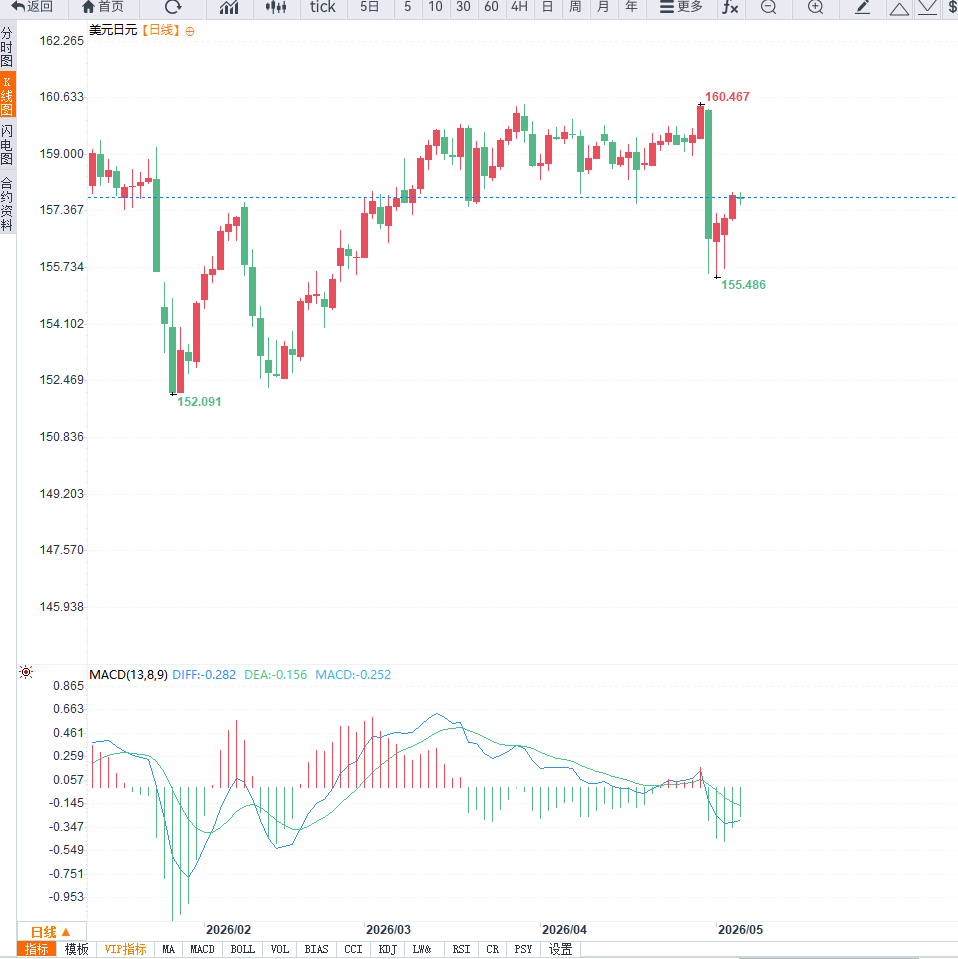
From a technical perspective, the USD/JPY pair shows signs of a high-level pullback on the daily chart. The exchange rate has retreated from its previous high, and short-term moving averages are flattening, indicating weakening upward momentum. The current price is around 157.50, with resistance levels at 158.50 and 160.00, and support levels around 156.50 and 155.00. The RSI indicator has fallen from its high to neutral territory, and the MACD has formed a death cross, indicating increased short-term downward pressure, but the overall trend has not yet fully turned bearish.
On the 4-hour chart, the exchange rate is exhibiting a downward trend with short-term moving averages turning downwards and the price trading below them, indicating that bearish momentum is dominant. The MACD remains below the zero line, and the RSI stays around 40, reflecting a weak market. If the exchange rate breaks below the 156.50 support level, it may further test the 155.00 area; conversely, if it rebounds and breaks through 158.50, it may retest the 160 level.
Editor's Summary:
The current USD/JPY exchange rate is influenced by multiple factors. On the one hand, the easing of tensions in the Middle East has reduced demand for the US dollar as a safe haven; on the other hand, expectations of intervention by Japanese authorities are putting downward pressure on the exchange rate. Policy expectations and macroeconomic data are the key variables driving short-term price movements. Going forward, close attention should be paid to US employment data and Japanese policy developments; the exchange rate is likely to maintain a highly volatile and volatile pattern.
The United States has stated that it will suspend related actions in order to advance negotiations on the agreement.
Amidst a rebound in risk appetite, the yen, as a traditional safe-haven currency, has also received some support. Furthermore, policy signals from Japan have a significant impact on the exchange rate. Market expectations that the Japanese authorities may intervene in the foreign exchange market again continue to rise.
Japanese Finance Minister Satsuki Katayama stated that Japan can take action against speculative foreign exchange fluctuations.
Market analysts point out that a new round of intervention may be needed to significantly depress the dollar.
Rising expectations of intervention have made the market cautious about the upside potential of the USD/JPY pair, also increasing short-term volatility. Investors are more cautious with their positions at high levels, limiting the upside potential of the exchange rate.
Meanwhile, market focus is gradually shifting to the upcoming US employment data. The ADP employment data, followed by the non-farm payroll report, will provide the market with important clues about the state of the US economy. The market generally expects the US to add approximately 60,000 jobs in April, with the unemployment rate remaining around 4.3%. The performance of the employment data will directly influence market expectations regarding the interest rate path, thereby affecting the dollar's trajectory.
From a technical perspective, the USD/JPY pair shows signs of a high-level pullback on the daily chart. The exchange rate has retreated from its previous high, and short-term moving averages are flattening, indicating weakening upward momentum. The current price is around 157.50, with resistance levels at 158.50 and 160.00, and support levels around 156.50 and 155.00. The RSI indicator has fallen from its high to neutral territory, and the MACD has formed a death cross, indicating increased short-term downward pressure, but the overall trend has not yet fully turned bearish.
On the 4-hour chart, the exchange rate is exhibiting a downward trend with short-term moving averages turning downwards and the price trading below them, indicating that bearish momentum is dominant. The MACD remains below the zero line, and the RSI stays around 40, reflecting a weak market. If the exchange rate breaks below the 156.50 support level, it may further test the 155.00 area; conversely, if it rebounds and breaks through 158.50, it may retest the 160 level.
Editor's Summary:
The current USD/JPY exchange rate is influenced by multiple factors. On the one hand, the easing of tensions in the Middle East has reduced demand for the US dollar as a safe haven; on the other hand, expectations of intervention by Japanese authorities are putting downward pressure on the exchange rate. Policy expectations and macroeconomic data are the key variables driving short-term price movements. Going forward, close attention should be paid to US employment data and Japanese policy developments; the exchange rate is likely to maintain a highly volatile and volatile pattern.
- Risk Warning and Disclaimer
- The market involves risk, and trading may not be suitable for all investors. This article is for reference only and does not constitute personal investment advice, nor does it take into account certain users’ specific investment objectives, financial situation, or other needs. Any investment decisions made based on this information are at your own risk.