Inflation concerns coupled with the upcoming Federal Reserve interest rate meeting have led to continued consolidation in gold prices.
2026-07-29 10:08:04
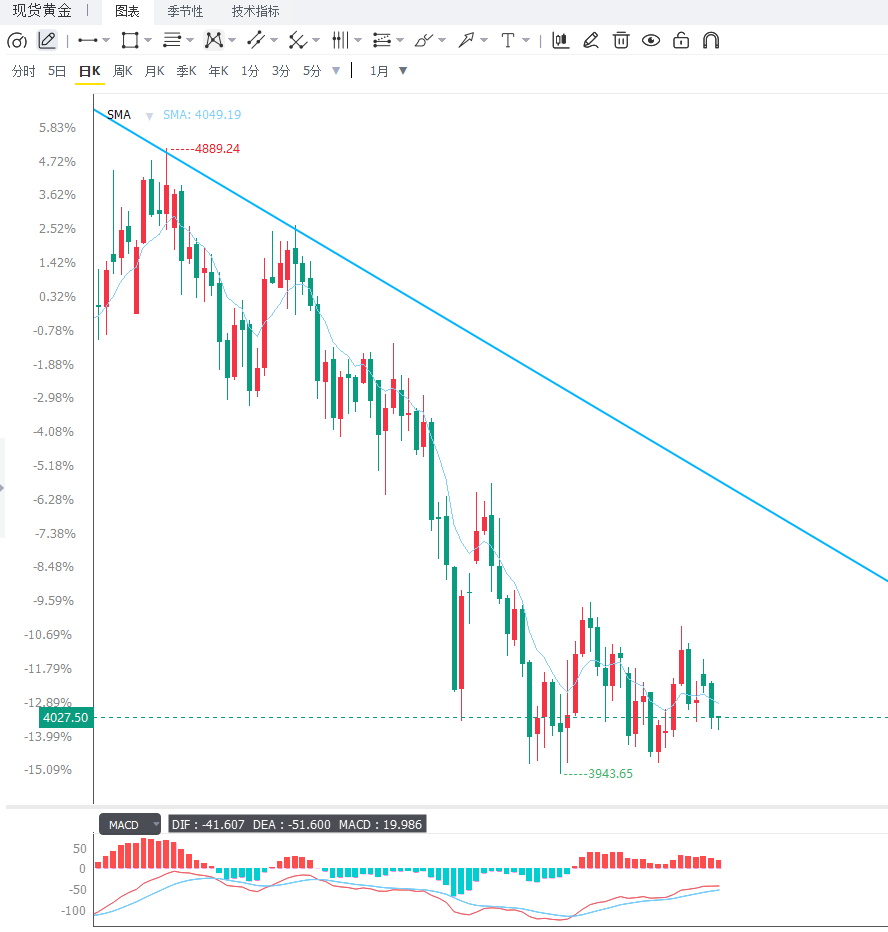
The international gold market was weak on Wednesday, with spot gold (XAU/USD) continuing to be pressured in Asian trading, hovering around $4,020 per ounce, marking its second consecutive day of decline. Despite a rise in global risk aversion, rising oil prices reignited concerns about inflationary pressures, causing investors to rebalance their demand for gold as a safe haven against interest rate pressures.  The recent situation in the Middle East has once again become a significant factor influencing the precious metals market. The market generally believes that the US action is related to previous military measures taken against Iranian naval forces, thus escalating regional tensions again. Geopolitical risks typically enhance gold's safe-haven appeal, but this time the market reaction did not fully drive up gold prices, primarily due to inflation concerns stemming from the synchronized rebound in oil prices. As a crucial global energy commodity, rising crude oil prices could increase future inflationary pressures and influence the pace of interest rate cuts by major central banks. Investors worry that if energy prices continue to rise, the Federal Reserve may need to maintain higher interest rates for an extended period, thereby diminishing the appeal of gold as a non-interest-bearing asset. Currently, market focus is on the Federal Reserve's upcoming monetary policy decision. The market widely expects the Fed to maintain interest rates at this meeting, but investors are closely watching the policy statement's statements regarding inflation, employment, and the future path of interest rates. Despite President Trump's repeated calls for lower interest rates, market trading data shows that investors remain cautious about future policy direction. There is significant disagreement in the market regarding short-term interest rate adjustments, with traders anticipating the possibility of policy changes in the near future, and market expectations for a September interest rate adjustment have clearly increased. The market currently estimates a 76.6% probability of an interest rate adjustment in September , indicating that investors still believe borrowing costs may remain high in the future. Looking at the dollar's performance, its recent results remain a significant factor influencing gold. Since gold is priced in dollars, a stronger dollar typically increases the cost for non-dollar investors to purchase gold, thus limiting the upside potential. However, if the Federal Reserve releases dovish signals in the future, putting downward pressure on the dollar, gold may regain upward momentum. Furthermore, the global economic growth outlook, changes in inflation data, and energy market volatility will continue to affect the medium- to long-term trend of gold. If Middle East risks continue to escalate, demand for gold as a safe haven may strengthen again; however, if rising oil prices lead to a renewed strengthening of high-interest-rate expectations in the market, gold may still face short-term downward pressure. Looking at the daily chart for spot gold, prices have recently corrected after consolidating at high levels and are currently trading around $4020, entering a short-term consolidation phase. From a trend structure perspective, gold remains in a high-level range-bound pattern; the bullish trend has not been completely broken, but upward momentum has weakened. The upside resistance level to watch is the $4050-$4080 area. A break above this area could see gold prices retest the resistance near $4100. Downside support levels to watch are the psychological level of $4000 and the $3970 area. A break below $4000 could see the market further retrace to around $3920. Daily momentum indicators suggest that the pace of gold's rise is slowing, and the market is awaiting new fundamental catalysts. The 4-hour chart shows that prices are under sustained selling pressure in the short term, with limited rebound strength, currently in a weak, range-bound structure. The MACD indicator shows signs of adjustment, short-term moving averages are trending downwards, and the RSI indicator is near neutral territory, indicating a temporary balance between bullish and bearish forces. If gold prices can regain a foothold above $4050, the short-term structure may shift towards a recovery, attempting to challenge the $4080 resistance level; however, if prices continue to be suppressed by $4020 and break below $4000, the pullback could widen, further seeking support below.
  Editor's Summary: The current gold price movement reflects the interplay between safe-haven demand and high interest rate pressures. While escalating tensions in the Middle East theoretically favor gold, rising oil prices and inflationary concerns have reinforced market expectations of a prolonged high-interest-rate environment, putting short-term pressure on gold. The future direction of gold still depends on three factors: whether Middle East risks escalate further, whether the Federal Reserve's policy signals shift towards easing, and changes in the US dollar's trajectory. If geopolitical risks continue to escalate while the Fed releases a more dovish policy stance, gold still has the potential to rise again; however, if inflationary pressures reignite due to rising energy prices, the market may continue to postpone easing expectations, and gold may face a period of adjustment. Overall, the long-term safe-haven logic for gold remains intact, but short-term price fluctuations will be significantly influenced by interest rate expectations.
The recent situation in the Middle East has once again become a significant factor influencing the precious metals market. The market generally believes that the US action is related to previous military measures taken against Iranian naval forces, thus escalating regional tensions again. Geopolitical risks typically enhance gold's safe-haven appeal, but this time the market reaction did not fully drive up gold prices, primarily due to inflation concerns stemming from the synchronized rebound in oil prices. As a crucial global energy commodity, rising crude oil prices could increase future inflationary pressures and influence the pace of interest rate cuts by major central banks. Investors worry that if energy prices continue to rise, the Federal Reserve may need to maintain higher interest rates for an extended period, thereby diminishing the appeal of gold as a non-interest-bearing asset. Currently, market focus is on the Federal Reserve's upcoming monetary policy decision. The market widely expects the Fed to maintain interest rates at this meeting, but investors are closely watching the policy statement's statements regarding inflation, employment, and the future path of interest rates. Despite President Trump's repeated calls for lower interest rates, market trading data shows that investors remain cautious about future policy direction. There is significant disagreement in the market regarding short-term interest rate adjustments, with traders anticipating the possibility of policy changes in the near future, and market expectations for a September interest rate adjustment have clearly increased. The market currently estimates a 76.6% probability of an interest rate adjustment in September , indicating that investors still believe borrowing costs may remain high in the future. Looking at the dollar's performance, its recent results remain a significant factor influencing gold. Since gold is priced in dollars, a stronger dollar typically increases the cost for non-dollar investors to purchase gold, thus limiting the upside potential. However, if the Federal Reserve releases dovish signals in the future, putting downward pressure on the dollar, gold may regain upward momentum. Furthermore, the global economic growth outlook, changes in inflation data, and energy market volatility will continue to affect the medium- to long-term trend of gold. If Middle East risks continue to escalate, demand for gold as a safe haven may strengthen again; however, if rising oil prices lead to a renewed strengthening of high-interest-rate expectations in the market, gold may still face short-term downward pressure. Looking at the daily chart for spot gold, prices have recently corrected after consolidating at high levels and are currently trading around $4020, entering a short-term consolidation phase. From a trend structure perspective, gold remains in a high-level range-bound pattern; the bullish trend has not been completely broken, but upward momentum has weakened. The upside resistance level to watch is the $4050-$4080 area. A break above this area could see gold prices retest the resistance near $4100. Downside support levels to watch are the psychological level of $4000 and the $3970 area. A break below $4000 could see the market further retrace to around $3920. Daily momentum indicators suggest that the pace of gold's rise is slowing, and the market is awaiting new fundamental catalysts. The 4-hour chart shows that prices are under sustained selling pressure in the short term, with limited rebound strength, currently in a weak, range-bound structure. The MACD indicator shows signs of adjustment, short-term moving averages are trending downwards, and the RSI indicator is near neutral territory, indicating a temporary balance between bullish and bearish forces. If gold prices can regain a foothold above $4050, the short-term structure may shift towards a recovery, attempting to challenge the $4080 resistance level; however, if prices continue to be suppressed by $4020 and break below $4000, the pullback could widen, further seeking support below. Editor's Summary: The current gold price movement reflects the interplay between safe-haven demand and high interest rate pressures. While escalating tensions in the Middle East theoretically favor gold, rising oil prices and inflationary concerns have reinforced market expectations of a prolonged high-interest-rate environment, putting short-term pressure on gold. The future direction of gold still depends on three factors: whether Middle East risks escalate further, whether the Federal Reserve's policy signals shift towards easing, and changes in the US dollar's trajectory. If geopolitical risks continue to escalate while the Fed releases a more dovish policy stance, gold still has the potential to rise again; however, if inflationary pressures reignite due to rising energy prices, the market may continue to postpone easing expectations, and gold may face a period of adjustment. Overall, the long-term safe-haven logic for gold remains intact, but short-term price fluctuations will be significantly influenced by interest rate expectations.
- Risk Warning and Disclaimer
- The market involves risk, and trading may not be suitable for all investors. This article is for reference only and does not constitute personal investment advice, nor does it take into account certain users’ specific investment objectives, financial situation, or other needs. Any investment decisions made based on this information are at your own risk.