Crude oil trading alert: US crude oil prices continue to rise; may the rebound continue?
2026-08-12 09:40:54
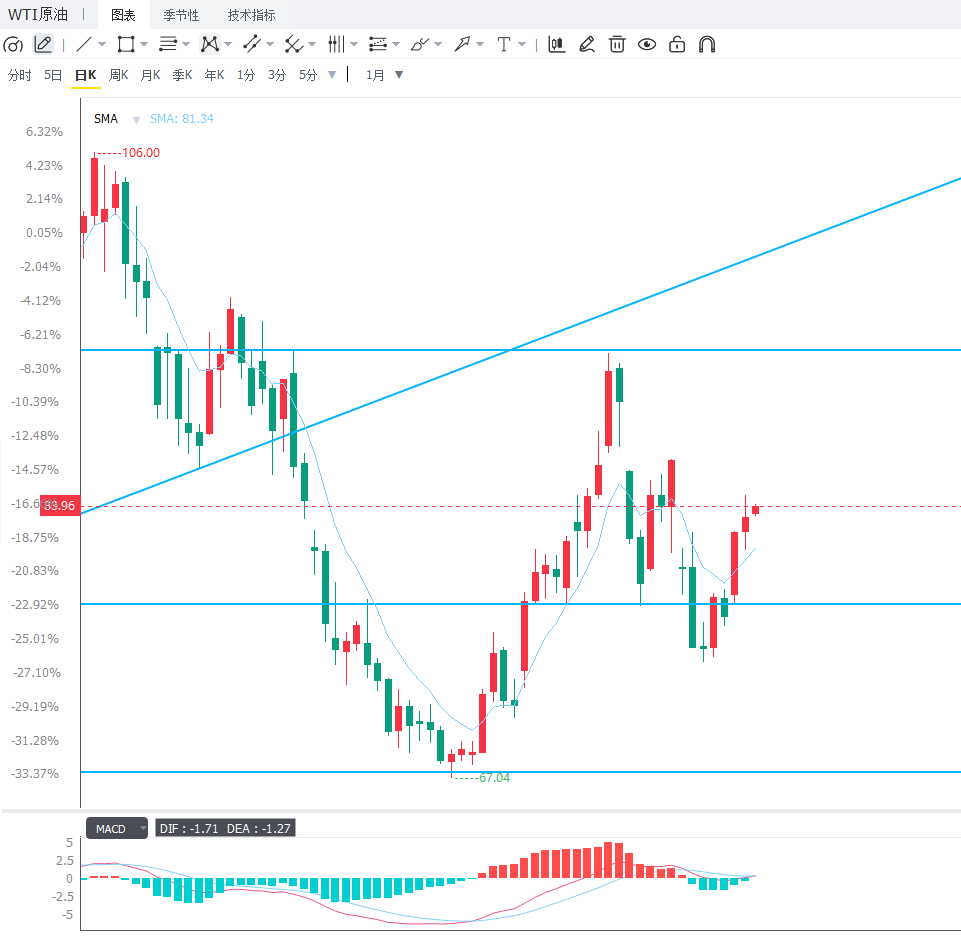
International crude oil prices continued to strengthen in Asian trading on Wednesday, with WTI crude rising for the third consecutive session, trading around $84 per barrel. The recent price increase was mainly driven by renewed supply risks in the Middle East, as investors assess the potential impact of changes in US-Iran relations on the global energy transportation landscape.  The market had previously seen some optimism due to improved diplomatic signals. Pakistan's Defense Minister stated that the US and Iran were close to reaching an arrangement to ensure the stable operation of the Strait of Hormuz, a crucial energy transport route. Simultaneously, parallel communications between Iran and Oman were also seen as progress, briefly pushing oil prices lower. However, market sentiment was subsequently influenced by a more hawkish stance. Signals from the US indicated that significant differences remained between the two sides on key issues, leading investors to re-price the risk of supply disruptions. Disputes surrounding the conditions for opening the Strait of Hormuz and related compensation demands have reduced market expectations for a comprehensive agreement in the short term. The Strait of Hormuz has long been considered a vital node for global energy transport, with approximately one-fifth of global seaborne crude oil supplies passing through the region ; therefore, any transport risks are quickly reflected in international oil prices. Commerzbank analysts believe that the recent cooling of agreement expectations and renewed geopolitical risks are driving up risk premiums in the energy market and increasing pressure on Brent crude to approach $90. Meanwhile, the European energy market is also indirectly affected. Prices of refined oil products such as diesel remain high due to market concerns about supply chain stability, further increasing energy cost pressures. Although Europe is not directly affected by supply disruptions, market concerns about future transportation security are driving a readjustment of risk assets. However, the rise in oil prices is not entirely driven by supply risks; US inventory data is exerting significant downward pressure on the market. Data released by the American Petroleum Institute (API) showed that US crude oil inventories increased by approximately 9.1 million barrels last week, far exceeding the market's previous expectation of a decrease of approximately 500,000 barrels, marking the largest weekly increase since February of this year. The unexpectedly large increase in US crude oil inventories indicates that short-term supply pressures remain. Inventory growth typically signifies changes in refinery demand, export performance, or production supply; therefore, investors are awaiting the official inventory report from the US Energy Information Administration (EIA) to further confirm the current market supply and demand situation. From a global market perspective, crude oil prices are currently caught in a tug-of-war between multiple factors. On the one hand, supply risks arising from the situation in the Middle East are driving funds into the energy market, creating a significant risk premium; on the other hand, the increase in US inventories and the uncertainty surrounding global economic growth expectations are limiting the potential for a sustained and rapid rise in oil prices. Market participants are currently focusing on three key factors: First, whether US-Iran communications can restore stability to the Strait of Hormuz; second, whether changes in US crude oil inventories will continue to reflect supply easing pressures; and finally, whether the dollar's performance and changes in global inflation expectations will affect the financial attributes of crude oil. If geopolitical risks continue to escalate, the crude oil market may maintain a highly volatile pattern; however, if diplomatic progress improves while inventories continue to increase, oil prices may face profit-taking pressure. The daily chart for WTI crude oil shows a clear rebound structure above $80 recently, with short-term moving averages gradually turning upwards, indicating increased market momentum. The MACD indicator shows weakening bearish momentum, with prices returning to near the upper edge of the medium-term trading range. However, the $85.50-$86 area currently forms short-term resistance; a break above this area could lead to further testing of the $88 level. Support levels to watch are the $80 psychological level, followed by the $78 area; a break below this level could lead to a retest of the $75 level. Overall, the daily trend leans towards a slightly bullish bias, but the pullback pressure from inventory data should not be underestimated. The 4-hour chart shows that after a continuous rise, oil prices have entered a short-term consolidation phase at high levels. The RSI indicator remains in the strong zone but has not shown a clear overbought signal, indicating that buying pressure still provides some support. The MACD histogram continues to expand, suggesting that bulls have the upper hand in the short term. However, there is technical resistance around $85.50-$86. If the price fails to break through effectively, a pullback to test the support around $81 may occur. If it breaks through $83 and holds, the short-term target may be the $86 area; conversely, a drop below $80 could weaken the current upward structure.
  Editor's Summary: The current crude oil market is under the dual influence of geopolitical risks and fundamental pressures. Uncertainty surrounding US-Iran relations has renewed the supply risk premium, causing WTI crude oil prices to rise continuously and approach $84. However, a significant increase in US inventories indicates that potential pressure remains on the supply side. Future oil price movements will depend on the balance between diplomatic developments, shipping risks in the Strait of Hormuz, and changes in US inventories. In the medium to long term, if supply risks persist, crude oil prices may still be supported; however, if market risk sentiment cools while inventories continue to accumulate, the upside potential for oil prices may be limited. It is necessary to pay attention to short-term opportunities arising from unforeseen events, while also guarding against the risk of rapid corrections in a highly volatile environment.
The market had previously seen some optimism due to improved diplomatic signals. Pakistan's Defense Minister stated that the US and Iran were close to reaching an arrangement to ensure the stable operation of the Strait of Hormuz, a crucial energy transport route. Simultaneously, parallel communications between Iran and Oman were also seen as progress, briefly pushing oil prices lower. However, market sentiment was subsequently influenced by a more hawkish stance. Signals from the US indicated that significant differences remained between the two sides on key issues, leading investors to re-price the risk of supply disruptions. Disputes surrounding the conditions for opening the Strait of Hormuz and related compensation demands have reduced market expectations for a comprehensive agreement in the short term. The Strait of Hormuz has long been considered a vital node for global energy transport, with approximately one-fifth of global seaborne crude oil supplies passing through the region ; therefore, any transport risks are quickly reflected in international oil prices. Commerzbank analysts believe that the recent cooling of agreement expectations and renewed geopolitical risks are driving up risk premiums in the energy market and increasing pressure on Brent crude to approach $90. Meanwhile, the European energy market is also indirectly affected. Prices of refined oil products such as diesel remain high due to market concerns about supply chain stability, further increasing energy cost pressures. Although Europe is not directly affected by supply disruptions, market concerns about future transportation security are driving a readjustment of risk assets. However, the rise in oil prices is not entirely driven by supply risks; US inventory data is exerting significant downward pressure on the market. Data released by the American Petroleum Institute (API) showed that US crude oil inventories increased by approximately 9.1 million barrels last week, far exceeding the market's previous expectation of a decrease of approximately 500,000 barrels, marking the largest weekly increase since February of this year. The unexpectedly large increase in US crude oil inventories indicates that short-term supply pressures remain. Inventory growth typically signifies changes in refinery demand, export performance, or production supply; therefore, investors are awaiting the official inventory report from the US Energy Information Administration (EIA) to further confirm the current market supply and demand situation. From a global market perspective, crude oil prices are currently caught in a tug-of-war between multiple factors. On the one hand, supply risks arising from the situation in the Middle East are driving funds into the energy market, creating a significant risk premium; on the other hand, the increase in US inventories and the uncertainty surrounding global economic growth expectations are limiting the potential for a sustained and rapid rise in oil prices. Market participants are currently focusing on three key factors: First, whether US-Iran communications can restore stability to the Strait of Hormuz; second, whether changes in US crude oil inventories will continue to reflect supply easing pressures; and finally, whether the dollar's performance and changes in global inflation expectations will affect the financial attributes of crude oil. If geopolitical risks continue to escalate, the crude oil market may maintain a highly volatile pattern; however, if diplomatic progress improves while inventories continue to increase, oil prices may face profit-taking pressure. The daily chart for WTI crude oil shows a clear rebound structure above $80 recently, with short-term moving averages gradually turning upwards, indicating increased market momentum. The MACD indicator shows weakening bearish momentum, with prices returning to near the upper edge of the medium-term trading range. However, the $85.50-$86 area currently forms short-term resistance; a break above this area could lead to further testing of the $88 level. Support levels to watch are the $80 psychological level, followed by the $78 area; a break below this level could lead to a retest of the $75 level. Overall, the daily trend leans towards a slightly bullish bias, but the pullback pressure from inventory data should not be underestimated. The 4-hour chart shows that after a continuous rise, oil prices have entered a short-term consolidation phase at high levels. The RSI indicator remains in the strong zone but has not shown a clear overbought signal, indicating that buying pressure still provides some support. The MACD histogram continues to expand, suggesting that bulls have the upper hand in the short term. However, there is technical resistance around $85.50-$86. If the price fails to break through effectively, a pullback to test the support around $81 may occur. If it breaks through $83 and holds, the short-term target may be the $86 area; conversely, a drop below $80 could weaken the current upward structure. Editor's Summary: The current crude oil market is under the dual influence of geopolitical risks and fundamental pressures. Uncertainty surrounding US-Iran relations has renewed the supply risk premium, causing WTI crude oil prices to rise continuously and approach $84. However, a significant increase in US inventories indicates that potential pressure remains on the supply side. Future oil price movements will depend on the balance between diplomatic developments, shipping risks in the Strait of Hormuz, and changes in US inventories. In the medium to long term, if supply risks persist, crude oil prices may still be supported; however, if market risk sentiment cools while inventories continue to accumulate, the upside potential for oil prices may be limited. It is necessary to pay attention to short-term opportunities arising from unforeseen events, while also guarding against the risk of rapid corrections in a highly volatile environment.
- Risk Warning and Disclaimer
- The market involves risk, and trading may not be suitable for all investors. This article is for reference only and does not constitute personal investment advice, nor does it take into account certain users’ specific investment objectives, financial situation, or other needs. Any investment decisions made based on this information are at your own risk.