Gold continued its volatile rebound, awaiting the release of US CPI data.
2026-08-12 10:54:54
International gold prices (XAU/USD) attracted some bargain hunting during Wednesday's Asian trading session, temporarily halting their decline from the $4435 area. This level represents a new high since June 5th, and gold has now regained its footing above $4400 as investors await the latest US inflation data to determine the Federal Reserve's future interest rate policy direction.  The gold market is currently experiencing a confluence of factors. On one hand, signs of a cooling US job market have increased market expectations for future interest rate cuts by the Federal Reserve. Previously released US non-farm payroll data showed lower-than-expected job growth, indicating a slowdown in the labor market, which weakens the rationale for the Fed to continue tightening monetary policy. On the other hand, rising energy prices have brought renewed inflationary risks, keeping the market wary of Fed policy. The recent significant strengthening of international oil prices is mainly due to escalating supply risks in the Middle East, with investors concerned that disruptions to energy transportation could push up global energy costs. Rising oil prices are becoming a crucial variable influencing gold prices . If energy prices continue to rise, it could slow the decline in inflation, allowing the Fed to maintain higher interest rates for an extended period, thus increasing the opportunity cost of holding non-yielding gold. Uncertainty surrounding shipping security in the Strait of Hormuz is increasing risk premiums in the energy market. Simultaneously, increased shipping risks near the Red Sea and the Bab el-Mandeb Strait are also driving up oil prices and strengthening demand for the US dollar as a safe haven. A stronger dollar is putting pressure on gold. Since gold is priced in US dollars, a rising dollar index typically reduces the cost advantage for investors using other currencies to buy gold. Furthermore, the recent rise in US Treasury yields has also increased the cost of holding gold. Market data shows that the yield on the 10-year US Treasury bond has recently approached the highs of late July, as investors repric their expectations for future Federal Reserve policy. Market opinions remain divided on future interest rate adjustments; some investors believe a weak job market supports a policy shift, but energy-driven inflation risks may keep the Fed cautious. Commerzbank analysts believe that significant volatility in the energy market is increasing pressure on the interest rate market, with rising oil prices pushing bond yields higher, while market expectations for future policy tightening have strengthened. Against this backdrop, gold needs new positive factors to break through key resistance levels. Currently, key factors investors are focusing on include US CPI data, subsequent speeches by Fed officials, the dollar's performance, and changes in the energy market. If US inflation continues to decline, the market may increase bets on future policy easing, and gold could retest recent highs; however, if inflation is reignited due to oil price fluctuations, gold may continue to face pressure from a rising dollar and yields. The daily chart for gold shows that prices are currently consolidating around the 100-day moving average, maintaining a slightly bullish short-term trend, but facing significant resistance above. Current prices are being pressured by the 50% Fibonacci retracement level of the April-June correction, and are also near the 200-day moving average, forming significant technical resistance around $4,500. If gold prices can effectively break through the $4,400-$4,500 area, bulls may regain control and further test previous highs. On the downside, the 100-day moving average around $4,388 provides the first support. A break below this area could lead to a pullback to the 38.2% Fibonacci level around $4,298, with further support at the $4,161 area. A breach of $4,160 could lead to a retest of the important structural support around $3,940. Overall, the daily trend leans towards a volatile upward movement, but the upward momentum needs further confirmation from macroeconomic factors. The 4-hour chart shows that gold prices experienced a technical pullback after reaching a high of around $4,435 and are currently consolidating around $4,400. Short-term moving averages remain upward, but the pace of increase has slowed. The RSI indicator has retreated from its highs, indicating a cooling of short-term buying pressure. If the price breaks above $4435 again, it may test the psychological level of $4500. If it fails to break through and falls below the support around $4380, it may enter a deeper correction phase, targeting the $4300 area. Short-term movements still depend on whether US inflation data drives further changes in the US dollar and US Treasury yields.
 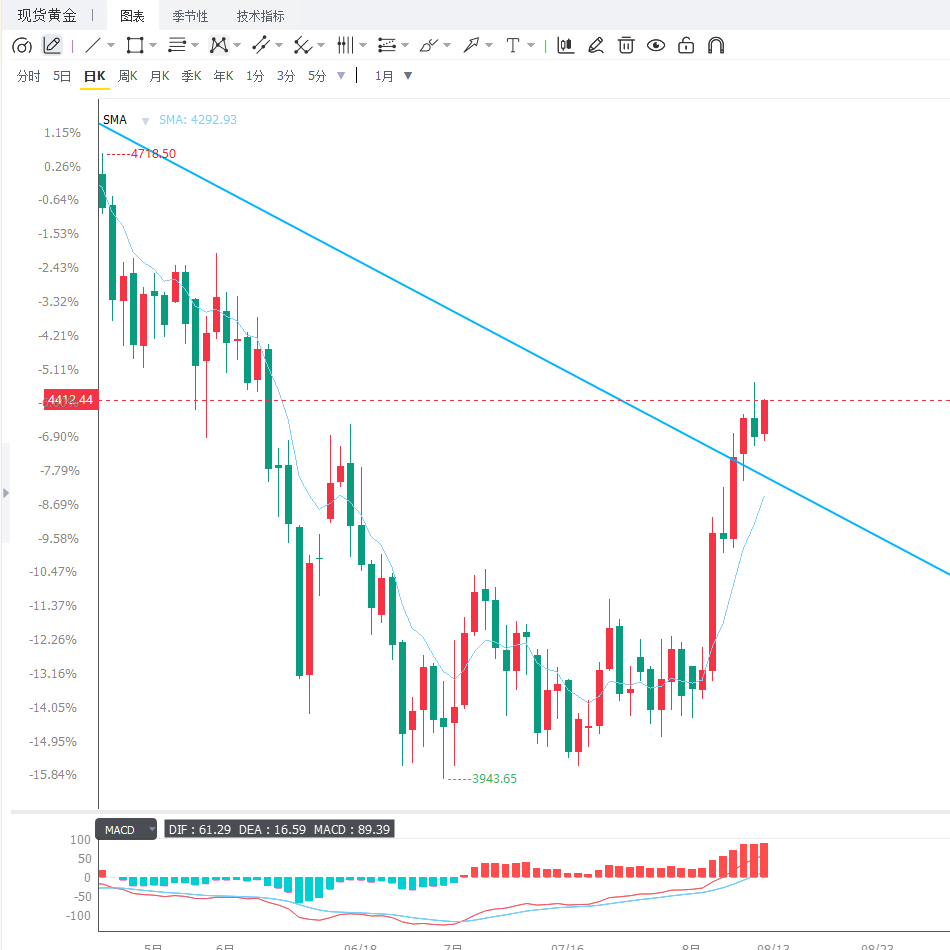 Editor's Summary: Gold is currently in a phase of macroeconomic rebalancing. The market benefits on one hand from expectations of policy easing due to a cooling job market, but is also suppressed by rising oil prices and renewed inflation risks. In the short term, US inflation data will be a crucial catalyst for gold's direction. If inflation continues to ease, gold may regain upward momentum and challenge the resistance around $4,500; however, if energy prices drive a rebound in inflation, and the Fed's policy expectations shift towards a hawkish stance, a stronger dollar and higher yields may limit gold's upside potential. From a medium- to long-term perspective, gold remains supported by safe-haven demand and global monetary policy uncertainty, but attention needs to be paid to whether it breaks through the $4,400-$4,500 range, and the effectiveness of the support around $4,300. In a highly volatile environment, the gold market presents both opportunities and risks.
The gold market is currently experiencing a confluence of factors. On one hand, signs of a cooling US job market have increased market expectations for future interest rate cuts by the Federal Reserve. Previously released US non-farm payroll data showed lower-than-expected job growth, indicating a slowdown in the labor market, which weakens the rationale for the Fed to continue tightening monetary policy. On the other hand, rising energy prices have brought renewed inflationary risks, keeping the market wary of Fed policy. The recent significant strengthening of international oil prices is mainly due to escalating supply risks in the Middle East, with investors concerned that disruptions to energy transportation could push up global energy costs. Rising oil prices are becoming a crucial variable influencing gold prices . If energy prices continue to rise, it could slow the decline in inflation, allowing the Fed to maintain higher interest rates for an extended period, thus increasing the opportunity cost of holding non-yielding gold. Uncertainty surrounding shipping security in the Strait of Hormuz is increasing risk premiums in the energy market. Simultaneously, increased shipping risks near the Red Sea and the Bab el-Mandeb Strait are also driving up oil prices and strengthening demand for the US dollar as a safe haven. A stronger dollar is putting pressure on gold. Since gold is priced in US dollars, a rising dollar index typically reduces the cost advantage for investors using other currencies to buy gold. Furthermore, the recent rise in US Treasury yields has also increased the cost of holding gold. Market data shows that the yield on the 10-year US Treasury bond has recently approached the highs of late July, as investors repric their expectations for future Federal Reserve policy. Market opinions remain divided on future interest rate adjustments; some investors believe a weak job market supports a policy shift, but energy-driven inflation risks may keep the Fed cautious. Commerzbank analysts believe that significant volatility in the energy market is increasing pressure on the interest rate market, with rising oil prices pushing bond yields higher, while market expectations for future policy tightening have strengthened. Against this backdrop, gold needs new positive factors to break through key resistance levels. Currently, key factors investors are focusing on include US CPI data, subsequent speeches by Fed officials, the dollar's performance, and changes in the energy market. If US inflation continues to decline, the market may increase bets on future policy easing, and gold could retest recent highs; however, if inflation is reignited due to oil price fluctuations, gold may continue to face pressure from a rising dollar and yields. The daily chart for gold shows that prices are currently consolidating around the 100-day moving average, maintaining a slightly bullish short-term trend, but facing significant resistance above. Current prices are being pressured by the 50% Fibonacci retracement level of the April-June correction, and are also near the 200-day moving average, forming significant technical resistance around $4,500. If gold prices can effectively break through the $4,400-$4,500 area, bulls may regain control and further test previous highs. On the downside, the 100-day moving average around $4,388 provides the first support. A break below this area could lead to a pullback to the 38.2% Fibonacci level around $4,298, with further support at the $4,161 area. A breach of $4,160 could lead to a retest of the important structural support around $3,940. Overall, the daily trend leans towards a volatile upward movement, but the upward momentum needs further confirmation from macroeconomic factors. The 4-hour chart shows that gold prices experienced a technical pullback after reaching a high of around $4,435 and are currently consolidating around $4,400. Short-term moving averages remain upward, but the pace of increase has slowed. The RSI indicator has retreated from its highs, indicating a cooling of short-term buying pressure. If the price breaks above $4435 again, it may test the psychological level of $4500. If it fails to break through and falls below the support around $4380, it may enter a deeper correction phase, targeting the $4300 area. Short-term movements still depend on whether US inflation data drives further changes in the US dollar and US Treasury yields. Editor's Summary: Gold is currently in a phase of macroeconomic rebalancing. The market benefits on one hand from expectations of policy easing due to a cooling job market, but is also suppressed by rising oil prices and renewed inflation risks. In the short term, US inflation data will be a crucial catalyst for gold's direction. If inflation continues to ease, gold may regain upward momentum and challenge the resistance around $4,500; however, if energy prices drive a rebound in inflation, and the Fed's policy expectations shift towards a hawkish stance, a stronger dollar and higher yields may limit gold's upside potential. From a medium- to long-term perspective, gold remains supported by safe-haven demand and global monetary policy uncertainty, but attention needs to be paid to whether it breaks through the $4,400-$4,500 range, and the effectiveness of the support around $4,300. In a highly volatile environment, the gold market presents both opportunities and risks.
- Risk Warning and Disclaimer
- The market involves risk, and trading may not be suitable for all investors. This article is for reference only and does not constitute personal investment advice, nor does it take into account certain users’ specific investment objectives, financial situation, or other needs. Any investment decisions made based on this information are at your own risk.