Energy and services sectors are heating up simultaneously, revealing the core of the next phase of euro pricing.
2026-08-19 18:26:58
On Wednesday, August 19th, the final reading of Eurozone inflation for July was officially released. Overall inflation rose to 2.9% year-on-year, higher than June's 2.8% and consistent with the preliminary reading. Core inflation, excluding energy, food, alcohol, and tobacco, was 2.5% year-on-year, also up from June's 2.4%. Meanwhile, the euro traded with a slightly stronger bias against the US dollar, currently above 1.1600, after previously touching near a two-month high. The final inflation reading did not present any significant surprises, but it further confirmed a more important issue for the market: Eurozone price pressures have not returned to a single energy-driven logic, but rather exhibit a structure where both energy and service prices are relatively strong. Looking at the overall inflation of 2.9% alone, the increase in July from June was only 0.1 percentage points, not considered aggressive. However, when the data is broken down, its policy implications are significantly different.  Energy prices rose 10.3% year-on-year in July, accelerating further from 8.5% in June, contributing 0.94 percentage points to overall inflation. More noteworthy is the 3.3% year-on-year increase in service prices, continuing the upward trend from 3.2% in the previous month, contributing 1.55 percentage points to overall inflation, making it the largest contributor among all components. Non-energy industrial goods rose 0.9% year-on-year, while food, alcohol, and tobacco rose 1.2%. In other words, although energy saw the largest increase, service prices remain the core source of current inflation stickiness. This means the market cannot simply interpret the current inflation rebound as a primary disturbance of energy prices. If energy prices continue to be transmitted through transportation, production costs, and corporate pricing, while service prices maintain a high growth rate, then policymakers really need to observe whether the secondary effects are strengthening. The European Central Bank kept its three policy rates unchanged on July 23, with the deposit facility rate, main refinancing rate, and marginal lending rate currently at 2.25%, 2.40%, and 2.65%, respectively. The European Central Bank (ECB) has made it clear that energy prices remain significantly higher than pre-conflict levels, and the full impact of the energy shock on inflation has not yet been fully reflected. The ECB will continue to monitor the duration, intensity, and indirect and secondary effects of the shock. Therefore, the final July inflation reading is not a direct indication to the market that interest rates will definitely be adjusted in September, but rather reduces the ECB's room for rapid policy easing. The ECB has previously stated that it will not pre-commit to a specific interest rate path, and policy decisions will remain data-driven and decided on a meeting-by-meeting basis. The July data showed core inflation rising from 2.4% to 2.5%, and services inflation rising to 3.3%, meaning that the market needs to consider both the persistence of the energy shock and internal price stickiness when assessing the next meeting. ECB President Christine Lagarde recently emphasized that policymakers are focusing on the duration, intensity, and propagation of the energy shock, especially its indirect and secondary effects. This statement indicates that the focus of policy judgment has shifted from the monthly energy price itself to whether energy costs are gradually being incorporated into wages, services, and corporate pricing. The recent pricing of the euro in the foreign exchange market is not solely due to improved Eurozone data, but more so to the recombination of policy expectations at both ends. Since August, the euro has risen to near a two-month high against the dollar, as the market reassesses the duration of the European Central Bank's (ECB) restrained policy under inflationary pressures and reduces bets on further short-term tightening by the Federal Reserve. The dollar index has recently hovered around 99, while the euro has maintained relative strength and volatility. What truly influences marginal exchange rate changes is often not the current policy interest rate level, but rather the difference in policy paths at future meetings. If the ECB maintains a higher level of inflationary vigilance, while policy expectations continue to be cautious, then interest rate differential expectations may change. However, excessively high energy prices simultaneously compress corporate profits and household purchasing power; therefore, for the euro, energy inflation includes both policy constraints and growth costs, and these cannot be simply considered variables moving in the same direction.
 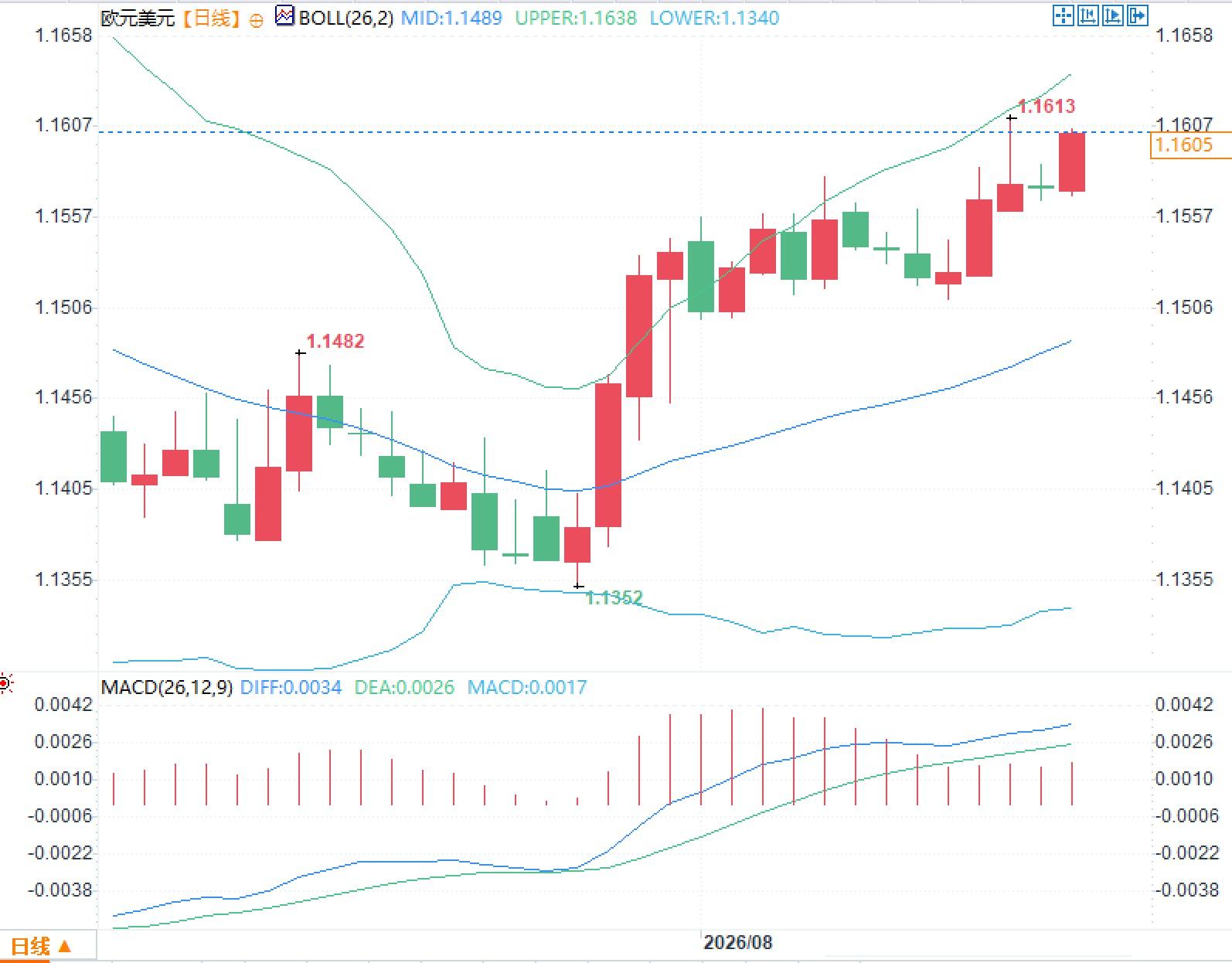 From the daily chart, the euro/dollar exchange rate has recently recovered from its previous lows, with the price moving to the upper Bollinger Band area and the middle Bollinger Band rising again. The MACD DIFF line is above the DEA line and above the zero line, indicating that the previous upward momentum is still reflected in the indicator system. However, after the price approached the upper Bollinger Band recently, the price fluctuations have widened, reflecting that the market is entering a phase where inflation data, central bank expectations, and interest rate repricing are all influencing the market.
Energy prices rose 10.3% year-on-year in July, accelerating further from 8.5% in June, contributing 0.94 percentage points to overall inflation. More noteworthy is the 3.3% year-on-year increase in service prices, continuing the upward trend from 3.2% in the previous month, contributing 1.55 percentage points to overall inflation, making it the largest contributor among all components. Non-energy industrial goods rose 0.9% year-on-year, while food, alcohol, and tobacco rose 1.2%. In other words, although energy saw the largest increase, service prices remain the core source of current inflation stickiness. This means the market cannot simply interpret the current inflation rebound as a primary disturbance of energy prices. If energy prices continue to be transmitted through transportation, production costs, and corporate pricing, while service prices maintain a high growth rate, then policymakers really need to observe whether the secondary effects are strengthening. The European Central Bank kept its three policy rates unchanged on July 23, with the deposit facility rate, main refinancing rate, and marginal lending rate currently at 2.25%, 2.40%, and 2.65%, respectively. The European Central Bank (ECB) has made it clear that energy prices remain significantly higher than pre-conflict levels, and the full impact of the energy shock on inflation has not yet been fully reflected. The ECB will continue to monitor the duration, intensity, and indirect and secondary effects of the shock. Therefore, the final July inflation reading is not a direct indication to the market that interest rates will definitely be adjusted in September, but rather reduces the ECB's room for rapid policy easing. The ECB has previously stated that it will not pre-commit to a specific interest rate path, and policy decisions will remain data-driven and decided on a meeting-by-meeting basis. The July data showed core inflation rising from 2.4% to 2.5%, and services inflation rising to 3.3%, meaning that the market needs to consider both the persistence of the energy shock and internal price stickiness when assessing the next meeting. ECB President Christine Lagarde recently emphasized that policymakers are focusing on the duration, intensity, and propagation of the energy shock, especially its indirect and secondary effects. This statement indicates that the focus of policy judgment has shifted from the monthly energy price itself to whether energy costs are gradually being incorporated into wages, services, and corporate pricing. The recent pricing of the euro in the foreign exchange market is not solely due to improved Eurozone data, but more so to the recombination of policy expectations at both ends. Since August, the euro has risen to near a two-month high against the dollar, as the market reassesses the duration of the European Central Bank's (ECB) restrained policy under inflationary pressures and reduces bets on further short-term tightening by the Federal Reserve. The dollar index has recently hovered around 99, while the euro has maintained relative strength and volatility. What truly influences marginal exchange rate changes is often not the current policy interest rate level, but rather the difference in policy paths at future meetings. If the ECB maintains a higher level of inflationary vigilance, while policy expectations continue to be cautious, then interest rate differential expectations may change. However, excessively high energy prices simultaneously compress corporate profits and household purchasing power; therefore, for the euro, energy inflation includes both policy constraints and growth costs, and these cannot be simply considered variables moving in the same direction. From the daily chart, the euro/dollar exchange rate has recently recovered from its previous lows, with the price moving to the upper Bollinger Band area and the middle Bollinger Band rising again. The MACD DIFF line is above the DEA line and above the zero line, indicating that the previous upward momentum is still reflected in the indicator system. However, after the price approached the upper Bollinger Band recently, the price fluctuations have widened, reflecting that the market is entering a phase where inflation data, central bank expectations, and interest rate repricing are all influencing the market.
- Risk Warning and Disclaimer
- The market involves risk, and trading may not be suitable for all investors. This article is for reference only and does not constitute personal investment advice, nor does it take into account certain users’ specific investment objectives, financial situation, or other needs. Any investment decisions made based on this information are at your own risk.