US-Canada Tariff Battle: Carney's Tough Stand Against Trump Sparks Global Attention on Canada's Sovereignty Defense
2026-08-24 12:15:04
As the global economic game enters its most complex phase, the clash between sovereignty and power is creating turbulent waves. Canadian Prime Minister Mark Carney's cry that "middle powers must stand up against economic coercion" has torn away the veil of fragility in the international order; while US President Trump's tariff weapon has pushed this ideological battle into the real battlefield. A fierce confrontation concerning sovereignty, economic lifeline, and the future of the global landscape is unfolding on Canada's stage, showcasing a survival struggle for middle powers in the new era, drawing the world's attention.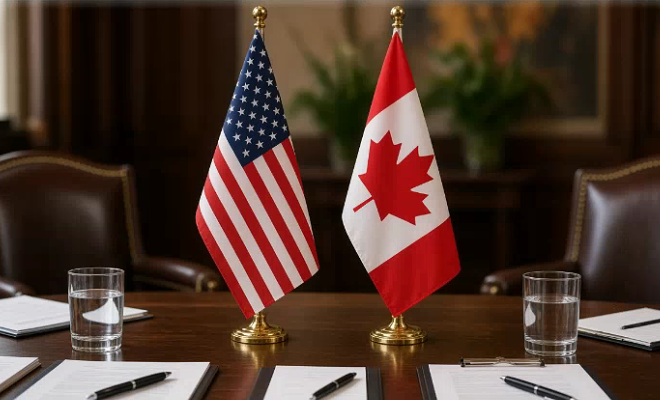
Escalating Situation: Sovereignty Game Amid Tariff Clashes
Canadian Prime Minister Mark Carney successfully captured global attention with his sharp warning to middle powers to resist economic coercion from larger nations. Now, US President Trump's move to impose new tariffs across the board puts Carney's warning to a real test. This contest not only concerns the resilience of the Canadian economy but also serves as a bellwether for global sovereignty. Early Saturday morning Beijing time, the situation escalated dramatically. Carney deemed the conditions offered by the US in exchange for tariff exemptions too harsh and decisively halted negotiations. Saturday evening, the US subsequently imposed a 50% tariff on approximately $20 billion worth of Canadian goods. Carney swiftly announced retaliatory measures starting September 8th, strongly stating that he would "definitely retaliate," officially launching this tariff showdown.Strategic Perseverance: A Breakthrough Attempt by Middle Powers
Carney's actions broke with the usual choices of many US allies, who preferred to endure economic pain rather than bow to tariff pressure. For him, this direct confrontation was the ultimate test of his core principles: middle powers must uphold their bottom line when facing economic pressure from major powers, even at a heavy cost. Canada's response will serve as an important reference for countries dealing with an era where the protective power of alliances is waning and economic ties are being used as tools of pressure. At the last moment of negotiations, Carney saw through the US restrictions on Canada's trade agreements with other countries, directly pointing out that this demand crossed a sovereign red line and was unacceptable. British Columbia Premier David Eby went even further, stating that accepting such conditions would make Canada "the 51st state in economic terms," precisely the plot repeatedly mentioned by Trump, further highlighting the urgency of the sovereignty battle.Echoes of History: A Fierce Clash Between Ideals and Reality
In January of this year, Carney spoke at the World Economic Forum in Davos, Switzerland. At a time when Europe was grappling with Trump's tariffs and territorial threats, his assertion that "the international order is experiencing a fracture rather than a transition" resonated strongly. He emphasized that the foundation of sovereignty lies in resilience, warning that middle powers cannot withstand the pressure of larger powers on their own. This concept has now taken root in Canada. Trump quickly retaliated, emphasizing Canada's dependence on the United States and repeatedly threatening to annex Canada. Seven months later, Canada became a testing ground for Carney's ideas. Carney directly accused the United States of using economic integration as a weapon of pressure, making promises as easily changeable as pencil writing, highlighting the complexity and protracted nature of this game.Challenges Ahead: The Cost of Resistance and Global Repercussions
Canada's heavy reliance on the US market is the biggest obstacle to its resistance. Nearly three-quarters of its exports go to the US, and given the vast economic disparity, rebuilding decades-old supply chains and customer networks is an insurmountable challenge. Carney acknowledged that retaliation would increase the cost of living and reduce consumer choice, but stressed that its sovereignty was a non-negotiable principle. US Trade Representative Jamieson Greer refuted Canada's claims of a breakdown in negotiations, stating that Canada had reneged on its commitments and that the US would pursue further measures, increasing the risk of escalation. University of Toronto professor Nelson Wiseman pointed out that whether Canada's resistance could trigger a chain reaction among middle powers globally was a key point to watch. Carney's tough stance also won recognition in Europe, with former Italian Prime Minister Paolo Gentiloni publicly praising him, demonstrating his demonstrative effect.People's hearts and minds: Local anger and unwavering determination
Public discontent with the United States continues to rise in Canada, with a strong stance against Trump's policies becoming the mainstream consensus. Quebec is urging its citizens to buy local products, elevating the boycott to a gesture of unity; at sporting events, fans are booing the American national anthem to vent their anger. Manitoba Premier Wab Kinew predicts this confrontation will last two years, hoping the situation will return to rationality after the midterm elections. Carney defines this confrontation as a battle for sovereignty, vowing to thwart any US annexation attempts. This struggle in Canada is not only about its own destiny but also serves as a vivid example of how the world should respond to pressure from major powers; its ultimate outcome will inevitably lead to profound changes in the international landscape.Conclusion
This tariff game has long transcended the scope of bilateral trade disputes, becoming an ultimate contest between sovereignty and power, principle and compromise. Carney led Canada in resolutely upholding its sovereignty, not only exploring a path for survival for middle powers in the great power game but also providing a moral compass for the world in dealing with economic coercion. Although the road ahead is fraught with economic pressure, this struggle, armored with courage, will ultimately leave its mark on the reconstruction of the international order. It reminds the world that the dignity of sovereignty never stems from compromise, but from standing tall in the face of pressure; and Canada's steadfastness may be igniting a glimmer of light piercing the fog in the global landscape of fair and just competition, guiding more countries to find the confidence and direction to defend their rights amidst hegemonic encirclement.- Risk Warning and Disclaimer
- The market involves risk, and trading may not be suitable for all investors. This article is for reference only and does not constitute personal investment advice, nor does it take into account certain users’ specific investment objectives, financial situation, or other needs. Any investment decisions made based on this information are at your own risk.