The Bank of Korea raised interest rates to 3.00% in two consecutive increases! The Korean won received support, but the US dollar remains a major obstacle?
2026-08-27 11:39:02
The Bank of Korea raised interest rates by 25 basis points on Thursday (August 27), pushing the benchmark rate to 3.00%. This is the second consecutive rate hike since July, and the first "back-to-back" tightening since the seven consecutive rate hikes from April 2022 to January 2023. The Bank of Korea pointed out that strong economic growth and rising inflationary pressures were the key drivers of the rate hike—second-quarter GDP grew by 3.7% year-on-year, far exceeding the central bank's previous forecast of 3%; core inflation rose to 2.6% year-on-year in July, the largest increase in two years and seven months. The Bank of Korea also raised its 2026 economic growth forecast to 3.3% (from 2.6%), and its 2027 forecast to 2.9%, while maintaining its inflation forecast at 2.7%. The recovery in domestic demand driven by the semiconductor industry boom and the continued rise in housing prices also increased the urgency of the rate hike. 
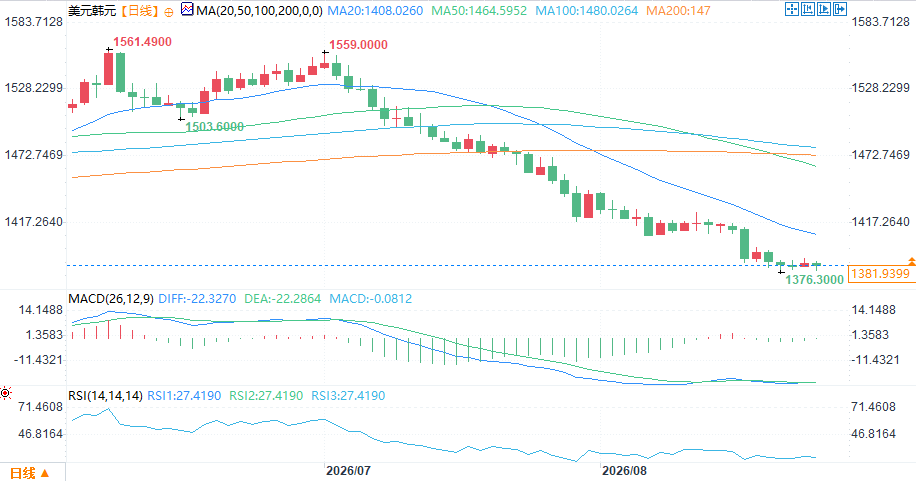 (USD/KRW daily chart, source: EasyForex) At 11:35 Beijing time on August 27, the USD/KRW exchange rate was 1380.80/1381.01.
The Bank of Korea raised interest rates for the second consecutive time, maintaining its tight monetary policy stance.
The Bank of Korea (BOK) raised its benchmark interest rate by 25 basis points to 3.00% on Thursday, marking the second consecutive rate hike since July and the first "back-to-back" rate increases since the seven consecutive hikes during the COVID-19 pandemic from April 2022 to January 2023. Looking back at its policy trajectory, the BOK cut rates by a total of 100 basis points to 2.50% between October 2024 and May 2025, then kept the rate unchanged for a considerable period until May of this year. The unexpected 25 basis point hike to 2.75% in July ended a three-and-a-half-year pause, and Thursday's further increase formally continues this tightening pace. This move indicates that the BOK is taking a more decisive approach to inflation and financial stability risks, moving away from a wait-and-see approach after a single adjustment and instead strengthening policy credibility through continuous action. Market interpretations suggest that the consecutive rate hikes convey the BOK's high vigilance regarding the current economic overheating and price pressures, and also signify a clear shift in short-term policy focus towards curbing demand and stabilizing expectations.Strong economic growth and rising inflationary pressures drive interest rate hikes
The core factor driving this interest rate hike is the significantly stronger-than-expected economic growth and the resulting risk of inflation transmission. Second-quarter GDP grew by 3.7% year-on-year, far exceeding the central bank's previous forecast of 3%, demonstrating unexpected resilience. Meanwhile, core inflation rose to 2.6% year-on-year in July, the largest increase in two years and seven months, indicating that price pressures are spreading from some sectors to a wider range. The continued boom in the semiconductor industry is the main engine of this growth, and the resulting improvements in investment, employment, and income have clearly translated into a recovery in domestic demand. The central bank is concerned that this transmission from strong exports to domestic demand may further push up prices from the demand side. In addition, the continued rise in household debt levels and the soaring housing prices in the Seoul metropolitan area have exacerbated the risk of financial imbalances, providing additional justification for the interest rate hike. In summary, the strong growth and rising inflation have created a synergy, forcing the central bank to take more aggressive tightening measures to prevent price expectations from becoming unanchored.Economic outlook revised upwards, future policy path
While raising interest rates, the Bank of Korea significantly revised its economic growth forecasts upward: GDP growth for 2026 was revised upward from 2.6% to 3.3%, and the forecast for 2027 was 2.9%, while the inflation forecast remained unchanged at 2.7%. This adjustment reflects the central bank's significantly increased confidence in the endogenous driving force of the economy. The central bank governor had previously stated clearly that "when considering inflation persistently exceeding the target, improved economic growth, and rising financial stability risks, it is appropriate to raise interest rates at the right time." Researchers further pointed out that waiting until October to take action would not yield significant benefits, while the costs of delaying interest rate hikes are accumulating rapidly, including rising inflation stickiness and increased risks of asset price bubbles. Therefore, this series of interest rate hikes is not only a response to current data but also lays the groundwork for future policy paths. The market expects that if growth and inflation continue to exceed expectations, the central bank may maintain a certain tightening bias throughout the year rather than quickly shifting to a wait-and-see approach. The focus of policy communication will be on balancing growth dividends and stability risks.USD/KRW: The Bank of Korea's hawkish rate hike supported the won, but external pressures remain.
The Bank of Korea's second consecutive interest rate hike provided support for the won in terms of interest rate differentials. The dollar fell by about 0.57% against the won to 1376.90, approaching the near one-year low hit on Monday. Currently, the dollar has rebounded slightly to trade around 1381 against the won. The recent rebound of the dollar has made won bulls hesitant, and the market had previously priced in some of the Bank of Korea's rate hike expectations. The Federal Reserve's benchmark interest rate remained at 3.5%-3.75%, narrowing the US-Korea interest rate differential to about 50-75 basis points, which helped alleviate the depreciation pressure on the won. However, the won's upside potential faces two constraints. First, the Bank of Korea raised its 2026 economic growth forecast to 3.3%, with the strong performance of the semiconductor industry being the core driver. However, this also means that the Korean economy is more sensitive to the global technology cycle—if AI-related demand slows down marginally, the won may face a second shock from declining external demand. Secondly, fiscal concerns stemming from the US Treasury's expanded bond buybacks continue to weigh on the dollar, but US Treasury yields remain high, limiting the dollar's downside potential and making a one-sided trend unlikely for the USD/KRW exchange rate. More importantly, the Bank of Korea emphasized in its statement that "financial stability risks" are a key consideration for interest rate hikes, particularly given rising household debt and housing prices. This suggests that the central bank's policy path will focus more on domestic financial balance rather than simply exchange rate stability, and the pace of future interest rate hikes may be constrained by the capacity of domestic demand. In the short term, the USD/KRW exchange rate may fluctuate within the 1370-1390 range. The Bank of Korea's hawkish stance provides a floor for the won, but the global technology cycle and the dollar's performance remain key external variables determining its direction.Summarize
The Bank of Korea raised its benchmark interest rate by 25 basis points to 3.00% on Thursday, marking its second consecutive rate hike and the first "back-to-back" increase since the seven consecutive rate hikes in 2022-2023. Second-quarter GDP grew by 3.7% year-on-year, exceeding expectations, and core inflation rose to a two-year, seven-month high of 2.6% in July. The recovery in domestic demand driven by the semiconductor boom and rising housing prices justified the rate hike. The central bank raised its 2026 growth forecast to 3.3%, while maintaining its inflation forecast at 2.7%. The central bank governor stated that "raising interest rates at the appropriate time is suitable," and the market anticipates that the tightening cycle may not yet be over. (USD/KRW daily chart, source: EasyForex) At 11:35 Beijing time on August 27, the USD/KRW exchange rate was 1380.80/1381.01.
- Risk Warning and Disclaimer
- The market involves risk, and trading may not be suitable for all investors. This article is for reference only and does not constitute personal investment advice, nor does it take into account certain users’ specific investment objectives, financial situation, or other needs. Any investment decisions made based on this information are at your own risk.