The USD/JPY pair is stuck around 159; what is the market waiting for?
2026-08-28 18:45:02
On Friday, August 28th, the foreign exchange market was entering the core pricing phase of the Jackson Hole Economic Symposium. The US dollar index was last quoted at approximately 99.20, and the USD/JPY exchange rate was currently around 159.65. The market's real focus was not on whether a single speech would provide direct policy answers, but rather on how Federal Reserve Chairman Warsh would address the emerging contradictions between inflation, financial conditions, and long-term interest rates. 
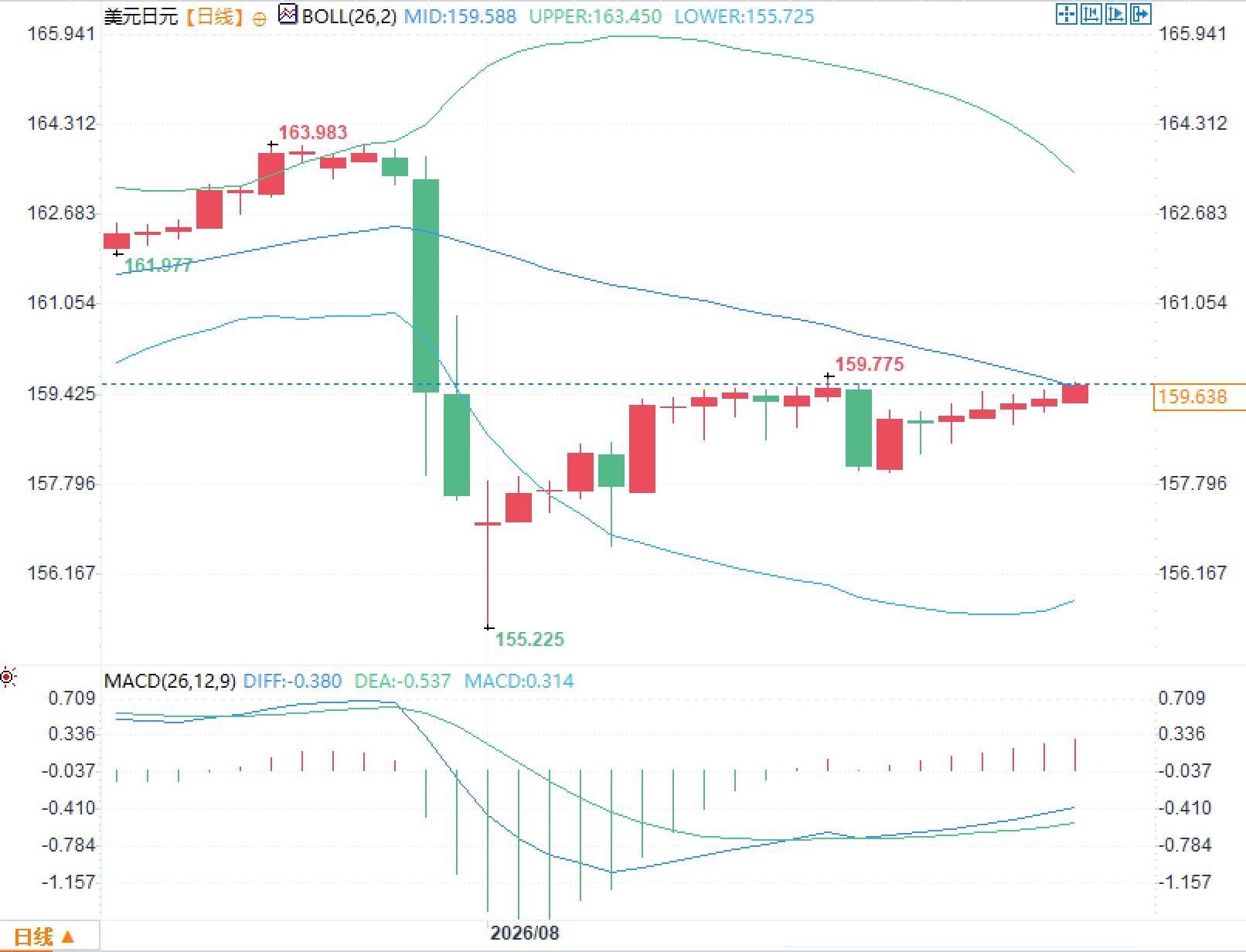 The market implication of this structure is primarily volatility compression, rather than directional confirmation. The Bollinger Band's middle line is still in a slow adjustment phase, the upper band is gradually declining, and the lower band, after a dip, is flattening out, indicating that the price dispersion left by previous extreme volatility is converging. Meanwhile, the MACD fast and slow lines are still below the zero axis, but the histogram has turned positive and is continuously expanding, mathematically meaning that short-term momentum has improved compared to before; however, the long-term trend and short-term momentum are not yet aligned. Currently, price, volatility, and momentum indicators collectively reflect a characteristic: the significant repricing at the end of July has entered an information digestion period, and the Jackson Hole speech, changes in the US yield curve, and expectations for the Bank of Japan's September meeting may all reshape volatility pricing.
Jackson Hole Focus Shifts: What the Market Is Really Waiting For Is a Statement on Financial Conditions
The Federal Reserve maintained its target range for the federal funds rate at 3.50% to 3.75% at its July meeting, but internal policy disagreements have widened significantly. The July decision passed with 9 votes in favor and 3 against, with the three dissenters favoring a 25 basis point rate hike. The Fed also explicitly stated that inflation remains above its 2% target. This means that the importance of Warsh's speech lies not in whether he announces a clear next interest rate move, but in whether he expresses concern about recent easing of financial conditions. This logic is crucial. Recently, the U.S. Treasury announced that, effective September 9th, it will increase the maximum repurchase agreement (repo) for liquidity support on 10- to 20-year and 20- to 30-year nominal Treasury bonds from $2 billion to at least $4 billion, effectively doubling the amount. The Treasury's stated reason is to improve liquidity in the long-term Treasury bond market. However, from an asset pricing perspective, improved liquidity and lower yields on long-term Treasury bonds will further impact corporate financing costs, housing financing conditions, and the valuation of risky assets. Therefore, the market is currently observing the combined financial conditions created by monetary policy and the Treasury's debt management operations. If Warsh emphasizes that recent changes in financial conditions may affect the process of inflation returning to the 2% target, the interest rate market will need to reassess the previously established loose financial environment. Conversely, if the speech focuses on the medium- to long-term policy framework without explicitly discussing financial conditions, the market's existing pricing may remain intact. The core variable here is not simply a hawkish or dovish label, but rather whether the Fed approves of the current combination of actual financial conditions and policy rates.The core of dollar pricing has shifted from interest rate levels to divergent interest rate paths.
The latest US inflation indicators still do not provide the market with sufficient policy certainty. Recent data shows that the personal consumption expenditure price index is around 3.7% year-on-year, while the Federal Reserve's official website shows that the policy rate remains at 3.50% to 3.75%. This means that actual policy discussions are still constrained by inflation stickiness. It is worth noting that the current dollar price is not simply based on the absolute interest rate level, but is increasingly dependent on changes in the market's probability of future interest rate paths. This is because the interest rate market has already undergone multiple rounds of policy expectation adjustments. When the current policy rate remains unchanged, what affects the marginal pricing of the exchange rate is often not today's interest rate, but rather what level the market believes the policy rate may reach in the next few meetings, and how this expectation is transmitted to the yields of different maturities of Treasury bonds, such as two-year and ten-year bonds. Therefore, this Jackson Hole speech will focus on observing three variables: how Warsh defines current financial conditions, how he assesses the persistence of inflation, and whether he believes that market interest rates have fully reflected policy constraints. These three questions together determine whether the dollar yield curve will be repriced, and their information value is significantly higher than simply looking for words like "rate hike" or "rate cut."The Yen's Dilemma: Expectations of Policy Normalization Have Already Been Priced In
The USD/JPY pair is currently trading around 159.65. It experienced significant volatility on July 30th, after which the exchange rate returned to around 159. Since August, the pair has mostly consolidated within the 157-160 range. The core issue facing the yen is not the lack of policy normalization intentions from the Bank of Japan (BOJ), but rather that this information has already been largely priced in by the market. The BOJ's latest economic and price outlook clearly states that if economic, price, and financial conditions meet the baseline scenario, it will continue to raise policy rates and adjust the degree of monetary easing, while emphasizing the need to monitor the process of stabilizing underlying inflation at around 2%. The market has already priced in a high probability of a September rate hike, with some market estimates reaching 80% to 90%. When a policy event enters a high-probability range, its marginal informational impact on the exchange rate decreases. In other words, the market is no longer more concerned with whether the BOJ will adjust interest rates, but rather whether the subsequent pace of adjustment can change the expected trajectory of the USD/JPY interest rate differential. Therefore, yen pricing requires observing two curves simultaneously: one is the speed of the BOJ's normalization, and the other is the future policy path of the Federal Reserve. Analyzing only one end can easily overestimate the actual impact of a single policy meeting.The technology structure has entered a compression phase.
Looking at the USD/JPY daily chart, the sharp fluctuations at the end of July significantly altered the previous trend structure. The exchange rate subsequently rebounded from its lows, but recently the candlestick bodies have been consistently shrinking, intraday volatility has decreased, and the price has been fluctuating around the middle Bollinger Band. The market implication of this structure is primarily volatility compression, rather than directional confirmation. The Bollinger Band's middle line is still in a slow adjustment phase, the upper band is gradually declining, and the lower band, after a dip, is flattening out, indicating that the price dispersion left by previous extreme volatility is converging. Meanwhile, the MACD fast and slow lines are still below the zero axis, but the histogram has turned positive and is continuously expanding, mathematically meaning that short-term momentum has improved compared to before; however, the long-term trend and short-term momentum are not yet aligned. Currently, price, volatility, and momentum indicators collectively reflect a characteristic: the significant repricing at the end of July has entered an information digestion period, and the Jackson Hole speech, changes in the US yield curve, and expectations for the Bank of Japan's September meeting may all reshape volatility pricing.
- Risk Warning and Disclaimer
- The market involves risk, and trading may not be suitable for all investors. This article is for reference only and does not constitute personal investment advice, nor does it take into account certain users’ specific investment objectives, financial situation, or other needs. Any investment decisions made based on this information are at your own risk.