Trump predicts "20% economic growth!" The dollar struggles between "vision" and "reality" below the 100 mark.
2026-09-01 12:10:04
US President Trump stated on Monday (August 31) that the US economy could grow at 14%, 15%, 16%, or even 20%, adding that "successful growth will not lead to inflation" and arguing that even high growth should not prompt the Federal Reserve to raise interest rates. However, since records began in 1947, the US has only experienced an annualized GDP growth rate of 20% or higher once—the 34.9% rebound in the third quarter of 2020 following the pandemic. The second highest was 16.7% in the first quarter of 1950. Current economic growth is far below these levels—the annualized real GDP growth rate is projected to be only 1.5% in the second quarter of 2026. The Federal Reserve maintained interest rates at 3.5%-3.75% in July, with three policymakers dissenting in favor of a rate hike. 
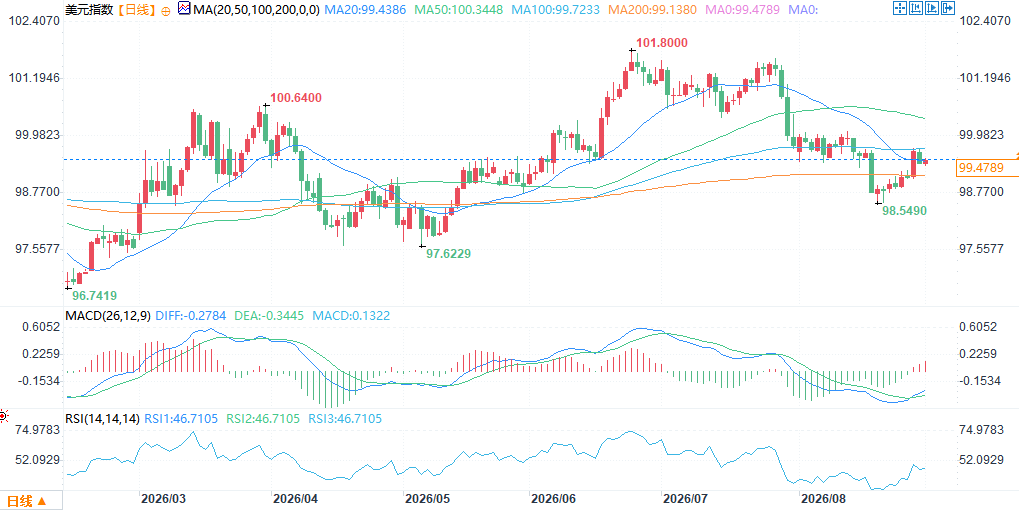 (US Dollar Index Daily Chart, Source: FX678) At 12:08 Beijing time, the US Dollar Index was at 99.51.
Trump: Economic growth could reach 20%, but it shouldn't trigger interest rate hikes.
During an event in the Oval Office, Trump stated that the US economy could grow by 14%-20%, emphasizing that "successful growth will not lead to inflation," and arguing that even high growth should not prompt the Federal Reserve to raise interest rates. He also called for the US to have the lowest interest rates in the world. These remarks come at a time when the Fed's policy path is a key market focus: the July meeting maintained interest rates at 3.5%-3.75%, but three policymakers dissented in favor of a rate hike, and the market is pricing in a roughly 60% probability of a September rate hike. Trump's statement contrasts sharply with the current reality of the Fed's fight against inflation. Inflation remains above the 2% target, while actual economic growth is far below his claimed levels—the annualized GDP growth rate in the second quarter was only 1.5%. There is a significant gap between high growth expectations and current economic reality. Analysts point out that Trump is attempting to argue that "growth does not necessarily lead to inflation" by emphasizing supply-side reforms, but this clearly diverges from the Fed's concerns that excessive demand could push up prices, potentially further exacerbating the tension between the White House and the central bank on policy stances.A 20% growth rate is almost unprecedented, and the current growth rate is far lower than that.
Since records began in 1947, the annualized GDP growth rate of the United States has only reached 20% or higher once—the 34.9% rebound in the third quarter of 2020 following the pandemic. The second-highest record is 16.7% in the first quarter of 1950. Current economic growth is far below these extreme levels, with an annualized growth rate of only 1.5% in the second quarter. Even considering the relatively robust performance of core indicators such as private domestic final demand, the overall growth remains within a moderate range. Economic growth itself does not necessarily trigger inflation, but when demand growth consistently exceeds the economy's supply capacity, prices will face upward pressure. Trump's remarks suggest he may promote growth through supply-side measures such as tax cuts, deregulation, and energy policies, while simultaneously avoiding rising inflation. However, this view contrasts with the Federal Reserve's assessment of current inflation stickiness and potential demand-driven risks. Historical experience shows that ultra-high growth often occurs during exceptional periods such as post-war recovery or post-crisis rebounds, and is difficult to sustain under normal circumstances. Markets and policymakers generally hold a cautious attitude towards such optimistic targets.US Dollar Index: Trump's "20% Growth" Rhetoric vs. the Fed's Reality
Trump's claims that the US economy could grow by 14%-20% and that this growth should not trigger interest rate hikes stand in stark contrast to the inflation reality faced by Federal Reserve officials, resulting in a confusing impact on the dollar index. On the one hand, if the market takes Trump's high-growth narrative seriously, it could reinforce the "American exceptionalism" narrative and support the dollar. On the other hand, his explicit opposition to interest rate hikes directly clashes with the market's pricing of a roughly 60% probability of a September rate hike, causing the dollar to fluctuate between 99 and 100. More importantly, Trump's statements lack supporting economic data—US GDP growth of 20% or higher has only occurred once since 1947 (34.9% in Q3 2020), while the current second-quarter growth is only 1.5%. This "disconnect between vision and reality" could weaken the confidence of dollar bulls, especially given Warsh's hawkish remarks paving the way for a September rate hike. If the market believes that Trump's political pressure could affect the Fed's independence, the dollar may face additional downside risks. In the short term, the dollar index may fluctuate between 98.50 and 100.00. If Friday's non-farm payroll data is strong, Warsh's hawkish framework will be validated, and the dollar may break through 99.50 and move towards 100; if the data is weak, Trump's opposition to interest rate hikes may gain more market support, and the dollar may fall back to 98.50. The tug-of-war between Trump's rhetoric and the Fed's realities is a microcosm of the current uncertainty surrounding the dollar's direction.Summarize
Trump claimed that the US economy could grow by 14%-20%, and argued that growth should not trigger interest rate hikes. However, growth rates exceeding 20% have only occurred once since 1947 (34.9% in Q3 2020), with the second-highest being 16.7% in Q1 1950. Currently, Q2 GDP growth is only 1.5%, the Federal Reserve maintained interest rates in July, and the market is pricing in a roughly 60% probability of a rate hike in September. Economic growth itself does not necessarily lead to inflation, but prices face upward pressure when demand exceeds supply capacity. There is a significant gap between Trump's rhetoric and the reality of the Federal Reserve's efforts to combat inflation. (US Dollar Index Daily Chart, Source: FX678) At 12:08 Beijing time, the US Dollar Index was at 99.51.
- Risk Warning and Disclaimer
- The market involves risk, and trading may not be suitable for all investors. This article is for reference only and does not constitute personal investment advice, nor does it take into account certain users’ specific investment objectives, financial situation, or other needs. Any investment decisions made based on this information are at your own risk.