Crude oil trading alert: Supply concerns are weighing on oil prices, which are expected to remain volatile at high levels in the short term, awaiting a test of the trading range's resistance.
2026-09-04 09:46:05
WTI crude oil remained range-bound in Asian trading on Friday, hovering around $92 per barrel, after falling in the previous session. The market is currently reassessing the balance between shipping security in the Strait of Hormuz and global supply risks. On the one hand, US military escorts of commercial vessels through this crucial energy route have reduced market concerns about short-term shipping disruptions; on the other hand, the high degree of uncertainty in the Middle East and the continued tight global refined product supply provide strong support for oil prices.  The latest developments in the market's focus came from the Strait of Hormuz. On Tuesday, the US military escorted approximately 40 commercial vessels carrying a total of about 18 million barrels of crude oil. This operation is considered one of the larger-scale wartime escort operations in recent times. If subsequent merchant ships can continue to pass safely through the strait, the market's risk premium for a sudden supply chain disruption may further decrease, putting some downward pressure on international oil prices. However, improved transport security does not mean the energy supply risk has been eliminated. Reports indicate that the US military responded to multiple drone attacks during this operation. Although the merchant ships ultimately passed through safely, the incident itself illustrates that this energy transport route remains in a high-risk environment. For the crude oil market, the real concern is not whether a single escort was successful, but whether maritime transport can remain continuous, stable, and predictable in the coming days and weeks. The importance of the Strait of Hormuz means that any transport risk will quickly translate into an oil price risk premium. Large quantities of Middle Eastern crude oil and refined products need to pass through this route to enter the global market; therefore, as long as the market perceives a substantial threat to the safety of passage, oil prices may re-induce the risk of supply disruption. Conversely, if commercial vessels can continue to resume normal passage, some of the premium initially created by geopolitical risks may gradually subside. The reason oil prices haven't fallen sharply despite easing transportation risks is also due to the continued possibility of regional instability. Recent military actions have exacerbated market concerns about disruptions to crude oil supply, while new security risks make it difficult for investors to completely withdraw from risk premiums in the energy market. Meanwhile, signals from Russia indicating a willingness to promote peace negotiations have provided some buffer to market sentiment, allowing some investors to reassess potential supply risks. Compared to crude oil itself, the tension signals from the refined oil market are more pronounced. The average price of US diesel rose to $5.820 per gallon on Thursday, a new record high. The continued rise in diesel prices indicates that global middle distillate supply is facing significant pressure, and this pressure is not solely from a single region. The ongoing conflict between the US and Iran, and the attacks by Ukraine on major Russian diesel export refineries, are jointly impacting the global refined oil supply chain. Even if global crude oil resources themselves remain, the effective refining capacity capable of timely conversion into products such as diesel and jet fuel may decrease after refinery disruptions. This structure of "adequate crude oil supply and tight refined product supply" also has a significant impact on oil prices. Therefore, a noteworthy divergence exists in the current crude oil market: eased shipping risks in the Strait of Hormuz have lowered crude oil risk premiums; however, tightening global refined product supply limits the downside potential for oil prices. These two forces offset each other, a key reason why WTI is currently fluctuating around $92. Canadian energy export data also reflects the important role of energy in the balance of payments. Canada continues to maintain a large energy surplus, but the deficit in non-energy sectors is widening. Market analysis shows that Canada's energy surplus narrowed from approximately C$15 billion to C$14.5 billion, while the non-energy deficit widened from approximately C$10.8 billion to C$13.7 billion. This means that energy exports continue to play a significant buffering role in the overall balance of payments, while also indicating increasing external balance pressures on the non-energy sector. For the international oil market, the importance of Canadian data lies not only in its single-month changes, but also in its further illustration that energy exports remain a crucial pillar for stabilizing the balance of payments for some global economies. When international oil prices remain high, energy export revenue can somewhat compensate for weakness in other sectors; however, if oil prices fall significantly, the energy surplus will narrow, and the external balance pressure on relevant economies may further increase. From the demand side, oil prices are also currently constrained. With WTI back above $90/barrel, the market will be more sensitive to the impact of high energy costs on global economic growth. If refined oil prices continue to rise rapidly, it may increase transportation, logistics, and industrial production costs, further pushing up inflation expectations. As a result, the room for monetary easing by major central banks around the world may be limited, while economic growth expectations may be under pressure, ultimately negatively impacting crude oil demand. Therefore, the core contradiction in future oil prices will gradually shift from simple geopolitical risks to a dual game of "supply security and demand pressure." If the Strait of Hormuz remains open and other supply chains gradually recover, WTI may gradually absorb the previously accumulated risk premium; however, if commercial vessels suspend passage on a large scale again, or if regional conflicts further affect key energy infrastructure, the market may quickly re-induce the risk of supply disruptions. From a daily chart perspective, WTI crude oil is currently trading at high levels, with prices hovering around $92 per barrel. While the bullish momentum hasn't accelerated significantly, the overall trend remains strong. Current market momentum is significantly enhanced by geopolitical events, meaning technical movements are easily influenced by unexpected news. The first resistance level to watch is the $93.50-$95.00 per barrel area. A successful break and hold above this level could open up further upside potential towards previous highs. On the downside, the key support level to watch is around $90.00. A break below this level could lead to a pullback to the $87.50-$87.00 area to find new buying support. If geopolitical risks ease further, the pressure for a technical correction may gradually increase. From a 4-hour chart perspective, WTI is currently consolidating after a period of high-level fluctuations. There is still some bullish support above $90, but after consecutive attempts to break through the $92 level, the price is also facing significant profit-taking pressure. If the price can break through and hold above $93.50 in the short term, the market may interpret the breakout as a signal that the bulls have regained control. Conversely, if the price falls below $90, it indicates that short-term momentum is weakening, and the possibility of a further pullback to around $87.50 will significantly increase. In the current market environment, which is highly sensitive to news, technical breakouts must be confirmed in conjunction with factors such as transportation security, refined oil supply, and changes in the regional situation.
 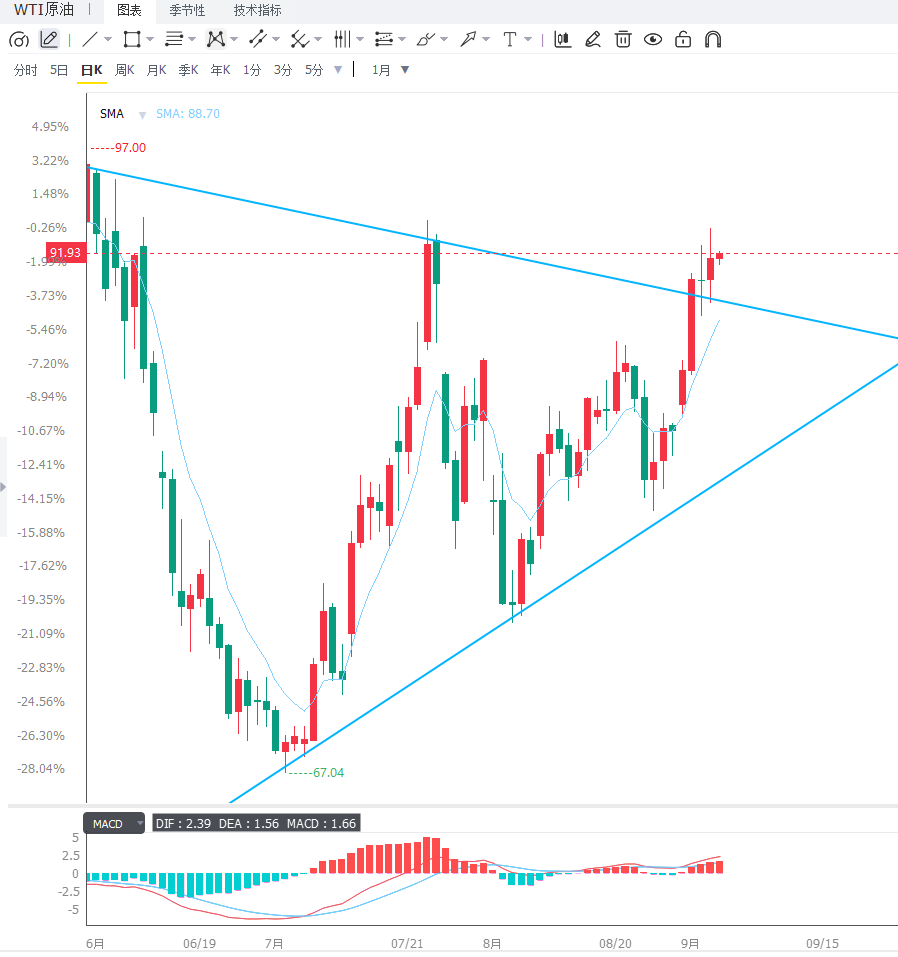 The editor summarizes that WTI is currently in a phase of tug-of-war between supply risks and the fading risk premium. The US military escorting approximately 40 merchant ships through the Strait of Hormuz alleviated the most immediate market concerns about shipping disruptions, but the safe passage of 18 million barrels of crude oil does not mean that supply risks have been completely eliminated. Meanwhile, US diesel prices rose to a record high of $5.820 per gallon, indicating that tight global refined product supplies continue to support the energy market. In the short term, the $93 mark will be a crucial battleground for WTI bulls and bears. If the Strait of Hormuz remains stable and regional tensions further ease, oil prices may gradually relinquish the risk premium; if shipping security is challenged again, or refining facilities experience further disruptions, oil prices could quickly rebound. Going forward, key factors to watch include the actual passage through the Strait of Hormuz, global refined product inventories and refinery operations, supply changes in major oil-producing regions, and the potential impact of high oil prices on global demand. These factors will collectively determine whether WTI can effectively break through the $93 mark.
The latest developments in the market's focus came from the Strait of Hormuz. On Tuesday, the US military escorted approximately 40 commercial vessels carrying a total of about 18 million barrels of crude oil. This operation is considered one of the larger-scale wartime escort operations in recent times. If subsequent merchant ships can continue to pass safely through the strait, the market's risk premium for a sudden supply chain disruption may further decrease, putting some downward pressure on international oil prices. However, improved transport security does not mean the energy supply risk has been eliminated. Reports indicate that the US military responded to multiple drone attacks during this operation. Although the merchant ships ultimately passed through safely, the incident itself illustrates that this energy transport route remains in a high-risk environment. For the crude oil market, the real concern is not whether a single escort was successful, but whether maritime transport can remain continuous, stable, and predictable in the coming days and weeks. The importance of the Strait of Hormuz means that any transport risk will quickly translate into an oil price risk premium. Large quantities of Middle Eastern crude oil and refined products need to pass through this route to enter the global market; therefore, as long as the market perceives a substantial threat to the safety of passage, oil prices may re-induce the risk of supply disruption. Conversely, if commercial vessels can continue to resume normal passage, some of the premium initially created by geopolitical risks may gradually subside. The reason oil prices haven't fallen sharply despite easing transportation risks is also due to the continued possibility of regional instability. Recent military actions have exacerbated market concerns about disruptions to crude oil supply, while new security risks make it difficult for investors to completely withdraw from risk premiums in the energy market. Meanwhile, signals from Russia indicating a willingness to promote peace negotiations have provided some buffer to market sentiment, allowing some investors to reassess potential supply risks. Compared to crude oil itself, the tension signals from the refined oil market are more pronounced. The average price of US diesel rose to $5.820 per gallon on Thursday, a new record high. The continued rise in diesel prices indicates that global middle distillate supply is facing significant pressure, and this pressure is not solely from a single region. The ongoing conflict between the US and Iran, and the attacks by Ukraine on major Russian diesel export refineries, are jointly impacting the global refined oil supply chain. Even if global crude oil resources themselves remain, the effective refining capacity capable of timely conversion into products such as diesel and jet fuel may decrease after refinery disruptions. This structure of "adequate crude oil supply and tight refined product supply" also has a significant impact on oil prices. Therefore, a noteworthy divergence exists in the current crude oil market: eased shipping risks in the Strait of Hormuz have lowered crude oil risk premiums; however, tightening global refined product supply limits the downside potential for oil prices. These two forces offset each other, a key reason why WTI is currently fluctuating around $92. Canadian energy export data also reflects the important role of energy in the balance of payments. Canada continues to maintain a large energy surplus, but the deficit in non-energy sectors is widening. Market analysis shows that Canada's energy surplus narrowed from approximately C$15 billion to C$14.5 billion, while the non-energy deficit widened from approximately C$10.8 billion to C$13.7 billion. This means that energy exports continue to play a significant buffering role in the overall balance of payments, while also indicating increasing external balance pressures on the non-energy sector. For the international oil market, the importance of Canadian data lies not only in its single-month changes, but also in its further illustration that energy exports remain a crucial pillar for stabilizing the balance of payments for some global economies. When international oil prices remain high, energy export revenue can somewhat compensate for weakness in other sectors; however, if oil prices fall significantly, the energy surplus will narrow, and the external balance pressure on relevant economies may further increase. From the demand side, oil prices are also currently constrained. With WTI back above $90/barrel, the market will be more sensitive to the impact of high energy costs on global economic growth. If refined oil prices continue to rise rapidly, it may increase transportation, logistics, and industrial production costs, further pushing up inflation expectations. As a result, the room for monetary easing by major central banks around the world may be limited, while economic growth expectations may be under pressure, ultimately negatively impacting crude oil demand. Therefore, the core contradiction in future oil prices will gradually shift from simple geopolitical risks to a dual game of "supply security and demand pressure." If the Strait of Hormuz remains open and other supply chains gradually recover, WTI may gradually absorb the previously accumulated risk premium; however, if commercial vessels suspend passage on a large scale again, or if regional conflicts further affect key energy infrastructure, the market may quickly re-induce the risk of supply disruptions. From a daily chart perspective, WTI crude oil is currently trading at high levels, with prices hovering around $92 per barrel. While the bullish momentum hasn't accelerated significantly, the overall trend remains strong. Current market momentum is significantly enhanced by geopolitical events, meaning technical movements are easily influenced by unexpected news. The first resistance level to watch is the $93.50-$95.00 per barrel area. A successful break and hold above this level could open up further upside potential towards previous highs. On the downside, the key support level to watch is around $90.00. A break below this level could lead to a pullback to the $87.50-$87.00 area to find new buying support. If geopolitical risks ease further, the pressure for a technical correction may gradually increase. From a 4-hour chart perspective, WTI is currently consolidating after a period of high-level fluctuations. There is still some bullish support above $90, but after consecutive attempts to break through the $92 level, the price is also facing significant profit-taking pressure. If the price can break through and hold above $93.50 in the short term, the market may interpret the breakout as a signal that the bulls have regained control. Conversely, if the price falls below $90, it indicates that short-term momentum is weakening, and the possibility of a further pullback to around $87.50 will significantly increase. In the current market environment, which is highly sensitive to news, technical breakouts must be confirmed in conjunction with factors such as transportation security, refined oil supply, and changes in the regional situation. The editor summarizes that WTI is currently in a phase of tug-of-war between supply risks and the fading risk premium. The US military escorting approximately 40 merchant ships through the Strait of Hormuz alleviated the most immediate market concerns about shipping disruptions, but the safe passage of 18 million barrels of crude oil does not mean that supply risks have been completely eliminated. Meanwhile, US diesel prices rose to a record high of $5.820 per gallon, indicating that tight global refined product supplies continue to support the energy market. In the short term, the $93 mark will be a crucial battleground for WTI bulls and bears. If the Strait of Hormuz remains stable and regional tensions further ease, oil prices may gradually relinquish the risk premium; if shipping security is challenged again, or refining facilities experience further disruptions, oil prices could quickly rebound. Going forward, key factors to watch include the actual passage through the Strait of Hormuz, global refined product inventories and refinery operations, supply changes in major oil-producing regions, and the potential impact of high oil prices on global demand. These factors will collectively determine whether WTI can effectively break through the $93 mark.
- Risk Warning and Disclaimer
- The market involves risk, and trading may not be suitable for all investors. This article is for reference only and does not constitute personal investment advice, nor does it take into account certain users’ specific investment objectives, financial situation, or other needs. Any investment decisions made based on this information are at your own risk.