Non-Farm Payrolls Preview: Can the Labor Market Quell Fed Rate Hike Expectations? US Stocks, Dollar, and Gold Face a Key Test
2026-09-04 10:24:03
The U.S. Bureau of Labor Statistics will release its August non-farm payrolls report at 8:30 p.m. Beijing time on September 4. Following Federal Reserve Chairman Warsh's hawkish speech in Jackson Hole and renewed inflation concerns due to rising international oil prices, this jobs report will be one of the most crucial macroeconomic data points ahead of the September FOMC meeting. 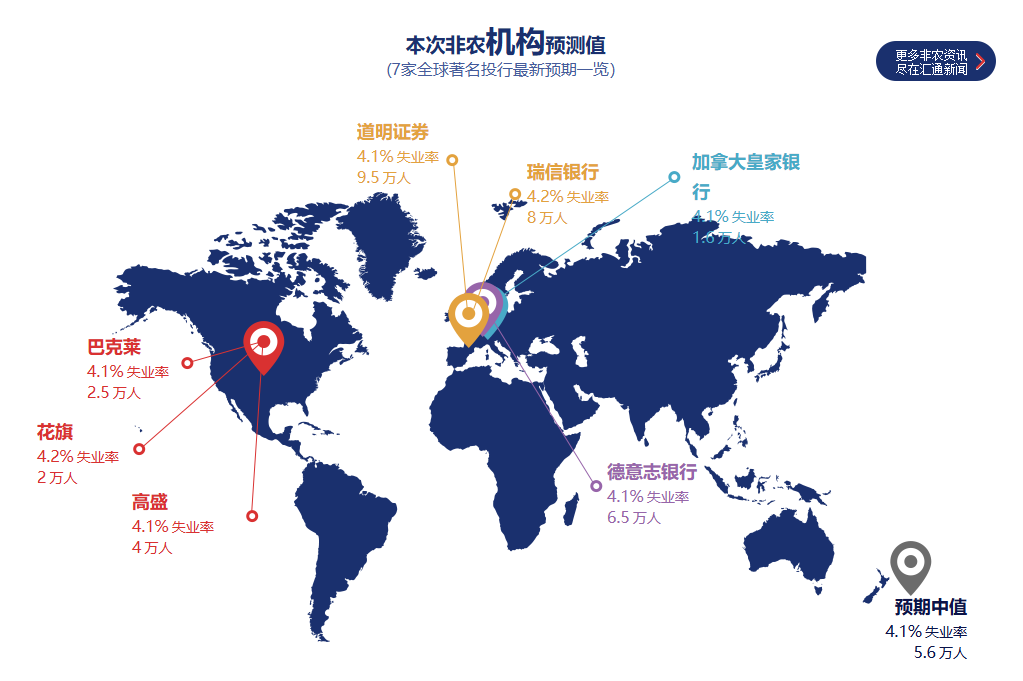
Nonfarm payrolls are expected to resume growth in August, but the US labor market remains in a slow expansion phase.
The US labor market has cooled significantly recently. Non-farm payrolls unexpectedly fell by 23,000 in July, while the unemployment rate remained at 4.1%. Meanwhile, the combined downward revisions of May and June's non-farm payroll data by 103,000 indicate that the actual performance of the labor market was weaker than previously reported. Average hourly earnings rose 3.2% year-over-year in July, and the labor force participation rate remained stable at 61.4%. For the upcoming August report, the latest survey expects non-farm payrolls to increase by approximately 56,000 (compared to approximately 58,000 a week ago), with the unemployment rate expected to remain at 4.1%. Data shows that even if August's non-farm payrolls meet expectations, the US labor market will only see a mild recovery from the contraction in July. Compared to the hundreds of thousands of jobs added in recent years, current job growth has slowed considerably. The latest ADP data further confirms this assessment. Private sector employment in the US increased by only 38,000 in August, lower than the market expectation of 48,000 and also lower than the revised 46,000 in July, marking the slowest growth since January of this year. Education and healthcare services added 45,000 jobs, but manufacturing lost 17,000 and professional and business services lost 16,000, indicating that businesses remain cautious in their hiring intentions. Notably, Warsh emphasized at the Jackson Hole conference that if the Federal Reserve cannot be certain that underlying inflation is returning to its 2% target at a sufficiently rapid pace, policymakers will need to take further action. Following his speech, the market significantly raised its expectations for a September rate hike. As of this week, the interest rate market is still pricing in a 60% probability of a 25 basis point rate hike in September. Meanwhile, the US-Iran conflict has driven international oil prices up again, and US long-term Treasury yields have also risen rapidly. Therefore, whether the August non-farm payrolls data proves that the labor market remains resilient will directly affect whether the Federal Reserve has room for further rate hikes in September. If the August non-farm payrolls data far exceeds expectations —for example, adding more than 100,000 jobs while the unemployment rate remains at 4.1% or even declines—it means that the July job decline is more likely to be a short-term fluctuation. Labor market resilience coupled with high inflation will further increase the likelihood of a September rate hike. If new jobs are added close to market expectations of around 50,000 to 60,000, it indicates that the labor market is still expanding, but at a very moderate pace. Such an outcome alone may not be sufficient to determine the policy direction in September; the Fed will still need to consider the subsequently released August PPI and CPI data for a comprehensive assessment. If non-farm payrolls again approach zero growth or continue to decline, while the unemployment rate rises to 4.2% or higher, it means the labor market is cooling faster than the Fed expected. Even if inflation remains high, the threshold for the Fed to continue raising interest rates will significantly increase.How does non-farm payroll data affect US stocks, the US dollar, and gold?
For US stocks, the S&P 500 is still up over 12% this year, with corporate earnings and AI capital spending continuing to support tech stocks. However, US Treasury yields and expectations of a Fed rate hike are suppressing valuations. If non-farm payrolls significantly exceed expectations, the market may further bet on a September rate hike, and rising yields will put pressure on highly valued tech stocks. The Nasdaq may be more sensitive than the Dow Jones. Conversely, if job growth is slightly below expectations and there are no clear signs of recession, a cooling of rate hike expectations may push yields down, which would be relatively beneficial for growth and tech stocks. What we really need to be wary of is a significantly weaker-than-expected non-farm payrolls report accompanied by a rise in the unemployment rate. At that time, the market may worry about an economic recession and corporate earnings, putting pressure on US stocks. For the US dollar, non-farm payrolls have a relatively direct impact on short-term trends. Stronger-than-expected employment data means the Fed has more room to continue controlling inflation, and expectations of a September rate hike may further increase, thus supporting the dollar index. If job growth is significantly below 50,000 or even turns negative again, the market may reduce its current bets on a rate hike by about 60%, and a decline in short-term Treasury yields will put pressure on the dollar. For gold (XAUUSD), the key impact of the non-farm payrolls report remains its effect on expectations of a Fed rate hike and Treasury yields. As of 10:20 AM on Friday, spot gold had rebounded to around $4480, mainly driven by a decline in the dollar and Treasury yields; meanwhile, the market still expects a roughly 50% probability of a September rate hike. If the non-farm payrolls report is significantly stronger than expected, especially with more than 100,000 new jobs and faster wage growth, Treasury yields and the dollar may rise again, and gold will face selling pressure again, testing the 100-day moving average support level of $4360 or even $4290. Conversely, if job growth is significantly weaker than expected, the market will lower its bets on a September rate hike, and gold may benefit from lower yields and rebound further, potentially breaking through the resistance level around the 200-day moving average of $4533, and even testing the resistance level around $4700 in the future. At 10:21 AM Beijing time, spot gold was trading at $4476.32 per ounce.- Risk Warning and Disclaimer
- The market involves risk, and trading may not be suitable for all investors. This article is for reference only and does not constitute personal investment advice, nor does it take into account certain users’ specific investment objectives, financial situation, or other needs. Any investment decisions made based on this information are at your own risk.