Brent crude is nearing $100, but the real danger isn't this psychological threshold.
2026-09-07 20:28:05
On Monday, September 7th, international crude oil prices re-entered a highly volatile range. Brent crude futures are currently trading around $97.50 per barrel, up about 1.7% from the previous trading day, near a six-week high. Meanwhile, the average daily passage of cargo ships through the Strait of Hormuz over the past 10 days has fallen to about 10 vessels, the lowest level since May, with the conflict between the US and Iran over ships over the weekend further increasing shipping risks. The crude oil market now needs to reprice not just a one-off geopolitical premium, but a systemic risk stemming from the combined effects of transportation constraints, declining inventories, and the persistence of energy inflation. 
 For bonds and equities, the combined impact of persistently high energy prices on real income, corporate profit margins, and policy interest rate expectations is more noteworthy. Rising oil prices initially increase transportation and production costs. If companies cannot fully pass on these costs, profit margins will be under pressure; if they can continue to pass them on, inflation stickiness will increase. The former path affects profitability, while the latter affects valuation discount rates; both channels could ultimately increase the difficulty of pricing risky assets. Therefore, the core observation framework for the current oil market has shifted from "whether it reaches $100" to three variables: the actual effective throughput of the Strait of Hormuz, the rate of global commercial inventory depletion, and the extent to which energy prices are transmitted to core services and wages. These three indicators are more crucial than round number price levels in determining whether an energy shock will ultimately remain in the commodity market or evolve into a broader macroeconomic pricing issue.
Behind the price approaching $100, the real concern lies in physical logistics rather than the round number mark.
$100/barrel is merely a psychological price; the core variable determining the macroeconomic impact is how long high oil prices can be maintained and whether spot supply can be normally allocated across regions. Data from the U.S. Energy Information Administration in August shows that in the second quarter of 2026, the average daily transport of crude oil and petroleum liquids through the Strait of Hormuz will be only 4.9 million barrels, compared to approximately 21.6 million barrels per day before the conflict in the fourth quarter of 2025, a decrease of nearly 80%. While alternative routes exist, the transport distance, costs, and actual capacity cannot fully replicate the strait's normal passage conditions. More importantly, the latest shipping data has deteriorated again. Over the past 10 days, the average daily passage of commodity ships has been around 10, with as few as 2 ships on Saturday. The shutdown of the Automatic Identification System (AIS) causes visible vessel data to underestimate actual transport volume; therefore, the number of ships cannot be simply equated with oil flow. However, insurance rates, shipowner risk appetite, waiting times, and effective shipping capacity are collectively affecting delivery costs, which will be reflected in spot premiums/discounts and refined product crack spreads. On September 6, seven OPEC and its partners decided to maintain the production levels required in September for October, without directly altering the current supply framework through increased production. For the market, this means that short-term balance will continue to depend primarily on the recovery of maritime transport, the reactivation of shut-down capacity, and inventory buffers, rather than solely on changes in nominal production policy.Inventory levels are transforming short-term shocks into more difficult-to-ignore supply and demand issues.
Data from the International Energy Agency's August report better explains the market's high sensitivity to shipping news. Global oil supply rose to 101.5 million barrels per day in July, but was still 6.3 million barrels per day less than the same period last year, with approximately 8.3 million barrels per day of production in the Gulf region still shut down. The agency estimates that the global oil market deficit in the third quarter will be approximately 1.8 million barrels per day, more than double its previous estimate. Inventory buffers are also declining. Global observable oil inventories fell by 69 million barrels in July, a cumulative decrease of approximately 410 million barrels since the start of the conflict. The financial significance of declining inventories lies in the fact that the price elasticity of the same scale of supply disruption differs between high and low inventory environments. When inventories can absorb transportation delays, geopolitical risks are more likely to manifest as short-term fluctuations; when inventories continue to deplete, uncertainty about long-term supply is more easily transmitted to near-month contracts, refined product profits, and corporate procurement costs. Therefore, whether an oil price reaches $100 is not the most critical macroeconomic variable. What truly needs to be observed is whether the rate of inventory depletion continues to outpace the rate of supply recovery, and whether the supply of middle distillates such as diesel and jet fuel remains exceptionally tight. The latter directly connects the freight, manufacturing, and aviation systems and is also a crucial channel through which energy shocks enter the physical price system.The second round of inflation is the most difficult part for the central bank to handle.
The first round of impacts from the energy shock is relatively easy to identify: rising costs of gasoline, diesel, electricity, and transportation. The second round is more complex. As logistics companies raise freight rates, airlines bear fuel costs, and manufacturers shoulder higher transportation and energy bills, these costs may further impact service prices, final commodity prices, and wage negotiations. Once this transmission continues, central banks will no longer be dealing with one-off energy price changes that can be temporarily ignored. Recent data already demonstrates the importance of energy factors. The US Consumer Price Index (CPI) rose 3.4% year-on-year in July, with the core index rising 2.5%, including a 14.7% year-on-year increase in energy prices and a 24.6% year-on-year increase in gasoline prices. In August, employment increased by 162,000, the unemployment rate remained at 4.1%, and average hourly earnings rose 3.1% year-on-year. These figures indicate that when energy price pressures emerged, the labor market had not yet shown significant signs of slowing down, thus requiring central banks to simultaneously assess the persistence of inflation and the resilience of demand. The Federal Reserve maintained the target range for the federal funds rate at 3.50%-3.75% in July and explicitly stated that inflation remained above the 2% target, with supply shocks in sectors such as energy being one of the reasons for price increases. In Europe, the preliminary estimate for overall inflation rose to 3.3% in August, with the energy component rising to 14.3% year-on-year, while inflation excluding food and energy was 2.4%. Recent research by the European Central Bank also points out that this round of price pressures differs from previous demand-driven inflation, with energy supply shocks playing a more significant role.Technical Structure and Cross-Asset Pricing: The Key is the Change in Volatility Patterns
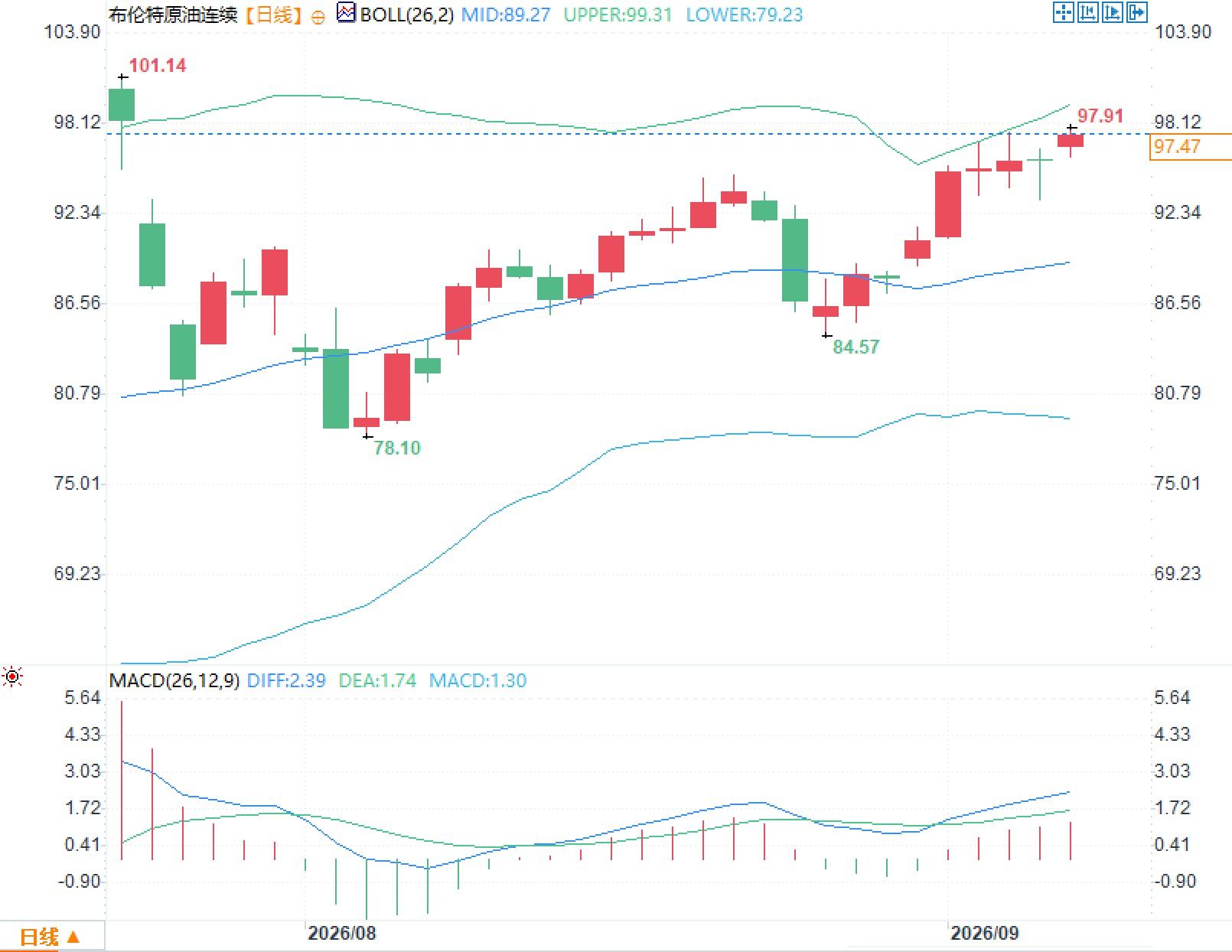
Looking at the daily chart for Brent crude oil, the price is currently trading above the middle Bollinger Band and near the upper edge of the channel, with the Bollinger Bands expanding again. In the MACD, both the DIFF and DEA lines are above the zero line, and the histogram remains positive. Recently, as the price has gradually entered the higher part of the Bollinger Bands, the daily candlesticks have shown some contraction, indicating that geopolitical events are having an increasing impact on intraday volatility. For bonds and equities, the combined impact of persistently high energy prices on real income, corporate profit margins, and policy interest rate expectations is more noteworthy. Rising oil prices initially increase transportation and production costs. If companies cannot fully pass on these costs, profit margins will be under pressure; if they can continue to pass them on, inflation stickiness will increase. The former path affects profitability, while the latter affects valuation discount rates; both channels could ultimately increase the difficulty of pricing risky assets. Therefore, the core observation framework for the current oil market has shifted from "whether it reaches $100" to three variables: the actual effective throughput of the Strait of Hormuz, the rate of global commercial inventory depletion, and the extent to which energy prices are transmitted to core services and wages. These three indicators are more crucial than round number price levels in determining whether an energy shock will ultimately remain in the commodity market or evolve into a broader macroeconomic pricing issue.Frequently Asked Questions
Question 1: Why isn't $100 the most important variable in the current crude oil market? Answer: Round numbers have more psychological significance. What truly affects inflation, corporate profits, and monetary policy is the duration of high energy costs. If transportation and inventory recover quickly, the impact may primarily remain on the commodity side; if supply constraints persist for a long time, costs may gradually be reflected in logistics, manufacturing, and service prices. Question 2: Does a decrease in the number of ships in the Hormuz zone equate to a proportional decrease in crude oil exports? Answer: Not simply. Some ships may have their Automatic Identification Systems (AIS) turned off, and alternative transportation routes exist. However, reduced ship traffic increases insurance, waiting, and transportation costs; therefore, even if the actual decrease in traffic is small, supply chain frictions may still increase significantly.- Risk Warning and Disclaimer
- The market involves risk, and trading may not be suitable for all investors. This article is for reference only and does not constitute personal investment advice, nor does it take into account certain users’ specific investment objectives, financial situation, or other needs. Any investment decisions made based on this information are at your own risk.