With the European Central Bank's decision approaching, why is market focus shifting from interest rate hikes to policy signals?
2026-09-08 15:40:06
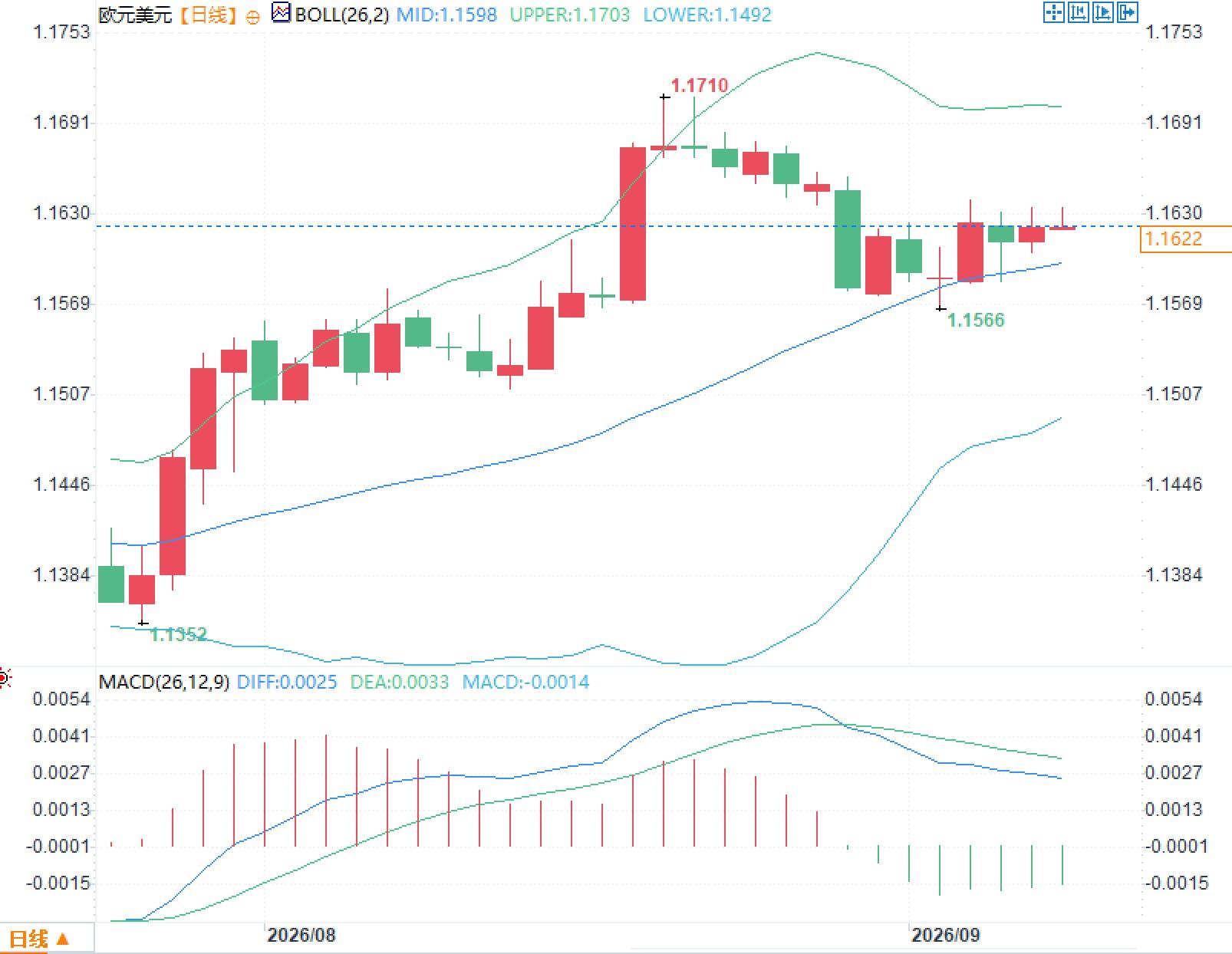
On Tuesday, September 8th, the euro was trading in a narrow range around 1.162 against the US dollar. The US Bureau of Labor Statistics reported that non-farm payrolls increased by 162,000 in August, significantly higher than the market's previous estimate of approximately 56,000; the unemployment rate remained at 4.1%, and average hourly earnings in the private sector rose 3.1% year-on-year and 0.3% month-on-month. June and July employment figures were revised upwards by a combined 55,000, with July's figure revised from a decrease to an increase of 21,000. Following the release of the employment report, federal funds rate futures raised the implied probability of a 25 basis point rate hike at the Fed's September 15-16 meeting to approximately 60%. The European Central Bank is scheduled to hold its monetary policy meeting on September 10th; the deposit facility rate is currently at 2.25%, and the market has almost fully priced in a 25 basis point increase to 2.50%. The Eurozone's harmonized index of consumer prices (HICP) rose to 3.3% year-on-year in August, the highest since September 2023; the energy sub-index rose to 14.3% year-on-year, while core inflation fell to 2.4%. As a result, exchange rate pricing is simultaneously driven by interest rate expectations on both sides, resulting in reduced volatility. Traders are no longer concerned with "whether it will move," but rather with how the wording of the statements and the subsequent path will be rewritten. 
 Eurozone inflation rose to 3.3% in August, primarily driven by a 14.3% year-on-year increase in energy prices, while services inflation fell to 3.0% and core inflation to 2.4%. This structure indicates that price pressures remain highly concentrated in energy and have not yet fully spread to wages and services. For the Governing Council, this provides both a justification for raising interest rates and a reason to "avoid locking in the path all at once." If Lagarde confirms that further tightening is still on the table, the expected interest rate differential between the euro's short-term rate and the dollar will be reassessed; if only the already priced-in 25 basis points are implemented, while all options remain open, then the dollar's rising interest rate expectations due to the employment report will continue to dominate the interest rate differential narrative. Exchange rate reactions depend on the density of the wording, not the interest rate hike figures themselves.
How employment data will rewrite the constraints of the Federal Reserve
Non-farm payrolls measure the net change in wages and jobs excluding agriculture and are one of the most commonly used monthly indicators for observing the Federal Reserve's policy space. The increase of 162,000 jobs in August was higher than the average monthly increase of approximately 31,000 over the past 12 months. The private sector added 127,000 jobs, and the government sector added 35,000, with food service, accommodation, local government, and education being the main contributors. Under the household survey, the labor force participation rate rose from 61.4% in July to 61.6%, and the employment-to-population ratio rose to 59.1%. The unemployment rate remained stable at 4.1%, indicating that job increases were not accompanied by a significant expansion of slack labor. For the interest rate market, the significance of this report lies not in the label of "growth strength," but in its alteration of the relative weights of two constraints in the policy function. If the labor market continues to absorb labor at a rate higher than the break-even point, the necessity for the Federal Reserve to ease monetary policy to support demand decreases, and the inflation path becomes the dominant variable again. While the year-on-year growth of hourly wages at 3.1% was slightly slower than July's 3.2%, it is still higher than the wage growth range that is compatible with the 2% price target in most models in the long term. The market has therefore raised its estimate of the probability of a September rate hike from around 50% before the report to around 60%, while viewing the August Consumer Price Index (CPI) released on September 11 as a key indicator to determine whether this probability will solidify further. What needs to be cautious about is the data structure. Leisure and hospitality, local government, and education accounted for a relatively large proportion of the August increase, while manufacturing added only 16,000 jobs. Improved employment diffusion does not mean that all sectors are overheating simultaneously. The Fed still faces the same set of trade-offs: the speed at which energy prices are transmitted to prices through conflicts in the Middle East, and whether the labor market is sufficient to support a policy fine-tuning primarily aimed at combating inflation. The jobs report merely shifted the balance away from "growth concerns," without providing a separate answer.ECB Meeting: Interest Rate Hike Already Induced, Variables to be Described After Meeting
On June 17, the European Central Bank (ECB) raised its deposit facility rate from 2.00% to 2.25%, its first rate hike in nearly three years. The rate remained unchanged at its July meeting, but ECB President Christine Lagarde acknowledged that some members of the Governing Council had discussed whether immediate action was necessary. At a July press conference, she stated, "The full impact of the energy shock has not yet materialized." At the Sintra Forum, she refused to call the June rate hike an "insurance hike," saying, "Some people have called the rate hike earlier this month an insurance hike. I'm sorry to disappoint them, but that's inaccurate. We face the prospect of simultaneous increases in both headline and core inflation." She also emphasized that policy would be adjusted sequentially based on data and meetings, no longer relying on complex forward guidance. By September, this 25 basis point increase had been almost entirely priced into the yield curve. Surveys of economists by multiple institutions indicate that a deposit facility rate of 2.50% is the baseline scenario; the money market also implies a further upward path, reaching close to 3.00% around June 2027, meaning that two more 25 basis point increases are partially priced in after this one. When the results are fully factored in, the resolution text rarely drives exchange rates on its own. What truly sets the price are three questions raised at the press conference: how will the staff’s latest forecasts rewrite the 2027 inflation return to 2% timeframe; whether the energy shock is described as an “upside risk still under discussion” or as “under observation”; and whether the Council is willing to clarify that “action may still be possible next time.” Eurozone inflation rose to 3.3% in August, primarily driven by a 14.3% year-on-year increase in energy prices, while services inflation fell to 3.0% and core inflation to 2.4%. This structure indicates that price pressures remain highly concentrated in energy and have not yet fully spread to wages and services. For the Governing Council, this provides both a justification for raising interest rates and a reason to "avoid locking in the path all at once." If Lagarde confirms that further tightening is still on the table, the expected interest rate differential between the euro's short-term rate and the dollar will be reassessed; if only the already priced-in 25 basis points are implemented, while all options remain open, then the dollar's rising interest rate expectations due to the employment report will continue to dominate the interest rate differential narrative. Exchange rate reactions depend on the density of the wording, not the interest rate hike figures themselves.The total volume and structure of orders from German factories do not point to the same conclusion.
Data from the German Federal Statistical Office shows that new manufacturing orders rose 2.5% month-on-month in July, higher than the market forecast of about 0.3%, and June's figure was also revised upward to 3.7%, marking the third consecutive month of expansion. Capital goods rose 2.4%, intermediate goods rose 4.3%, and consumer goods fell 4.8%. On the surface, industrial demand in the Eurozone's largest economy is recovering, which the European Central Bank could use to judge that the economy has a certain capacity to absorb higher interest rates. However, after breaking down the structure, the conclusion needs to be discounted. Excluding large contracts, orders fell 1.4% month-on-month. Domestic orders jumped 9.1%, while foreign orders fell 2.1%, with demand outside the Eurozone falling 10.1% and demand within the Eurozone rising 12.1%. Large contracts in shipbuilding, rail vehicle, and aircraft manufacturing contributed most of the increase, while automobile orders fell 12.5%. In other words, the overall improvement is highly dependent on a few long-term projects and demand within the Eurozone, while external demand, especially external demand, has not recovered in tandem. The implications for monetary policy are two-way. Large contracts indicate that the industrial system can still secure medium- to long-term projects, and output will not suddenly stall, weakening the extreme narrative that "interest rate hikes will immediately crush manufacturing." However, the narrow range of order quality and sensitivity to a few contracts suggests a limited breadth of recovery, making it difficult for the Governing Council to interpret this data as a license to unrestrained tightening. German orders are therefore more like a stepping stone: they support the assessment that "the economy can withstand a 2.50% deposit rate," but are insufficient to determine the interest rate ceiling in 2027 on their own.- Risk Warning and Disclaimer
- The market involves risk, and trading may not be suitable for all investors. This article is for reference only and does not constitute personal investment advice, nor does it take into account certain users’ specific investment objectives, financial situation, or other needs. Any investment decisions made based on this information are at your own risk.