Ahead of the Fed's decision, the dollar index has risen for six consecutive days and is nearing the upper limit of its trading range, awaiting a directional move.
2026-09-16 14:32:11
The US dollar index continued its strength in Asian trading on Wednesday, rising for the sixth consecutive trading day and currently trading around 99.70. With the Federal Reserve's September interest rate decision approaching, market funds continue to reposition themselves around US inflation, energy prices, and the future path of monetary policy, maintaining a short-term bullish trend for the dollar. Last week's higher-than-expected US inflation data further reinforced market expectations that the Fed will continue to tighten monetary policy. The market currently widely expects the Fed to raise its benchmark overnight rate by 25 basis points to a range of 3.75% to 4.00%. According to the CME FedWatch tool, the market has priced in a 25 basis point rate hike at approximately 92.4%, indicating that this policy move has been largely priced in by the market.  However, more noteworthy than the rate hike itself is the Fed's stance on future policy path. If the policy statement and economic forecasts continue to signal a hawkish stance, the dollar may receive further support; conversely, if the market believes this round of rate hikes is nearing its end, the dollar may face short-term profit-taking pressure. Changes in the energy market are increasing the complexity of policy decisions. International oil prices rose further after Saudi Arabia closed a major oil pipeline bypassing the Strait of Hormuz. Continued high energy prices may be passed on to end-user prices through fuel, transportation, and production costs, thus increasing inflationary pressure. If high oil prices persist longer than expected, the Fed may maintain a tighter monetary policy for a correspondingly longer period, potentially supporting the dollar. Meanwhile, high US Treasury yields further enhance the attractiveness of dollar assets. With the market already heavily pricing in this rate hike, whether the dollar can continue to strengthen will depend more on whether the Fed uses economic forecasts and policy guidance to raise market expectations for further rate adjustments in October or December. Market focus will therefore shift to Fed Chairman Kevin Warsh's post-meeting press conference. Investors will focus on clues regarding inflation, employment, economic growth, and subsequent interest rate adjustments. If Warsh emphasizes the potential impact of energy prices on inflation and hints that policy needs to remain restrictive, the dollar index is likely to maintain its high levels; however, a more cautious tone could trigger a short-term pullback. From a daily chart perspective, the dollar index is currently trading around 99.70, remaining above the 50-period and 9-period EMAs. The short-term moving averages maintain a bullish alignment, indicating that the recent upward trend of the dollar index has not been broken. The 14-day RSI is around 56, in a relatively strong zone, but has not yet entered a clearly overbought area. Therefore, current technical indicators still provide room for the dollar to further test higher levels. The first support level to watch is around 99.64 near the 50-day EMA, which is currently the most direct dynamic support. If the dollar index experiences a technical pullback after the Fed's decision, whether 99.64 can hold will be a crucial reference for judging short-term strength. Further support lies at around 99.35 near the 9-day EMA. A break below this area would weaken the short-term bullish advantage formed by the recent continuous rise. The key area to watch is the 99.70 to 100.00 range. 99.70 is the current short-term trading level, while 100.00 is a significant psychological barrier. If the US dollar index can break through and stabilize above 100.00 driven by policy support, market attention will shift further to the previous high area; if it encounters resistance, caution is needed regarding potential pullback pressure from the realization of positive news. On the 4-hour chart, the US dollar index maintains an upward trend, with short-term moving averages continuing to provide support. Volatility may increase significantly after the Fed's decision, with 99.64 and 99.35 forming a short-term bullish defense zone, while 100.00 is a key psychological level. Short-term trading should focus on whether the policy statement and press conference change market expectations regarding the future interest rate path.
 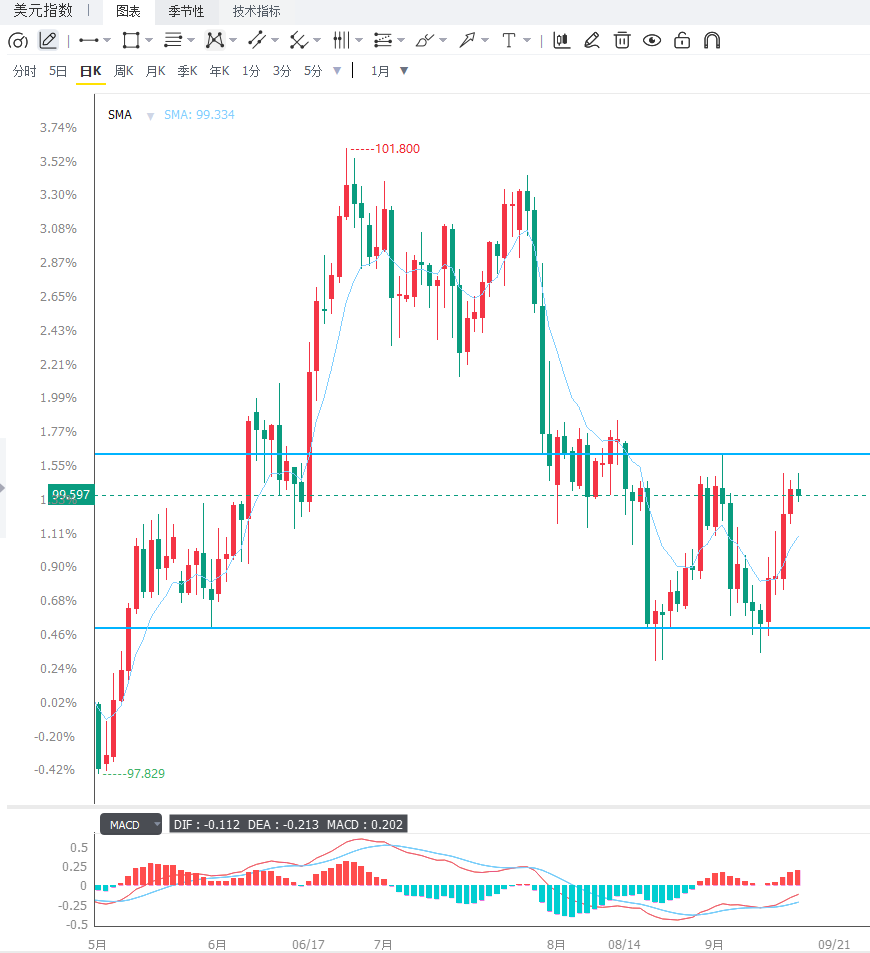 Editor's Summary: The US dollar index has risen for six consecutive trading days. Current market expectations for a 25 basis point rate hike by the Federal Reserve are highly concentrated. The real short-term variables lie in the repricing of subsequent interest rate paths by the policy statement, economic forecasts, and press conference. Inflation risks from high oil prices, US Treasury yields, and monetary policy expectations will continue to jointly influence the dollar's trajectory. Technically, 99.64 and 99.35 are important support levels, while 100.00 is a key psychological level to watch in the next phase.
However, more noteworthy than the rate hike itself is the Fed's stance on future policy path. If the policy statement and economic forecasts continue to signal a hawkish stance, the dollar may receive further support; conversely, if the market believes this round of rate hikes is nearing its end, the dollar may face short-term profit-taking pressure. Changes in the energy market are increasing the complexity of policy decisions. International oil prices rose further after Saudi Arabia closed a major oil pipeline bypassing the Strait of Hormuz. Continued high energy prices may be passed on to end-user prices through fuel, transportation, and production costs, thus increasing inflationary pressure. If high oil prices persist longer than expected, the Fed may maintain a tighter monetary policy for a correspondingly longer period, potentially supporting the dollar. Meanwhile, high US Treasury yields further enhance the attractiveness of dollar assets. With the market already heavily pricing in this rate hike, whether the dollar can continue to strengthen will depend more on whether the Fed uses economic forecasts and policy guidance to raise market expectations for further rate adjustments in October or December. Market focus will therefore shift to Fed Chairman Kevin Warsh's post-meeting press conference. Investors will focus on clues regarding inflation, employment, economic growth, and subsequent interest rate adjustments. If Warsh emphasizes the potential impact of energy prices on inflation and hints that policy needs to remain restrictive, the dollar index is likely to maintain its high levels; however, a more cautious tone could trigger a short-term pullback. From a daily chart perspective, the dollar index is currently trading around 99.70, remaining above the 50-period and 9-period EMAs. The short-term moving averages maintain a bullish alignment, indicating that the recent upward trend of the dollar index has not been broken. The 14-day RSI is around 56, in a relatively strong zone, but has not yet entered a clearly overbought area. Therefore, current technical indicators still provide room for the dollar to further test higher levels. The first support level to watch is around 99.64 near the 50-day EMA, which is currently the most direct dynamic support. If the dollar index experiences a technical pullback after the Fed's decision, whether 99.64 can hold will be a crucial reference for judging short-term strength. Further support lies at around 99.35 near the 9-day EMA. A break below this area would weaken the short-term bullish advantage formed by the recent continuous rise. The key area to watch is the 99.70 to 100.00 range. 99.70 is the current short-term trading level, while 100.00 is a significant psychological barrier. If the US dollar index can break through and stabilize above 100.00 driven by policy support, market attention will shift further to the previous high area; if it encounters resistance, caution is needed regarding potential pullback pressure from the realization of positive news. On the 4-hour chart, the US dollar index maintains an upward trend, with short-term moving averages continuing to provide support. Volatility may increase significantly after the Fed's decision, with 99.64 and 99.35 forming a short-term bullish defense zone, while 100.00 is a key psychological level. Short-term trading should focus on whether the policy statement and press conference change market expectations regarding the future interest rate path. Editor's Summary: The US dollar index has risen for six consecutive trading days. Current market expectations for a 25 basis point rate hike by the Federal Reserve are highly concentrated. The real short-term variables lie in the repricing of subsequent interest rate paths by the policy statement, economic forecasts, and press conference. Inflation risks from high oil prices, US Treasury yields, and monetary policy expectations will continue to jointly influence the dollar's trajectory. Technically, 99.64 and 99.35 are important support levels, while 100.00 is a key psychological level to watch in the next phase.
- Risk Warning and Disclaimer
- The market involves risk, and trading may not be suitable for all investors. This article is for reference only and does not constitute personal investment advice, nor does it take into account certain users’ specific investment objectives, financial situation, or other needs. Any investment decisions made based on this information are at your own risk.