A seven-day easing of tensions between the US and Iran has led to a plan to reopen the Strait of Hormuz, with concessions even made on nuclear matters.
2026-09-25 20:16:19
The biggest variable in the oil market this week came from the sudden easing of geopolitical tensions in the Middle East. Early Friday morning, a sudden positive development emerged: reports surfaced that the US and Iran were negotiating a phased reconciliation plan, with the core issues revolving around reopening the Strait of Hormuz, lifting the US maritime blockade, and resuming nuclear negotiations. Subsequently, on Friday, Iranian officials officially stated that if the US accepted the framework of the June Islamabad Memorandum of Understanding, Iran could reopen the Strait of Hormuz within seven days. This news directly rewrote short-term trading logic, with the previously escalating geopolitical risk aversion quickly subsiding. Brent and WTI crude oil prices fell simultaneously, risk appetite rapidly recovered, leading to lower US Treasury yields, narrowing losses in US stocks, and a decline in the US dollar index. The entire market underwent a significant risk repricing. 
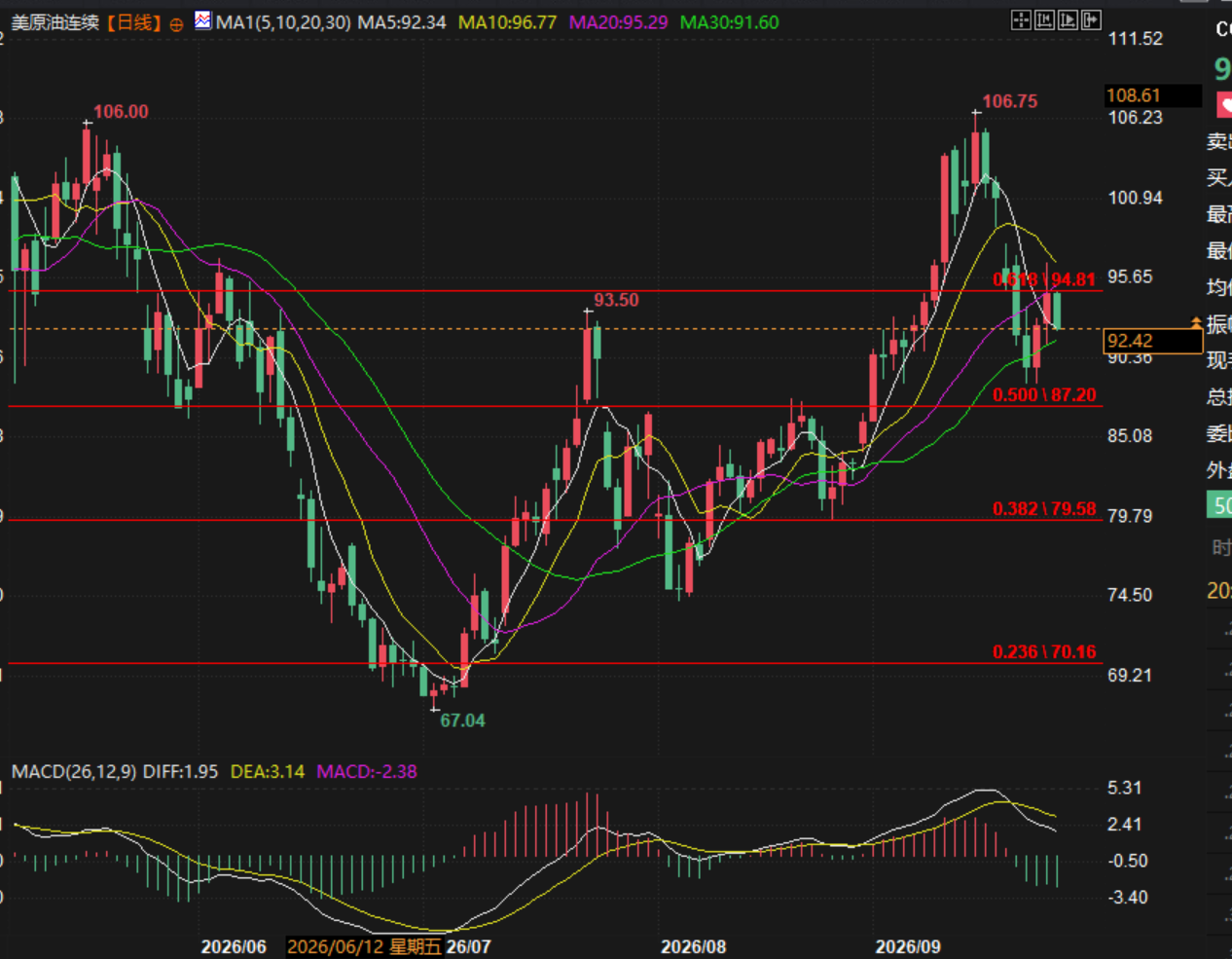 (WTI crude oil futures main contract daily chart, source: EasyTrade) At 20:14 Beijing time, WTI crude oil futures main contract was trading at $92.78 per barrel.
Iran's forced concessions: The pressure of long-term blockade has accumulated, and the marginal situation has shown a clear shift.
Iran's recent offer of a negotiation proposal is not a chance gesture of goodwill, but rather a passive compromise under long-term sanctions and blockades. The US-Iran conflict has now lasted for over seven months, with Iran facing a US maritime blockade and financial sanctions, resulting in a near standstill in its oil exports. Coupled with the recent suspension of shipping routes to Iran by the UAE and Iraq, Iran's land and sea routes are restricted, leading to a comprehensive escalation of external pressure. Crucially, the Iranian oil blockade has lasted for over 70 days, domestic oil storage capacity remains tight, and inventory pressure is approaching a critical level. Continued standoff would have an irreversible impact on Iran's domestic economy and energy system. Under these multiple pressures, Iran's policy stance has softened significantly, which is the core underlying reason for this round of geopolitical de-escalation.Hidden risks: The government's overtures, but the pro-war faction's silence, may be a delaying tactic.
Although the Iranian president and foreign minister have repeatedly signaled goodwill towards peace talks, expressing willingness to abandon high-enriched uranium, accept inspections, and continue using the old agreement framework, the market needs to be highly vigilant about structural disagreements. Currently, moderates dominate Iranian diplomacy, but the militant faction led by the Revolutionary Guard has remained silent and has not abandoned its military confrontation stance. In other words, the current signs of détente may be a temporary delaying tactic by Iran: to release goodwill through negotiations, alleviate the pressure of the blockade, and free up storage capacity, while the militant forces remain at the table awaiting further developments. The deep-seated conflicts in the Middle East have not been truly resolved.Regional conflicts have not subsided, and geopolitical premiums have not been fully cleared.
While diplomatic efforts have eased, military conflicts in the Middle East continue to escalate. The Houthi rebels have launched sustained large-scale missile and drone attacks on Saudi military targets, prompting Saudi Arabia to intercept ballistic missiles multiple times and triggering emergency alerts in cities such as Mecca and Jeddah. Saudi Arabia, along with Turkey and Pakistan, held an emergency defense meeting, indicating that the regional standoff persists. This means that even if US-Iran negotiations progress, the geopolitical risk premium in the oil market will not be completely eliminated, and the downside potential for oil prices will continue to be constrained.Medium- to long-term trading logic: High oil prices are an abnormal state and will eventually return to fundamentals.
The energy turmoil, extreme high oil prices, and global imported inflation that have lasted for over seven months are typical of abnormal geopolitical disturbances, not the norm in the market. Neither the global economies' anti-inflationary pressures nor Iran's own economic pressures can sustain the current standoff indefinitely. As all parties' tolerance levels approach their limits, the buffer space for geopolitical maneuvering continues to shrink. The general trend is for the Middle East situation to cool down and oil prices to gradually return to supply and demand fundamentals. In the short term, oil prices will continue to fluctuate weakly due to the receding geopolitical tensions, but before the geopolitical conflict is fully resolved, the market will remain highly volatile and prone to repeated fluctuations. Technically, WTI crude oil futures have recently fallen below the 0.618 Fibonacci retracement level of this price surge and are currently fluctuating in the 95-87 range. (WTI crude oil futures main contract daily chart, source: EasyTrade) At 20:14 Beijing time, WTI crude oil futures main contract was trading at $92.78 per barrel.
- Risk Warning and Disclaimer
- The market involves risk, and trading may not be suitable for all investors. This article is for reference only and does not constitute personal investment advice, nor does it take into account certain users’ specific investment objectives, financial situation, or other needs. Any investment decisions made based on this information are at your own risk.