Gold prices have fallen sharply as the market faces a double whammy of declining interest rates and liquidity.
2026-09-28 18:02:20
The current market is in a typical bearish environment for gold: the Federal Reserve continues to tighten monetary policy, the US dollar continues to strengthen, and the 10-year US Treasury yield has soared to around 5.2%, reaching a near 20-year high. According to traditional trading logic, gold, as a non-interest-bearing asset, should experience a deep sell-off. According to the World Gold Council's classic pricing model: all other things being equal, for every 25 basis point increase in the 10-year US Treasury yield, the price of gold falls by approximately 1.75%. Based on the current extremely high yields, theoretically, the price of gold should fall below $4,000 per ounce. However, the actual market situation has completely deviated from this traditional framework. Last week, the price of gold held above $4,300 per ounce, demonstrating extremely strong resilience. Almost all traditional correlation indicators point to a deep fall in gold, and thus, this morning, with the collective sell-off in Asian equity markets, gold also began a technical breakdown and subsequent decline. 
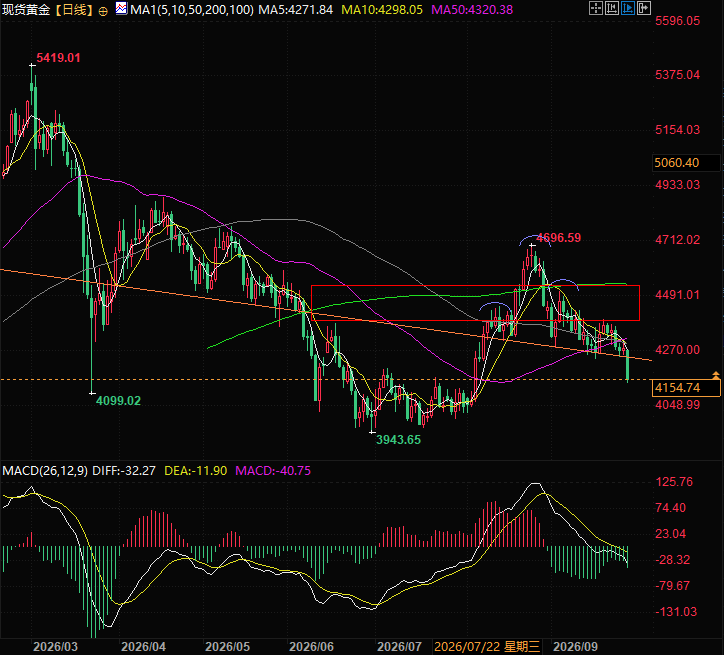 (Spot gold daily chart, source: EasyTrade) At 17:59 Beijing time, spot gold is currently trading at $4156 per ounce.
Short-term price correction is confirmed: A renewed surge in negative interest rates coupled with a liquidity crunch is driving the market.
Gold is not entirely free from interest rate constraints; last week, gold prices fell by over 2%, and this morning saw a technical breakdown. The combined impact of interest rate shocks and cross-market liquidity shocks this morning directly led to this breakdown and subsequent decline in gold prices. This morning, US Treasury real yields rose sharply again (2-10 year US Treasury yields rose), further increasing the opportunity cost of holding non-interest-bearing assets. Funds continued to favor high-yield US Treasuries and dollar assets, directly suppressing gold prices. Simultaneously, a significant liquidity squeeze occurred in the short-term market; even though the dollar index did not strengthen today, gold still experienced a sharp decline. This means that the core driver of this correction has shifted from simple dollar-denominated price suppression to a double whammy of interest rate valuation reshaping and market-wide liquidity withdrawal. A comparison with previous market conditions clearly shows that even when interest rates and the dollar remained extremely bearish, gold prices consistently showed limited declines and strong resilience. However, today's rebound in yields, coupled with collective selling pressure in the equity market, directly broke through short-term technical support for gold, triggering a further decline.Sources of resilience: Central bank support + inflation and fiscal risks reshaping the value of gold
Even with the technical breakdown caused by the current interest rate rebound and liquidity crunch, the underlying support logic for gold's long-term resilience has not completely disappeared. The current market pricing logic for gold has completely departed from a single "interest rate pricing" model, evolving into a two-way game of "interest rate suppression + risk hedging." Global central bank gold purchases remain the most solid underlying support for the market, coupled with the actual situation of the global debt crisis, continuously offsetting the negative pressure on interest rates. At the same time, persistent high global inflation, volatile Middle East geopolitical situations, and the continued escalation of US fiscal risks ensure that gold's portfolio hedging value remains constant, which is the core reason why gold prices have long been far higher than traditional pricing models. A more crucial structural change lies in the fact that the current ultra-high 5.2% US Treasury yield is completely different from historical environments with similar yields. US government debt has exceeded $40 trillion, and every 1 percentage point increase in borrowing costs will bring nearly $400 billion in new interest payments annually, leading to a continuous accumulation of debt risk. The market has formed a rare paradox of bullish and bearish game: rising yields continue to increase the cost of holding gold and suppress prices; however, the core drivers of soaring yields—persistent inflation, debt expansion, and concerns about fiscal sustainability—conversely continue to strengthen the long-term allocation logic of gold, which is also the core reason why traditional interest rate models have been continuously hedged recently.Cross-asset sell-off: A-shares and gold weaken in tandem, highlighting extreme liquidity squeeze characteristics.
The most significant anomaly in this morning's trading was the simultaneous sharp decline in Asian equity markets, including A-shares, along with gold. Combined with the fact that the US dollar did not strengthen today, it can be determined that this gold decline was not due to externally priced negative factors, but rather a typical market-wide liquidity squeeze. Against the backdrop of a collective plunge in Asian equity markets and a comprehensive revaluation of assets, institutions were forced to reduce their positions, withdraw cash, and replenish margin. Gold, as the most liquid asset class globally, became the preferred target for rapid liquidation and liquidity withdrawal. This completely rendered gold's short-term safe-haven properties ineffective, causing it to fall in tandem with risk assets—a typical example of fund-driven behavior rather than a weakening of fundamentals.The underlying cause of the decline: AI-driven market analysis is reshaping the global asset valuation system and amplifying market volatility.
The core trigger for this round of cross-market liquidity tightening and collective asset correction lies in the global asset revaluation risk brought about by the AI narrative, which is also the biggest new uncertainty variable in the current market. On the one hand, AI technology continues to disrupt and replace traditional industries, continuously compressing the profit margins of traditional industries, leading to a significant reduction in the valuation of a large number of traditional equity assets in the A-share market. This puts pressure on the overall equity market, triggering passive position reductions and a contraction of risk exposure. On the other hand, the market is gradually becoming wary of the overvaluation bubble risk in the AI sector. Coupled with the US's continued tightening of export restrictions on AI technology (restrictions on optical modules were introduced last Friday), the uncertainty of the global AI industry chain has increased significantly, weakening expectations for growth assets and further amplifying market volatility and risk aversion. The market is caught in a dual valuation anxiety of "traditional assets shrinking and AI assets being overvalued." The only way to cope is to withdraw cash and reduce positions, and gold, with its best liquidity, has become the main target of this round of capital flight.The core logic for the market outlook: old pricing rules are no longer effective, and short-term liquidity shocks do not change the long-term logic.
The current market is clearly divided between bulls and bears: the market will eventually face a directional choice. Either the US economy weakens and US Treasury yields fall from their highs, correcting gold's valuation; or high interest rates persist, continuously exposing the structural vulnerability of the massive US debt, further strengthening gold's long-term hedging value. In the short term, given the repeated rebounds in US Treasury yields and the continued tightening of market liquidity, gold still has room for further adjustment, and its technical weakness is unlikely to reverse in the short term. However, the core focus of this market trend has never been a short-term correction in gold, but rather the exceptional resilience of gold prices, far exceeding traditional pricing models, amidst 20 years of high interest rates and repeated negative factors. Today's market, where the dollar did not rise but gold fell sharply, further confirms that gold pricing has completely broken away from the traditional single formula of "dollar + interest rate." Old trading logic has become completely ineffective, and gold has officially entered a new pricing cycle driven by multiple factors including interest rates, debt, inflation, liquidity, and geopolitics. Technically, spot gold has broken below a head and shoulders pattern, with a measured decline of around 4000 points. (Spot gold daily chart, source: EasyTrade) At 17:59 Beijing time, spot gold is currently trading at $4156 per ounce.
- Risk Warning and Disclaimer
- The market involves risk, and trading may not be suitable for all investors. This article is for reference only and does not constitute personal investment advice, nor does it take into account certain users’ specific investment objectives, financial situation, or other needs. Any investment decisions made based on this information are at your own risk.