Gold prices retreated slightly as bulls and bears cautiously traded ahead of the US CPI data release.
2026-10-14 10:26:19
Spot gold fell about 0.27% in the previous trading session, closing at $4160.58 per ounce, after briefly touching the $4200 mark before encountering resistance and falling back. Gold prices continued their weakness in Asian trading on Wednesday, trading around $4155, while spot silver, platinum, and palladium also came under pressure. Domestic spot gold is currently quoted at approximately 894.6 yuan per gram, a slight decrease from yesterday's close.  The core contradiction in the current gold market lies in the interplay between "geopolitical safe-haven demand" and "high interest rate suppression." The escalating situation in the Middle East—with the Houthi rebels launching multiple missile attacks on Saudi Arabia and increased shipping risks in the Strait of Hormuz—has kept Brent crude oil above $106 and WTI crude oil at $94.79 per barrel. High oil prices, through the inflation transmission chain, reinforce the necessity for the Federal Reserve to maintain its tightening policy. The 10-year US Treasury yield remains high at around 5.2%, and the real interest rate of approximately 2.9% is at its highest level since 2008, significantly increasing the opportunity cost of holding non-interest-bearing gold. This transmission path of "rising oil prices, falling gold prices" has become the dominant logic in recent gold pricing. Divergent statements from Federal Reserve officials have exacerbated market uncertainty. New York Fed President Williams stated on Tuesday that another rate hike this year would be appropriate, but believes further tightening is unnecessary in 2027. Following his speech, the dollar index fell to 102.18, and US Treasury yields declined in tandem. However, Cleveland Fed President Hamack made hawkish comments on the same day, stating that the Fed should "relatively quickly" shift to a more restrictive policy to control inflation. The CME FedWatch tool shows that the market prices a 19% to 20% probability of an October rate hike, but the probability of a December rate hike remains as high as 85% to 88%. From a funding perspective, CTA institutions have begun to cover some of their short positions in gold and platinum, but TD Securities warns that prices still face the risk of further selling pressure. The medium- to long-term logic of global central banks' continued gold purchases remains unchanged—major Asian central banks have increased their gold holdings for 23 consecutive months, buying another 740,000 ounces in September—building a bottom support for gold prices. However, short-term ETF holdings are not stable, and a break below the $4,000 mark could trigger concentrated selling. From a technical perspective, gold maintains a downtrend on the daily chart, with the price trading below the 100-day moving average (approximately $4,250) and the Bollinger Band middle line (approximately $4,220), and the overall bearish pattern remains unbroken. The RSI is around 43, below the neutral 50 line but not yet in oversold territory, indicating weak buying interest rather than extreme oversold conditions. The MACD histogram remains green, suggesting that bearish momentum has not yet clearly weakened. The first resistance level is at the $4200 psychological level, corresponding to the upper edge of the recent trading range; a break above this level could extend a short-term rebound to the $4220-$4230 area, with stronger resistance at $4250 (100-day moving average) and $4390 (upper Bollinger Band). On the downside, the first support level to watch is $4150, corresponding to the recent low and the lower Bollinger Band (around $4045); a break below this level would likely lead to a test of $4120, with stronger support at the $4000 psychological level.
 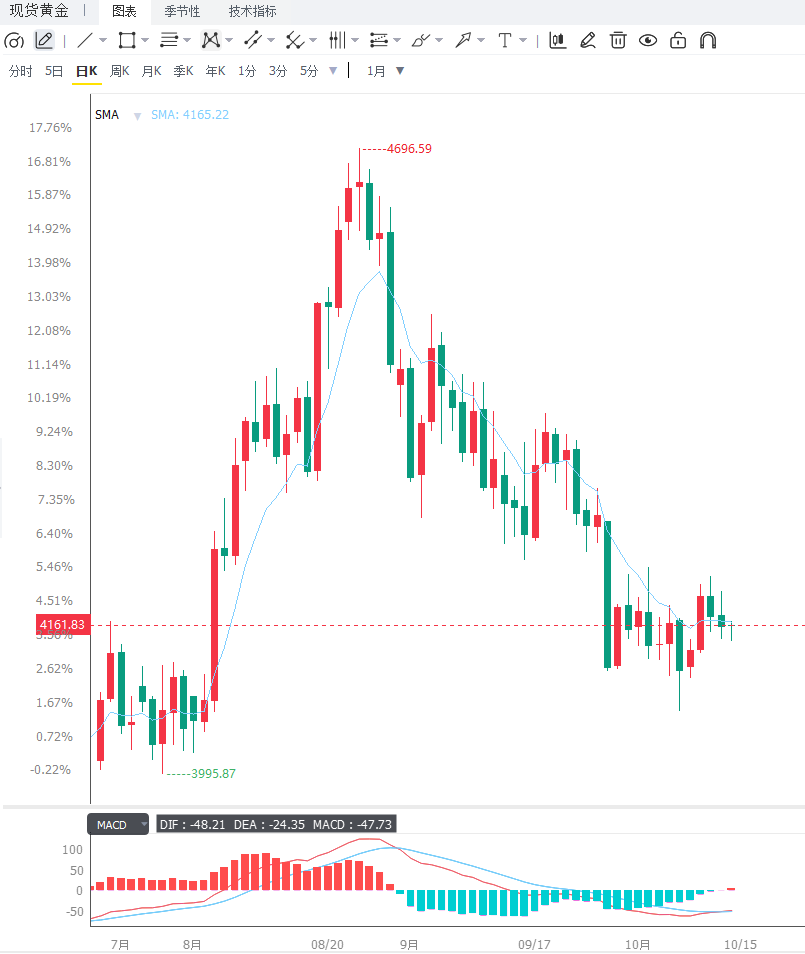 Editor's Summary: Gold is currently caught in a dual game of "high oil prices + high interest rates suppressing growth" and "geopolitical safe-haven demand + central bank gold purchases supporting growth." Technically, the bearish structure remains intact, but the RSI has not entered extreme oversold territory, limiting the potential for a short-term rebound. Tonight's US September CPI data will be a key variable—if core inflation is stronger than expected, it could reignite bets on a December rate hike, potentially pushing gold prices below $4150 to test $4120; if the data is weaker, the dollar and US Treasury yields will fall, and gold prices could test the $4200-$4230 resistance zone. Until $4200 is effectively broken, the overall structure will likely remain range-bound.
The core contradiction in the current gold market lies in the interplay between "geopolitical safe-haven demand" and "high interest rate suppression." The escalating situation in the Middle East—with the Houthi rebels launching multiple missile attacks on Saudi Arabia and increased shipping risks in the Strait of Hormuz—has kept Brent crude oil above $106 and WTI crude oil at $94.79 per barrel. High oil prices, through the inflation transmission chain, reinforce the necessity for the Federal Reserve to maintain its tightening policy. The 10-year US Treasury yield remains high at around 5.2%, and the real interest rate of approximately 2.9% is at its highest level since 2008, significantly increasing the opportunity cost of holding non-interest-bearing gold. This transmission path of "rising oil prices, falling gold prices" has become the dominant logic in recent gold pricing. Divergent statements from Federal Reserve officials have exacerbated market uncertainty. New York Fed President Williams stated on Tuesday that another rate hike this year would be appropriate, but believes further tightening is unnecessary in 2027. Following his speech, the dollar index fell to 102.18, and US Treasury yields declined in tandem. However, Cleveland Fed President Hamack made hawkish comments on the same day, stating that the Fed should "relatively quickly" shift to a more restrictive policy to control inflation. The CME FedWatch tool shows that the market prices a 19% to 20% probability of an October rate hike, but the probability of a December rate hike remains as high as 85% to 88%. From a funding perspective, CTA institutions have begun to cover some of their short positions in gold and platinum, but TD Securities warns that prices still face the risk of further selling pressure. The medium- to long-term logic of global central banks' continued gold purchases remains unchanged—major Asian central banks have increased their gold holdings for 23 consecutive months, buying another 740,000 ounces in September—building a bottom support for gold prices. However, short-term ETF holdings are not stable, and a break below the $4,000 mark could trigger concentrated selling. From a technical perspective, gold maintains a downtrend on the daily chart, with the price trading below the 100-day moving average (approximately $4,250) and the Bollinger Band middle line (approximately $4,220), and the overall bearish pattern remains unbroken. The RSI is around 43, below the neutral 50 line but not yet in oversold territory, indicating weak buying interest rather than extreme oversold conditions. The MACD histogram remains green, suggesting that bearish momentum has not yet clearly weakened. The first resistance level is at the $4200 psychological level, corresponding to the upper edge of the recent trading range; a break above this level could extend a short-term rebound to the $4220-$4230 area, with stronger resistance at $4250 (100-day moving average) and $4390 (upper Bollinger Band). On the downside, the first support level to watch is $4150, corresponding to the recent low and the lower Bollinger Band (around $4045); a break below this level would likely lead to a test of $4120, with stronger support at the $4000 psychological level. Editor's Summary: Gold is currently caught in a dual game of "high oil prices + high interest rates suppressing growth" and "geopolitical safe-haven demand + central bank gold purchases supporting growth." Technically, the bearish structure remains intact, but the RSI has not entered extreme oversold territory, limiting the potential for a short-term rebound. Tonight's US September CPI data will be a key variable—if core inflation is stronger than expected, it could reignite bets on a December rate hike, potentially pushing gold prices below $4150 to test $4120; if the data is weaker, the dollar and US Treasury yields will fall, and gold prices could test the $4200-$4230 resistance zone. Until $4200 is effectively broken, the overall structure will likely remain range-bound.
- Risk Warning and Disclaimer
- The market involves risk, and trading may not be suitable for all investors. This article is for reference only and does not constitute personal investment advice, nor does it take into account certain users’ specific investment objectives, financial situation, or other needs. Any investment decisions made based on this information are at your own risk.