Rising US Treasury yields are suppressing gold's rebound, and it has returned to the lower edge of its trading range in the short term.
2026-10-20 10:14:20
U.S. Treasury yields generally rose, with the 2-year Treasury yield climbing more than 3 basis points to 4.778%, the 10-year yield rising more than 4 basis points to 5.144%, and the 30-year yield increasing by more than 4 basis points to 5.476%. Gold, as a non-interest-bearing asset, is highly sensitive to changes in real interest rates and U.S. Treasury yields. Rising yields increase the opportunity cost of holding gold, thus putting downward pressure on its price. Furthermore, the large-scale riots that erupted in France over the weekend led to a sell-off of French government bonds, further pushing up global sovereign bond yields. Although the decline in energy prices has alleviated inflation concerns to some extent, the rise in U.S. Treasury yields has a more direct and significant impact on gold prices.  Following the Federal Reserve's 25 basis point rate hike in September, market focus has shifted to the October 28th policy meeting. Fed Chairman Warsh's recent cautious statements, stating he would not "predict" the meeting's outcome, have been interpreted by the market as support for maintaining interest rates unchanged this month. The CME FedWatch tool shows that the federal funds futures market is pricing in an approximately 82.8% probability that the Fed will keep interest rates unchanged in October. Deutsche Bank strategists point out that this week's US data calendar is relatively light, and the market will continue to digest last week's better-than-expected inflation data. Meanwhile, inflation expectations are rising simultaneously in Europe and the US—the US 1-year inflation swap rose 17 basis points last week to 2.74%, and the Eurozone 1-year inflation swap rose 21 basis points to 3.69%, which has exacerbated market concerns about double-dip inflation to some extent, but the short-term boost to gold has been offset by rising US Treasury yields. In his speech, Warsh also mentioned the potential impact of AI demand shocks on employment, and the Fed's newly established task force's focus on technology-driven macroeconomic and financial stability risks. The FXS Fed Sentiment Index remained high at 127.51, indicating that the overall policy tone remained hawkish, which supported the US dollar and indirectly suppressed gold. From a daily chart perspective, gold is trading below the 100-day simple moving average and below the Bollinger Band's middle line, indicating a continued short-term bearish trend. The RSI (14) is around 42, below the 50 neutral line, indicating weak momentum, but it has not yet entered the oversold zone, suggesting further downside potential. Regarding resistance, the Bollinger Band's middle line at approximately $4180 is the primary resistance level for the recent rebound, while the 100-day moving average at approximately $4240 provides stronger resistance. The upper Bollinger Band at approximately $4315 is a key confirmation level for a trend reversal. On the downside, the lower Bollinger Band at approximately $4050 is a key defensive level recently; if it breaks down effectively, the correction could extend further to the $4000 level. Gold prices are currently facing headwinds from both moving average resistance and rising yields. Bulls need to wait for prices to firmly establish themselves above $4,180 before confirming an upward revision of the rebound; if prices fall below $4,050, the risk of accelerated decline should be noted.
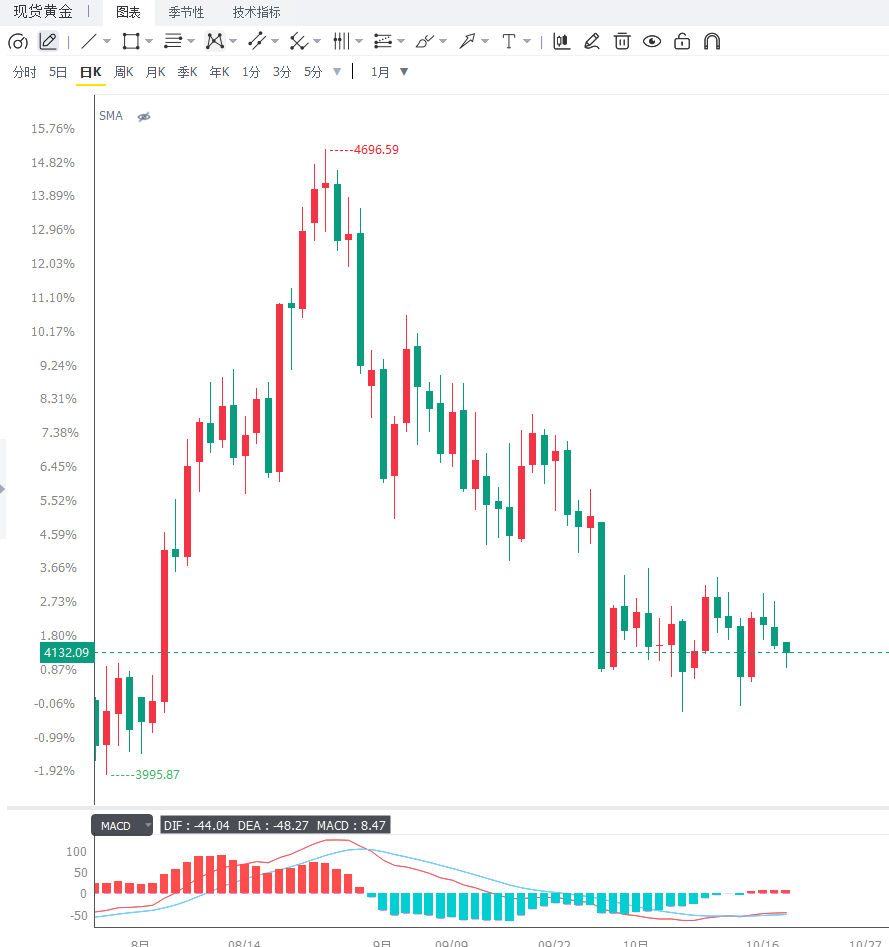 Editor's Summary: Gold faces dual pressure in the short term from rising US Treasury yields and expectations of Federal Reserve policy. Although the French riots and political uncertainty in the Eurozone provided some safe-haven support, it was insufficient to reverse the short-term bearish trend. Next week's Fed meeting in October will be a key catalyst. If the meeting releases a hawkish signal or US Treasury yields continue to rise, gold prices may further test the $4050 support level; conversely, if the Fed's stance is dovish or geopolitical risks escalate, gold prices are expected to rebound and test the $4180-$4240 resistance zone.
Following the Federal Reserve's 25 basis point rate hike in September, market focus has shifted to the October 28th policy meeting. Fed Chairman Warsh's recent cautious statements, stating he would not "predict" the meeting's outcome, have been interpreted by the market as support for maintaining interest rates unchanged this month. The CME FedWatch tool shows that the federal funds futures market is pricing in an approximately 82.8% probability that the Fed will keep interest rates unchanged in October. Deutsche Bank strategists point out that this week's US data calendar is relatively light, and the market will continue to digest last week's better-than-expected inflation data. Meanwhile, inflation expectations are rising simultaneously in Europe and the US—the US 1-year inflation swap rose 17 basis points last week to 2.74%, and the Eurozone 1-year inflation swap rose 21 basis points to 3.69%, which has exacerbated market concerns about double-dip inflation to some extent, but the short-term boost to gold has been offset by rising US Treasury yields. In his speech, Warsh also mentioned the potential impact of AI demand shocks on employment, and the Fed's newly established task force's focus on technology-driven macroeconomic and financial stability risks. The FXS Fed Sentiment Index remained high at 127.51, indicating that the overall policy tone remained hawkish, which supported the US dollar and indirectly suppressed gold. From a daily chart perspective, gold is trading below the 100-day simple moving average and below the Bollinger Band's middle line, indicating a continued short-term bearish trend. The RSI (14) is around 42, below the 50 neutral line, indicating weak momentum, but it has not yet entered the oversold zone, suggesting further downside potential. Regarding resistance, the Bollinger Band's middle line at approximately $4180 is the primary resistance level for the recent rebound, while the 100-day moving average at approximately $4240 provides stronger resistance. The upper Bollinger Band at approximately $4315 is a key confirmation level for a trend reversal. On the downside, the lower Bollinger Band at approximately $4050 is a key defensive level recently; if it breaks down effectively, the correction could extend further to the $4000 level. Gold prices are currently facing headwinds from both moving average resistance and rising yields. Bulls need to wait for prices to firmly establish themselves above $4,180 before confirming an upward revision of the rebound; if prices fall below $4,050, the risk of accelerated decline should be noted. Editor's Summary: Gold faces dual pressure in the short term from rising US Treasury yields and expectations of Federal Reserve policy. Although the French riots and political uncertainty in the Eurozone provided some safe-haven support, it was insufficient to reverse the short-term bearish trend. Next week's Fed meeting in October will be a key catalyst. If the meeting releases a hawkish signal or US Treasury yields continue to rise, gold prices may further test the $4050 support level; conversely, if the Fed's stance is dovish or geopolitical risks escalate, gold prices are expected to rebound and test the $4180-$4240 resistance zone.
- Risk Warning and Disclaimer
- The market involves risk, and trading may not be suitable for all investors. This article is for reference only and does not constitute personal investment advice, nor does it take into account certain users’ specific investment objectives, financial situation, or other needs. Any investment decisions made based on this information are at your own risk.