Euro/Dollar Forecast: Rebound Encounters Resistance Ahead of Fed Decision
2026-10-26 19:08:22
On Monday (October 26), the euro opened sharply higher against the US dollar in early European trading before fluctuating downwards. The exchange rate remains within a closely watched, cautious trading range. Major financial institutions are positioning themselves within this range, anticipating a series of risk events this week—events that will not only impact the euro/dollar pair but also ripple through various global financial markets. Retail traders planning to trade the euro/dollar should be aware that short-term market drivers are numerous, leading to highly volatile and rapidly changing market conditions.  Uncertainty surrounding Federal Reserve policy coupled with concerns about French debt levels The Federal Reserve will release its Federal Open Market Committee (FOMC) statement on Wednesday. The market widely expects the Fed to maintain interest rates this week, following the September rate hike. However, inflation remains stubbornly persistent due to high energy prices. The US dollar is dominating market sentiment, continuing to suppress the euro's upward momentum against the dollar. Meanwhile, concerns about French debt are growing, and the topic continues to gain traction; with the French elections approaching next spring, related news will likely continue to emerge. This means that even if the euro rebounds against the dollar, downside risks remain, with the exchange rate repeatedly testing support levels. The euro/dollar pair remains hovering near recent lows. Retail traders need to be aware that the market will experience frequent volatile swings this week. Those with limited funds who cannot withstand sharp market fluctuations should exercise extra caution. Large institutions will position themselves in advance before the Fed's policy announcement, and the market's reaction after the policy is implemented may even seem counterintuitive. The current market is volatile, with the euro/dollar pair trading around 1.1200. The currency pair closed at 1.12015 last Friday, after briefly dipping to around 1.11850 before weakening further. Monday morning's rebound was moderate, but not a strong breakout, and the pair retreated during the session, remaining generally low. Many institutions believe the euro/dollar was oversold last Friday, but unless there's a sudden shift in market sentiment, it's unlikely the pair will break out of its near-month lows. Such a sudden shift in sentiment is unlikely, and traders should be rational about future expectations. How will stock and oil prices affect the euro/dollar? Faced with a market fluctuating within low ranges, speculative traders always try to capture the momentum of the euro/dollar. Looking back at last week, resistance levels repeatedly acted as resistance, and such short-term trading strategies did have viable opportunities at the time. Short-term price movements will largely be influenced by the Fed's statements, but the tense atmosphere in global stock markets cannot be ignored. If stock indices continue to experience sell-offs, the dollar may strengthen further. The rise in West Texas Intermediate (WTI) crude oil prices, seemingly unrelated to the overall market sentiment, can also affect the foreign exchange market and the euro/dollar exchange rate. Intraday traders should be prepared: in the current uncertain, even pessimistic, environment, a price movement after its initial surge is likely to be quickly followed by a reversal. The Fed's decision and the US election keep volatility risks at bay. Retail traders engaging in short-term trading should avoid holding onto losing positions. Large institutions will capitalize on market volatility to quickly take profits and exit. The sharp drop in the exchange rate last Friday, followed by a surge of buying on Monday morning, reminds us that market momentum could reverse rapidly in the coming days. Wednesday's Fed announcement is not the end of the volatility; institutional investors are also assessing the market impact of the November 3rd US midterm elections, the results of which will also influence market sentiment. Euro/Dollar Short-Term Outlook: Key Support and Resistance In short, multiple factors are stirring the market; caution is advised when trading the euro/dollar today. Trading requires patience; think carefully before using leverage to open positions. The selling pressure at the end of last week's trading session has not completely dissipated, indicating that downside risks remain in the market, while a rebound to test lower levels is also possible. Monday's rebound has not completely reversed the overall trend. The selling pressure at the end of last week's trading session is still worth noting, and this rebound also demonstrates how quickly short-term market reversals can occur. With the Fed's decision approaching, traders should be wary of sharp two-way fluctuations and manage their positions and leverage appropriately. ING stated, "We are bullish on the 1.1250/70 level; the upside potential for EUR/USD is limited in the short term; the support level of 1.1180 is likely to be tested this week."
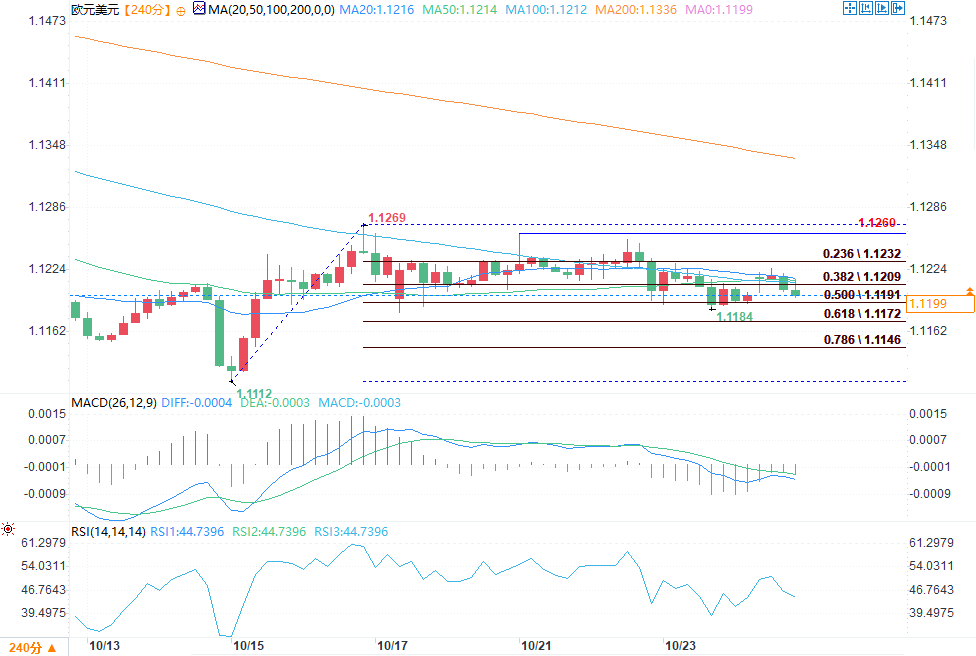 (EUR/USD 4-hour chart source: EasyForex) The EUR/USD 4-hour chart is currently in a consolidation phase after an upward wave, with the price retracing to near the 0.382-0.5 Fibonacci retracement level, where short-term moving averages are providing resistance. The 1.1209 and 1.1232 levels form consecutive resistance above, while the 1.1172-1.1184 level is the key short-term support below. The price has not yet broken out of the range, and there is no clear directional trend. Indicators show weak bearish divergence. The MACD DIFF is running below the DEA and near the zero line, with a very small green histogram, indicating that bearish momentum has not been sustained. The RSI is at 44.74, below the 50 midline, neither entering oversold territory to trigger a rebound nor failing to break above 50 to confirm a bullish resurgence; overall, the bullish and bearish forces are relatively balanced. The subsequent price action will depend on a breakout from the range. Only if it firmly establishes itself above 1.1209 and breaks through 1.1232 will there be a chance to challenge the previous high of 1.1269 again; if it effectively breaks below the support of 1.1172, the pullback will deepen and look towards 1.1146; before the range is broken, it is advisable to treat it as a range-bound market and avoid chasing highs and lows within the range.
Uncertainty surrounding Federal Reserve policy coupled with concerns about French debt levels The Federal Reserve will release its Federal Open Market Committee (FOMC) statement on Wednesday. The market widely expects the Fed to maintain interest rates this week, following the September rate hike. However, inflation remains stubbornly persistent due to high energy prices. The US dollar is dominating market sentiment, continuing to suppress the euro's upward momentum against the dollar. Meanwhile, concerns about French debt are growing, and the topic continues to gain traction; with the French elections approaching next spring, related news will likely continue to emerge. This means that even if the euro rebounds against the dollar, downside risks remain, with the exchange rate repeatedly testing support levels. The euro/dollar pair remains hovering near recent lows. Retail traders need to be aware that the market will experience frequent volatile swings this week. Those with limited funds who cannot withstand sharp market fluctuations should exercise extra caution. Large institutions will position themselves in advance before the Fed's policy announcement, and the market's reaction after the policy is implemented may even seem counterintuitive. The current market is volatile, with the euro/dollar pair trading around 1.1200. The currency pair closed at 1.12015 last Friday, after briefly dipping to around 1.11850 before weakening further. Monday morning's rebound was moderate, but not a strong breakout, and the pair retreated during the session, remaining generally low. Many institutions believe the euro/dollar was oversold last Friday, but unless there's a sudden shift in market sentiment, it's unlikely the pair will break out of its near-month lows. Such a sudden shift in sentiment is unlikely, and traders should be rational about future expectations. How will stock and oil prices affect the euro/dollar? Faced with a market fluctuating within low ranges, speculative traders always try to capture the momentum of the euro/dollar. Looking back at last week, resistance levels repeatedly acted as resistance, and such short-term trading strategies did have viable opportunities at the time. Short-term price movements will largely be influenced by the Fed's statements, but the tense atmosphere in global stock markets cannot be ignored. If stock indices continue to experience sell-offs, the dollar may strengthen further. The rise in West Texas Intermediate (WTI) crude oil prices, seemingly unrelated to the overall market sentiment, can also affect the foreign exchange market and the euro/dollar exchange rate. Intraday traders should be prepared: in the current uncertain, even pessimistic, environment, a price movement after its initial surge is likely to be quickly followed by a reversal. The Fed's decision and the US election keep volatility risks at bay. Retail traders engaging in short-term trading should avoid holding onto losing positions. Large institutions will capitalize on market volatility to quickly take profits and exit. The sharp drop in the exchange rate last Friday, followed by a surge of buying on Monday morning, reminds us that market momentum could reverse rapidly in the coming days. Wednesday's Fed announcement is not the end of the volatility; institutional investors are also assessing the market impact of the November 3rd US midterm elections, the results of which will also influence market sentiment. Euro/Dollar Short-Term Outlook: Key Support and Resistance In short, multiple factors are stirring the market; caution is advised when trading the euro/dollar today. Trading requires patience; think carefully before using leverage to open positions. The selling pressure at the end of last week's trading session has not completely dissipated, indicating that downside risks remain in the market, while a rebound to test lower levels is also possible. Monday's rebound has not completely reversed the overall trend. The selling pressure at the end of last week's trading session is still worth noting, and this rebound also demonstrates how quickly short-term market reversals can occur. With the Fed's decision approaching, traders should be wary of sharp two-way fluctuations and manage their positions and leverage appropriately. ING stated, "We are bullish on the 1.1250/70 level; the upside potential for EUR/USD is limited in the short term; the support level of 1.1180 is likely to be tested this week." (EUR/USD 4-hour chart source: EasyForex) The EUR/USD 4-hour chart is currently in a consolidation phase after an upward wave, with the price retracing to near the 0.382-0.5 Fibonacci retracement level, where short-term moving averages are providing resistance. The 1.1209 and 1.1232 levels form consecutive resistance above, while the 1.1172-1.1184 level is the key short-term support below. The price has not yet broken out of the range, and there is no clear directional trend. Indicators show weak bearish divergence. The MACD DIFF is running below the DEA and near the zero line, with a very small green histogram, indicating that bearish momentum has not been sustained. The RSI is at 44.74, below the 50 midline, neither entering oversold territory to trigger a rebound nor failing to break above 50 to confirm a bullish resurgence; overall, the bullish and bearish forces are relatively balanced. The subsequent price action will depend on a breakout from the range. Only if it firmly establishes itself above 1.1209 and breaks through 1.1232 will there be a chance to challenge the previous high of 1.1269 again; if it effectively breaks below the support of 1.1172, the pullback will deepen and look towards 1.1146; before the range is broken, it is advisable to treat it as a range-bound market and avoid chasing highs and lows within the range.
- Risk Warning and Disclaimer
- The market involves risk, and trading may not be suitable for all investors. This article is for reference only and does not constitute personal investment advice, nor does it take into account certain users’ specific investment objectives, financial situation, or other needs. Any investment decisions made based on this information are at your own risk.