The European Central Bank held rates steady, causing the euro to plunge 25 points! The French bond panic is rewriting policy logic.
2026-10-29 21:26:23
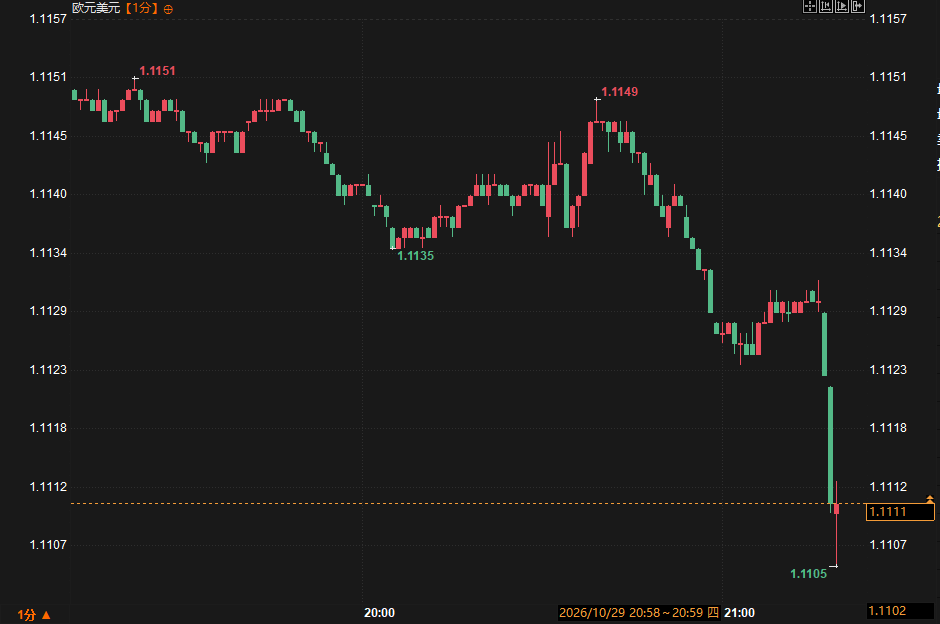
On Thursday (October 29) at 21:15 Beijing time, the European Central Bank announced its latest interest rate decision. The deposit facility rate remained unchanged at 2.5%, while the main refinancing rate and marginal lending rate remained unchanged at 2.65% and 2.90%, respectively, in line with market expectations. Following the announcement, the euro fell sharply against the US dollar by about 25 points, hitting a low of 1.1113.  The market had largely priced in the "no change" decision. The European Central Bank (ECB) had just completed a 25-basis-point rate hike in September, primarily based on rising energy prices. Currently, the Eurozone's consumer price index (CPI) rose 3.8% year-on-year in September, the highest in three years, with energy costs continuing to push up inflation expectations. However, the yield on French 10-year government bonds briefly broke through 5% last week, reaching a more than two-decade high, significantly increasing tension in the sovereign debt market. Institutions generally believe that the rise in bond yields has already tightened financial conditions, thus reducing the urgency for further rate hikes by the central bank. Lagarde's announcement on the same day that she would step down early in February 2027 also added additional focus to the market. Overall, the decision itself was not unexpected, but the immediate reaction shows that concerns about imbalances within the Eurozone are still being released.
The market had largely priced in the "no change" decision. The European Central Bank (ECB) had just completed a 25-basis-point rate hike in September, primarily based on rising energy prices. Currently, the Eurozone's consumer price index (CPI) rose 3.8% year-on-year in September, the highest in three years, with energy costs continuing to push up inflation expectations. However, the yield on French 10-year government bonds briefly broke through 5% last week, reaching a more than two-decade high, significantly increasing tension in the sovereign debt market. Institutions generally believe that the rise in bond yields has already tightened financial conditions, thus reducing the urgency for further rate hikes by the central bank. Lagarde's announcement on the same day that she would step down early in February 2027 also added additional focus to the market. Overall, the decision itself was not unexpected, but the immediate reaction shows that concerns about imbalances within the Eurozone are still being released. Deep interconnect analysis
From a fundamental perspective, the European Central Bank's decision to hold rates steady was driven by a need to balance inflationary pressures with sovereign debt risks. While inflation data is high, the main driver is energy, with underlying inflation relatively stable and wage transmission not yet showing significant effects. Meanwhile, French bond yields have risen rapidly, partially offsetting the effects of interest rate hikes by increasing financing costs for businesses and households. MUFG economist Henry Cook noted before the decision that while the energy environment is more challenging than in September, policymakers have downgraded their assessment of the urgency following the rise in sovereign yields. Technically, the euro traded in a range of 1.1130-1.1150 against the dollar before the decision. Historical trends show that when the ECB maintains its interest rate unchanged without releasing clear hawkish signals, the euro often experiences short-term selling. The latest quote touched a low of 1.1113, down about 25 points from the pre-decision high, indicating short-term bearish momentum. This reaction is consistent with the immediate market movements after similar previous decisions: the market first digests the "as expected" sentiment before trading on the "lack of further tightening signals" and pressure on the French bond market. A significant discrepancy existed between the expectations of prominent institutions and retail investors prior to the decision. Institutions emphasized that "maintaining the status quo is the baseline scenario, with the focus on whether there will be a rate hike in December," remaining restrained on the French bond issue and believing that rising yields had already partially fulfilled the policy objective. Retail investors, on the other hand, were more concerned about inflation data and potential surprises from Lagarde's speech, with some traders positioning themselves for euro long positions in anticipation of hawkish rhetoric. After the decision was announced, institutional commentary quickly shifted to "in line with expectations, with attention focused on the subsequent statement's wording regarding energy shocks and financing conditions," while retail feedback focused more on the disappointment of the euro's immediate drop and the uncertainty surrounding Lagarde's early resignation. The expectation discrepancy mainly stemmed from the fact that institutions had already fully priced in the "no change" scenario, while retail investors were unprepared for immediate volatility. The overall long-term and short-term logic remains consistent. Short-term pressure on the euro stems from the decision's lack of additional support; medium-term pressure depends on energy price trends and the stability of the French bond market. If financing conditions continue to tighten, inflationary pressures may ease on their own, giving the ECB more flexibility in its subsequent actions.Trend Outlook
From a technical perspective, the euro/dollar pair may enter a consolidation phase after touching 1.1113. If subsequent statements maintain a data-dependent and meeting-to-meeting tone, and do not reinforce the signal of a December rate hike, short-term selling pressure may continue, with technical support around 1.1100. Conversely, if the statement emphasizes upside risks to inflation, the euro may see some short covering. The French bond market remains a key variable. If yields continue to remain high, they will create a tightening effect, potentially reducing the need for further central bank action. The overall market logic leans towards a wait-and-see approach, awaiting further inflation and growth data for confirmation. Regarding related instruments, the euro's short-term bullish momentum is limited, and the dollar's relative advantage has strengthened, but the medium-term direction still needs to be observed in the correlation between energy and sovereign debt.Further Reading
Q: Why did the ECB choose to keep interest rates unchanged when inflation hit a three-year high? The main consideration was the significantly increased pressure on the French sovereign debt market. The 10-year French bond yield broke through 5%, already achieving a tightening effect by raising financing costs. Meanwhile, underlying inflation was relatively stable, and wage transmission was limited, so policymakers chose to observe more data before deciding on the next path. Q: The euro fell by about 25 points in the short term after the decision. Was this reaction beyond expectations? The magnitude was within a reasonable range. The market had already fully priced in the "no change" decision. The lack of clear hawkish signals, coupled with the news of Lagarde's early resignation, triggered short-term profit-taking and risk aversion. Historically, similar decisions have often resulted in immediate declines. Q: What substantive impact did Lagarde's early announcement of her resignation have on the market? In the short term, it increased discussions about policy continuity, but the interest rate decision itself proceeded within the established framework. The market is more focused on the potential policy inclinations of her successor and the degree of adherence to a data-dependent strategy during the transition period. Q: How does the rise in French bond yields affect the ECB's policy space? High yields directly increase borrowing costs for businesses and households, creating additional tightening that could help curb inflation. This reduces the need for the central bank to rely solely on interest rate hikes, explaining the decision to hold rates steady this time. Q: What factors will drive future market movements? We will focus on changes in energy prices, Eurozone inflation and growth data, and the stability of the French bond market. If financing conditions continue to tighten and inflationary pressures remain manageable, the ECB may be more flexible; however, if the energy shock intensifies, a reassessment of the policy path will be necessary.- Risk Warning and Disclaimer
- The market involves risk, and trading may not be suitable for all investors. This article is for reference only and does not constitute personal investment advice, nor does it take into account certain users’ specific investment objectives, financial situation, or other needs. Any investment decisions made based on this information are at your own risk.