The USD/CAD pair is poised for its second consecutive gain, supported by safe-haven demand ahead of US and Canadian employment data releases.
2026-11-06 15:34:26
The US dollar gained momentum against the Canadian dollar in European trading on Friday (November 6), rising to around 1.4050 and poised for a second consecutive day of gains. Safe-haven demand pushed the dollar higher after a sell-off in US stocks. Markets may turn cautious ahead of the release of US and Canadian employment data later on Friday. Democrats won majority in both the Senate and the House of Representatives, regaining control from Republicans. The party secured its first major victory in decades in several Republican strongholds, and tens of millions of voters sharply rejected President Trump. 
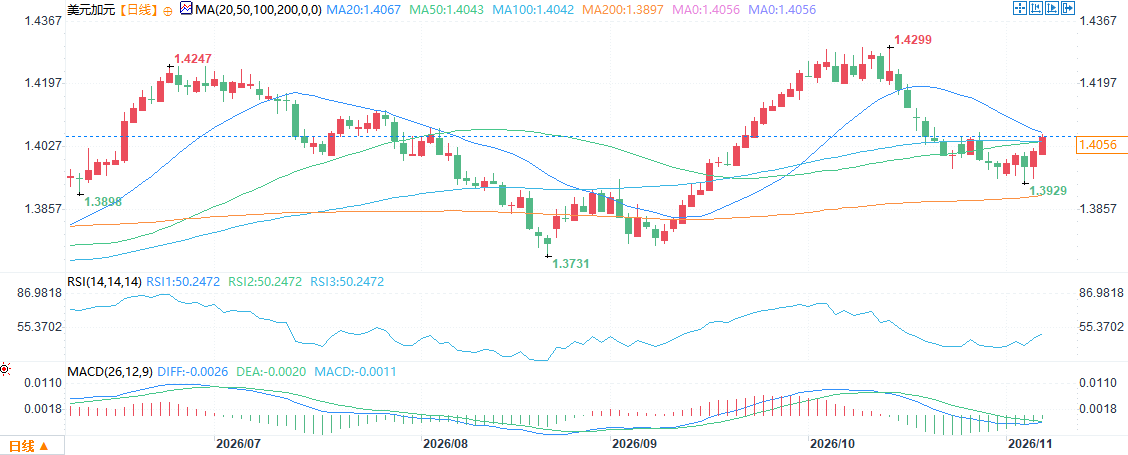 (USD/CAD daily chart, source: EasyForex) At 15:24 Beijing time, USD/CAD was trading at 1.4053/54.
US Non-Farm Payrolls: Expected at 65,000; data strength will determine the direction of the US dollar.
Traders will be closely watching Friday's U.S. October non-farm payrolls report for more clues about the Federal Reserve's interest rate path. Economists' consensus forecast is for approximately 65,000 new jobs, significantly higher than September's mere 29,000, with the unemployment rate expected to remain low at 4.2%. This forecast reflects the market's assessment of a moderate improvement in the labor market. If the actual data is significantly stronger than expected, it could strengthen the case for a further rate hike by the Fed in December, thus supporting the dollar; conversely, signs of weakness could weaken rate hike expectations and drag down the dollar's performance. Some analysts point out that several recent high-frequency data points have shown improvement in the labor market, and this report is expected to continue this trend. The market is particularly focused on average hourly earnings and the magnitude of previous revisions, as these details often have a greater impact on interest rate pricing than the headline figures. Overall, the non-farm payrolls data has become the core catalyst for the current dollar's movement, and the divergence between strong and weak data will directly determine the short-term direction.Canadian employment: Expected increase of 13,600, unemployment rate remains at 6.5%.
In Canada, the market generally expects October employment data to recover some of the previous losses, with a consensus of a modest increase of approximately 13,600 jobs and the unemployment rate remaining unchanged at 6.5%. This expectation corresponds to a scenario where the Canadian economy recovers slightly from its previous weakness. If the actual data meets or slightly exceeds expectations, the downward pressure on the Canadian dollar will be relatively limited, as improved employment will help support the Bank of Canada in maintaining its current policy stance; if it significantly falls short of expectations, the upside potential for USD/CAD may further open up. The Canadian job market has recently been significantly affected by commodity price fluctuations and export demand, and this data is also an important window to test its economic resilience. Traders need to pay close attention to changes in the labor force participation rate and the full-time/part-time structure, as these details often reveal the strength of real demand. Overall, Canadian employment data will provide a comparison with US non-farm payrolls, affecting the relative pricing of USD/CAD.Institutional View: The Canadian dollar has underperformed, interest rate spreads have widened, and its strength has not been confirmed by fundamentals.
JPMorgan Chase forecasts the USD/CAD pair to reach 1.41 by December 2026, suggesting a possible partial reversal of the recent Canadian dollar strength, followed by a slight recovery to around 1.39 in 2027. Strategists point out that Canada's third-quarter growth was weaker than expected, tracking around 1.5% (annualized), below the Bank of Canada's 2% forecast, limiting further room for interest rate hikes. The bank believes the Canadian dollar's resilience poses a challenge to the currency table, with weak growth data leading the market to question how much more the Bank of Canada can raise rates. The overall view is that the USD/CAD pair has room for further upside before the end of the year, but may still decline in the medium term as fundamentals improve. TD Securities believes the USD/CAD pair will remain above 1.40 in the near term, as US policy rates remain higher than Canadian rates. The bank has adjusted its expected timing for rate hikes, giving a year-end target of around 1.38 to 1.41. Looking ahead to the first quarter of 2027, the environment will be more favorable for the Canadian dollar as the Canadian recovery strengthens and potential rate hikes begin. TD Securities also cautioned that US tariff risks could drag down Canada's recovery and extend the Bank of Canada's wait-and-see period. The overall stance is cautious; the US dollar is supported in the near term, but currency pairs may gradually weaken in the medium term as the policy-growth gap changes.in conclusion
The US dollar rose to around 1.4050 against the Canadian dollar, supported by safe-haven demand following the sell-off in US stocks, as markets became cautious ahead of US and Canadian employment data. US non-farm payrolls are expected to increase by 65,000 while the unemployment rate remains at 4.2%, and the strength of this data will determine the direction of the US dollar. Canadian non-farm payrolls are expected to increase by 13,600 while the unemployment rate remains at 6.5%, suggesting a moderate recovery and limited downward pressure on the Canadian dollar. (USD/CAD daily chart, source: EasyForex) At 15:24 Beijing time, USD/CAD was trading at 1.4053/54.- Risk Warning and Disclaimer
- The market involves risk, and trading may not be suitable for all investors. This article is for reference only and does not constitute personal investment advice, nor does it take into account certain users’ specific investment objectives, financial situation, or other needs. Any investment decisions made based on this information are at your own risk.