With Japan's record-breaking intervention coinciding with the US-Japan interest rate differential, who will determine the direction of the yen?
2026-11-09 11:28:29
On Monday (November 9th) during Asian trading hours, the USD/JPY pair fluctuated slightly lower, currently trading around 158.35. Official data released on Monday showed that Japan injected a record $50 billion in a single day at the end of July to support the yen. This data confirmed the scale of intervention that the market had long speculated, including rare coordinated action with the United States. According to media reports, data from Japan's Ministry of Finance showed that Tokyo purchased approximately 15.4 trillion yen (about $97 billion) in total from July to August. Nearly 8 trillion yen of this was injected in a single day on July 30th, the largest single-day intervention on record. The total for these two months exceeded the spending from April to May. These figures themselves are not surprising, as these operations had been widely hinted at at the time, but they provide hard data on the strength of Tokyo's actions. Finance Minister Katayama and US Treasury Secretary Bessenter confirmed at the end of July that the two countries had jointly intervened to support the yen, the first such coordinated action since 1998. 
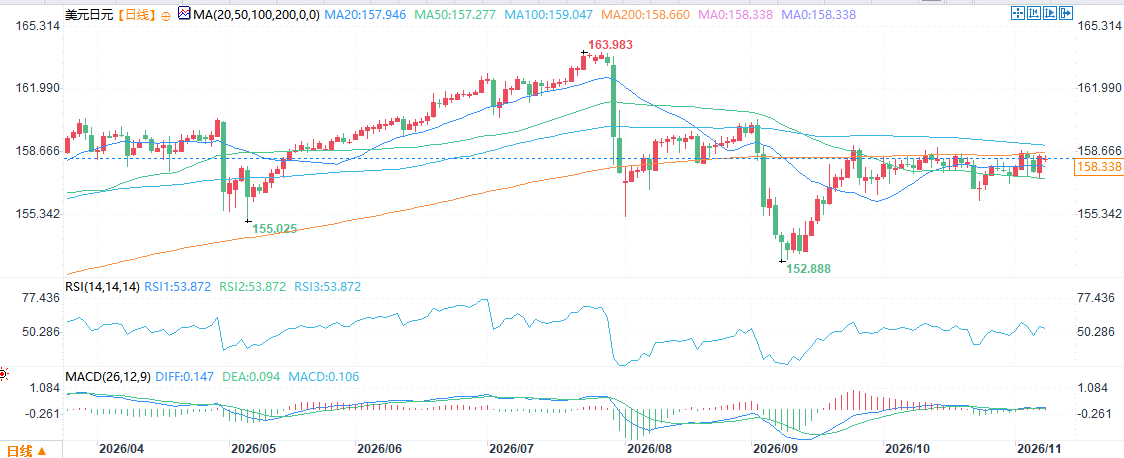 (USD/JPY daily chart, source: FX678) At 11:27 Beijing time, USD/JPY was trading at 158.33/34.
Intervention Background: The yen fell to a 40-year low, and the US publicly supported it.
This scale directly reflects Tokyo's growing vigilance and determination after the yen fell to a 40-year low of nearly 164 earlier this year. A weak yen continues to push up the cost of imported energy and food, exacerbating domestic inflationary pressures and threatening household purchasing power and corporate profits. US Treasury Secretary Bessenter publicly and bluntly spoke out against the yen's depreciation in the summer, explicitly supporting Japan's fight against what he called the yen's undervaluation and pointing to the role of a weak yen in driving up domestic inflation in Japan. The confirmation of joint intervention and the scale of the intervention together send a clear signal: Tokyo has indicated its willingness to spend heavily and join forces with Washington to defend the yen. This is not merely a simple foreign exchange market operation, but a rare tacit understanding between the two countries on monetary policy coordination, breaking with nearly 30 years of precedent and demonstrating a shared concern about the economic and financial risks that excessive exchange rate volatility could trigger.Limitations of intervention: Interest rate differentials remain unchanged, and the yen is still around 158.
However, the data also clearly highlights the limitations of intervention. The yen initially strengthened significantly after the coordinated action, rebounding from a low near 164, but is currently hovering around 158, failing to establish a sustained appreciation trend. The fundamental reason is that the huge interest rate differential between the US and Japan has not yet substantially narrowed. Rising expectations of further interest rate hikes by the Federal Reserve have reinforced the market consensus that the interest rate differential will remain wide, thus putting continuous downward pressure on the yen. Bessant's comments also fueled speculation that the Bank of Japan would tighten policy more quickly. The Bank of Japan raised its policy rate to 1.25% in September, and the market widely expects another move before the end of the year. Governor Kazuo Ueda clearly stated last Friday that he sees some upside risks to inflation as energy costs gradually pass on to consumer prices. This means that intervention can only temporarily change market sentiment and cannot fundamentally reverse the capital flows driven by interest rate differentials.Institutional Views
HSBC forecasts the USD/JPY exchange rate to be 160 in Q4 2026, gradually declining to 159 in Q1 2027, 158 in Q2, and 157 in Q3. The bank believes recent policy changes have helped stabilize the exchange rate, but a sustainable downward trend has not yet formed. High oil prices, persistently high US interest rates, and a generally strong US dollar remain the main obstacles to the yen's appreciation. HSBC points out that potential support could come from further official intervention, discussions on government pension fund asset allocation adjustments, or carry trade unwinding due to deteriorating global risk sentiment. Overall, the exchange rate is more likely to fluctuate within a wider range rather than experiencing a sharp, one-sided decline. UniCredit expects the USD/JPY to gradually weaken, targeting 156 in Q4 2026, 154 in Q1 2027, and further down to 153 in Q2. The bank is concerned about the impact of the tech stock sell-off on the yen's safe-haven appeal, believing that the yen is likely to receive some support in an environment of US tech stock correction and declining US Treasury yields. However, a synchronized decline in the Japanese stock market may weaken traditional safe-haven buying. Unicredit's forecast implies that the yen could appreciate by about 3%-4% from its current level of around 158 by mid-2027. Interest rate expectations and capital flows remain key variables; if the Bank of Japan continues to raise interest rates while the Federal Reserve slows its pace of rate hikes, downward pressure on the exchange rate will further increase.What this means for traders: The risk of intervention remains, but interest rate expectations are the dominant factor.
For traders, the key message is that Tokyo has clearly indicated its willingness to spend heavily and join forces with Washington to defend the yen, so the risk of intervention remains real as USD/JPY approaches 158. This level, not far from this year's low of 164, limits the upside potential of USD/JPY and makes carry trade-driven long positions more two-way and riskier. Interest rate expectations remain the dominant driver: the probability of a Fed rate hike in December is about 80%, keeping the USD/JPY interest rate differential wide; while the Bank of Japan's likely action in December—supported by Ueda's comments on upside inflation risks—is the main path to narrowing the interest rate differential. If the exchange rate approaches 160 again, official rhetoric is expected to become more hawkish, and intervention expectations may rise again. Traders need to pay attention to short-term intervention signals while focusing on the policy paths of the two central banks and changes in the interest rate differential, avoiding over-reliance on technical rebounds from a single intervention.in conclusion
Japan intervened in the foreign exchange market on July 30th, injecting nearly 8 trillion yen (approximately $50 billion), the largest single-day intervention on record. The total intervention from July to August was approximately 15.4 trillion yen (approximately $97 billion), including the first joint intervention with the United States since 1998. This scale reflects the yen's alertness after falling to a 40-year low of nearly 164, and also indicates Tokyo's willingness to spend heavily and cooperate with Washington to defend the yen. However, the limitations of the intervention are equally clear: the yen remains around 158, the US-Japan interest rate differential remains unchanged, and the approximately 80% probability of a Fed rate hike in December keeps the differential wide. Interest rate expectations, rather than intervention, are the dominant driver of the yen's direction. The Bank of Japan raised interest rates to 1.25% in September and is expected to act again before the end of the year. Ueda's statements on the upside risks of inflation are the main path to narrowing the interest rate differential. For traders, the risk of intervention remains real near 158, limiting the upside of USD/JPY and making long positions more two-way; if the exchange rate approaches 160 again, official rhetoric is expected to become more hawkish. (USD/JPY daily chart, source: FX678) At 11:27 Beijing time, USD/JPY was trading at 158.33/34.
- Risk Warning and Disclaimer
- The market involves risk, and trading may not be suitable for all investors. This article is for reference only and does not constitute personal investment advice, nor does it take into account certain users’ specific investment objectives, financial situation, or other needs. Any investment decisions made based on this information are at your own risk.