With geopolitical premiums still present and interest rate hike expectations already priced in, what's next for the US dollar?
2026-11-10 12:06:27
On Tuesday (November 10) during the Asian session, the US dollar index fluctuated narrowly, currently trading around 101.70, as the market digested further developments in the Middle East conflict and a wait-and-see attitude ahead of US consumer inflation data. President Trump stated that there was positive momentum in ending the conflict with Iran, that resuming strikes was "highly unlikely," and declared the conflict effectively over. However, Iranian Supreme National Security Council Secretary Rezaei denied reports of positive negotiations, calling them "fake news," and reiterated that Washington must accept Tehran's seven conditions for an end to the conflict. This kept the geopolitical risk premium in play, supporting the safe-haven dollar. 
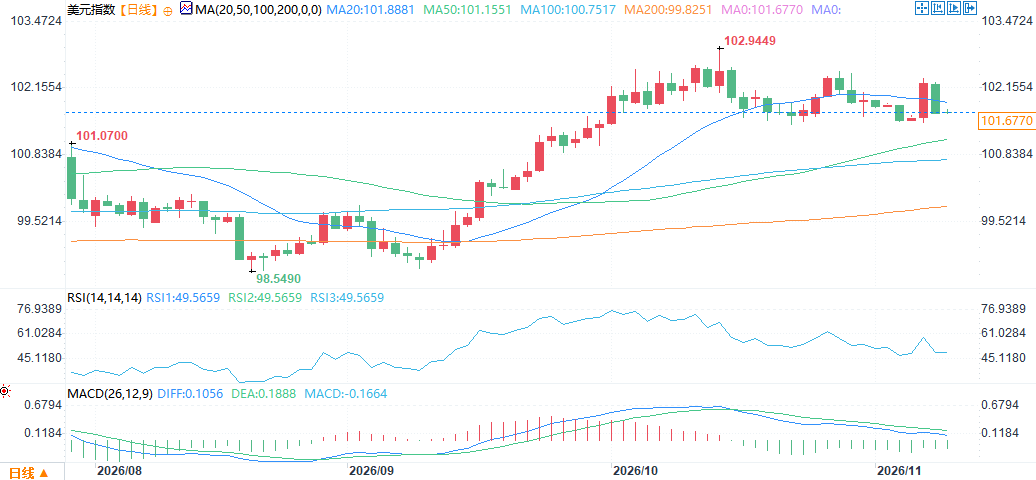 (US Dollar Index Daily Chart, Source: EasyForex) At 12:04 Beijing time, the US Dollar Index was at 101.68.
Divergent Signals from Iran: Trump claims the conflict is "effectively over," while Iran calls the reports "fake news."
Statements from Trump and Iranian senior official Rezaei present a starkly contrasting picture. Trump recently stated publicly that the conflict is "effectively over" and emphasized that the probability of further large-scale strikes is extremely low. Theoretically, this statement should significantly weaken market demand for safe-haven assets, driving capital outflows from the US dollar and other safe-haven assets. However, Rezaei quickly responded, dismissing reports of progress in negotiations as "fake news" and reiterating that Tehran's seven conditions remain prerequisites for any agreement. This strong denial directly offset the optimism generated by Trump's statement. The coexistence of these two statements has left geopolitical risk premiums in an uncertain intermediate state: neither has it significantly subsided due to the US's de-escalating rhetoric, nor has it escalated substantially due to Iran's hardline stance. The market cannot price in either side's statements as a fait accompli and can only remain on the sidelines. Lacking a clear direction, traders tend to hold the US dollar as a hedging tool, thus forming short-term bottom support for the dollar index.Interest rate hike expectations: Strong non-farm payrolls data strengthens bets on a December rate hike, with a probability exceeding 80%.
Last Friday's US non-farm payrolls report became another important factor supporting the US dollar. Data showed that October's job growth far exceeded expectations, reinforcing the assessment that the labor market remains resilient and directly boosting market bets on a December rate hike by the Federal Reserve. According to the CME FedWatch tool, traders are currently pricing in an over 80% probability of another rate hike at the Fed's December meeting. This high probability provides clear bottom support for the dollar index. However, since the market has already fully priced in this roughly 80% probability, further upward revisions require confirmation from subsequent inflation data. Therefore, bulls are choosing to wait and see, awaiting the upcoming Consumer Price Index (CPI) report before deciding whether to establish new long positions. It is precisely this combination of "high expectations, data yet to be verified" that has led to the dollar index remaining "flat" rather than continuously "rising" around 101.70. While rate hike expectations provide support, upward momentum is suppressed before key data is released, and the market remains cautious overall.Market Outlook: CPI and Geopolitical Headlines to Determine Short-Term Direction
The upcoming Consumer Price Index (CPI) report will be crucial data for the market seeking further clues about the Federal Reserve's policy path. The report's results will directly influence further adjustments to the probability of a December rate hike, thus determining the short-term direction of the US dollar index. Meanwhile, the continuous influx of geopolitical headlines will also play a significant role in influencing dollar price dynamics and providing additional momentum to the dollar index. Given the current fundamental backdrop, bearish traders need to exercise extreme caution. Geopolitical uncertainty and high expectations of rate hikes together constitute downside support for the dollar, and any one-sided bearish bet lacks a sufficient fundamental basis. Only if CPI data is significantly weaker than expected, or if geopolitical risk premiums show a clear decline, will the dollar face greater downward pressure. Until then, the market is more likely to maintain a range-bound pattern, and traders need to simultaneously track inflation readings and developments in the Middle East to determine the next move of the dollar index.in conclusion
The US dollar index has halted its overnight decline, supported by a confluence of two factors. First, there's the divergence in signals from Iran: Trump stated the conflict is "effectively over" and resuming strikes is "extremely unlikely," but Iran's Supreme National Security Council Secretary Rezaei denied active negotiations, called reports "fake news," and reiterated seven conditions—thus, geopolitical risk premiums remain in an "uncertain" state, supporting the safe-haven dollar. Second, there are expectations of interest rate hikes: strong non-farm payroll data reinforces bets on a December rate hike, with a probability exceeding 80%, providing a floor for the dollar, but bulls are choosing to wait for the CPI before establishing positions. Short-term direction depends on the CPI and geopolitical headlines—if inflation data strengthens expectations of a rate hike, the dollar index may test higher levels; if it weakens, it may fall back; and any substantial progress or escalation in the Iranian situation will affect the dollar through the risk premium channel. Until both factors become clearer, the dollar index is more likely to remain range-bound, with bearish bets lacking a fundamental basis. (US Dollar Index Daily Chart, Source: EasyForex) At 12:04 Beijing time, the US Dollar Index was at 101.68.
- Risk Warning and Disclaimer
- The market involves risk, and trading may not be suitable for all investors. This article is for reference only and does not constitute personal investment advice, nor does it take into account certain users’ specific investment objectives, financial situation, or other needs. Any investment decisions made based on this information are at your own risk.