Why did a shrinking GDP fail to change the market's pricing of a Bank of Japan interest rate hike?
2026-11-16 12:16:33
The USD/JPY pair traded in a narrow range during Asian trading hours on Monday (November 16), currently hovering around 159.60, virtually unchanged for the day. Japan's economy unexpectedly contracted in the July-September quarter as rising living costs forced households to cut spending. Economists say this weakness is unlikely to deviate the Bank of Japan from its tightening path. GDP contracted at an annualized rate of 0.1%, below the median forecast of 0.3% growth, and the previous quarter saw an upwardly revised 1.7% increase. This is the first contraction in four quarters. On a quarter-on-quarter basis, output declined by 0.02%, also below the expected 0.1% growth. 
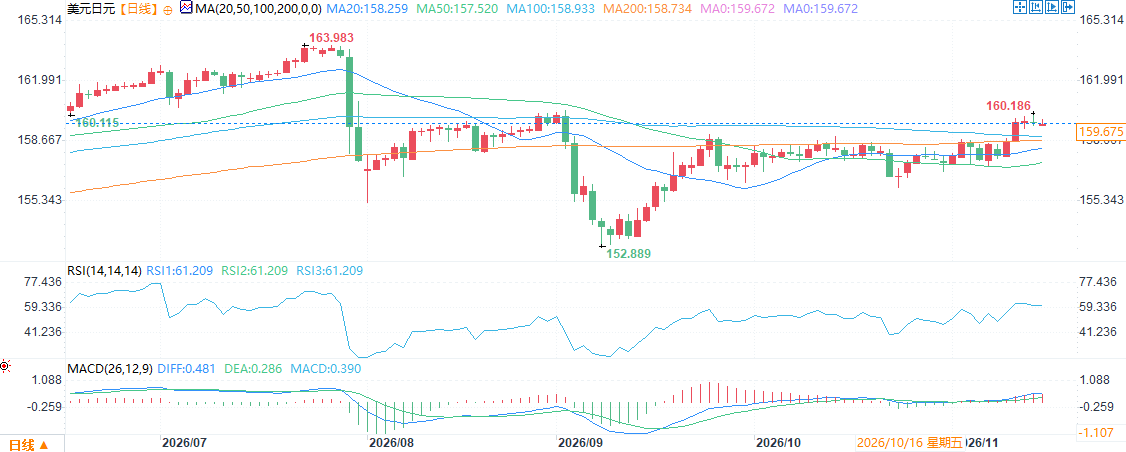 (USD/JPY daily chart, source: FX678) At 12:13 Beijing time, USD/JPY was trading at 159.61/62.
Households were the main drag: private consumption fell 0.3%, with high prices and weather adding to the pressure.
Households were the main drag. Private consumption, which accounts for more than half of economic output, fell 0.3%, slightly worse than the expected 0.2% decline. Persistent inflation, heavy rains, and typhoons weighed on spending. Purchases of cars and air conditioners also declined after a temporary boost from tax and regulatory changes in the previous quarter. Economists warn that higher prices linked to Middle East tensions will continue to squeeze household purchasing power, even as wages rise. The weakness in consumption is not a proactive contraction in demand, but rather a passive reduction due to price shocks—contrary to the inflation logic of "overheated demand," it points to "cost-push" inflationary pressures.Trade drags down net exports by 0.6 percentage points, while energy imports recover.
Trade also took a share of the growth. Net external demand dragged down growth by 0.6 percentage points, more than the expected 0.4 percentage points. Imports rose sharply as Japan diversified its supply following disruptions caused by the Middle East conflict and resumed purchases of oil and other energy sources. The rise in imports reflects a "supply recovery" rather than "overheated demand"—Japan's diversification of energy purchases led to a rise in its import bill following the recovery of Middle Eastern supplies, which is both a drag on the trade balance and a reflection of improved energy security.Highlights and official statements: Capital expenditure increased by 1.6%, exceeding expectations; the Minister of Economy warned of risks in the Middle East.
Business investment was a bright spot. Capital expenditure grew by 1.6%, exceeding the expected 1.5%, supported by spending on labor-saving technologies and AI-related projects. The Economy Minister stated that better employment and income conditions, along with policy measures, should support a gradual recovery, but emphasized the need to closely monitor the situation in the Middle East. Strong business investment and official expectations of a "gradual recovery" provide a basis for a "see-through" analysis of the overall figures—but the explicit listing of Middle East risks as a variable to be monitored suggests that this optimism is not unconditional.For the Bank of Japan and the market: The tightening path remains largely unchanged, but disagreements within the committee pose a risk.
For the Bank of Japan—which already raised rates in June and September—economists say this weaker-than-expected data doesn't change much. Several economists believe that weak consumption is itself a symptom of high prices, which actually strengthens the case for further rate hikes, with many expecting the next move as early as December. However, a report warns that if weak consumption persists, it could widen the divisions within the committee, giving more dovish members reasons to advocate caution. For markets, economists' objections are more important than the overall figure discrepancy: if weak consumption is interpreted as a symptom of inflation rather than a reason for a pause, the December rate hike should be priced in, thus limiting the yen's continued weakness due to the data—although the USD/JPY pair remains in intervention territory near 160. The risk lies in the divisions within the committee: further weakness in consumption data could give more influence to doves, delaying the timing of rate hikes, thereby suppressing the yen and pushing up Japanese government bonds. Oil is the intermediary—energy-driven inflation both hurts households and pushes the Bank of Japan to tighten, so higher oil prices exacerbate the policy dilemma.A delicate balance around 160 for the USD/JPY pair.
On the surface, weaker-than-expected GDP and sluggish consumption should have weakened the arguments for yen bulls—a weakening economy and a potential delay in interest rate hikes by the Bank of Japan. However, the market's interpretation is quite the opposite: many economists believe that weak consumption itself is a symptom of high prices, which actually strengthens the case for further rate hikes. This interpretation has maintained the pricing of a December rate hike, thus limiting the yen's continued weakness due to the data. In other words, the data for USD/JPY is a case of "sell the news" rather than "realizing the negative." But this support is limited. USD/JPY is close to 160, still within intervention territory, and Japanese officials have repeatedly warned; the real risk lies in the internal divisions within the committee—if consumption data weakens further, doves may gain more influence and delay the timing of rate hikes, which would suppress the yen and push up USD/JPY. The interplay of these two forces determines the short-term pattern: the negative data is offset by the interpretation of "inflation symptoms," making it difficult for the exchange rate to break through 160 due to GDP; but internal divisions and the risk of intervention also prevent a significant decline. A true directional breakout requires confirmation from the actual actions of the December meeting and subsequent consumption data.in conclusion
Japan's third-quarter GDP contracted at an annualized rate of 0.1%, below the expected 0.3% growth, marking the first decline in four quarters. Private consumption fell 0.3%, dragged down by high prices and severe weather, while net exports dragged down by 0.6 percentage points, and energy imports recovered. Capital expenditure rose 1.6%, exceeding expectations, supported by AI and labor-saving investments. Economists believe the Bank of Japan's tightening path remains largely unchanged—several argue that weak consumption is a symptom of high prices, thus strengthening the case for a rate hike, and many expect action in December. For the market, economists' rebuttals are more important than the discrepancies in the figures: if weak consumption is interpreted as a symptom of inflation rather than a reason for a pause, the pricing of a December rate hike should remain, limiting the yen's continued weakness due to data—although the USD/JPY exchange rate is near 160 and still in intervention territory. The risk lies in internal divisions within the committee: further weakness in consumption data could give more influence to doves, delaying the timing of rate hikes, suppressing the yen, and pushing up Japanese government bonds. Oil is the intermediary—energy-driven inflation both hurts households and pushes the central bank to tighten, and higher oil prices exacerbate the policy dilemma. (USD/JPY daily chart, source: FX678) At 12:13 Beijing time, USD/JPY was trading at 159.61/62.
- Risk Warning and Disclaimer
- The market involves risk, and trading may not be suitable for all investors. This article is for reference only and does not constitute personal investment advice, nor does it take into account certain users’ specific investment objectives, financial situation, or other needs. Any investment decisions made based on this information are at your own risk.