The USD/JPY pair remains volatile, with the risk of intervention at the 160 level and expectations of a Fed rate hike at play.
2026-11-17 12:04:30
On Tuesday (November 17) during the Asian session, the USD/JPY pair fluctuated narrowly, currently trading around 159.30, with bullish momentum weakening somewhat. 
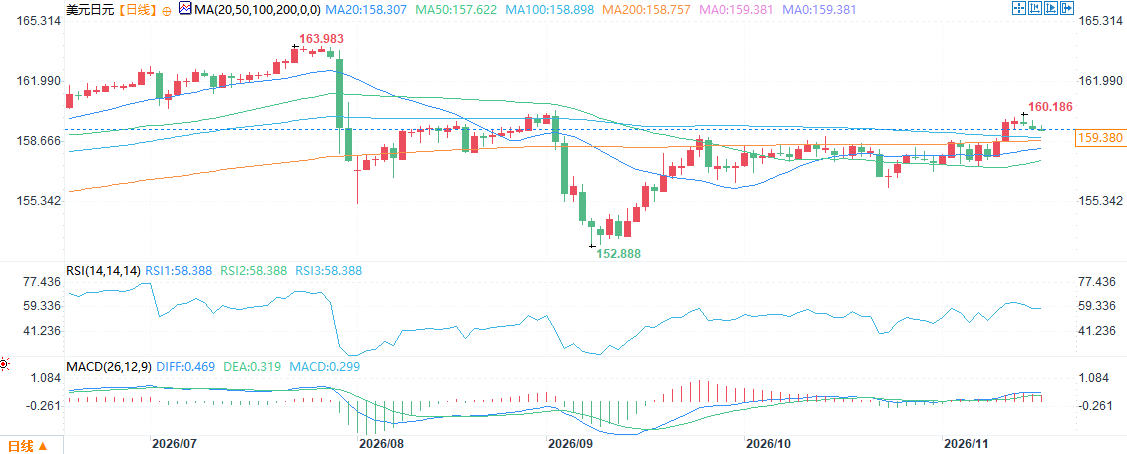 (USD/JPY daily chart, source: FX678) At 12:02 Beijing time, USD/JPY was trading at 159.28/29.
The USD/JPY exchange rate is facing policy deterrence as its upward movement is capped.
Traders are currently highly vigilant about the possibility of Japanese monetary authorities intervening at any time. This expectation of intervention is providing temporary support for the yen, significantly limiting the upside potential of the currency pair. The market generally views the 160.00 level as a potential trigger point for intervention; approaching or briefly breaking through this level would significantly increase the probability of action by the authorities. Japanese Finance Minister Satsuki Katayama previously stated that he had observed recent one-sided and rapid fluctuations in the foreign exchange market, and that the government would respond appropriately to the sharp exchange rate fluctuations and maintain communication with the US Treasury. This statement further reinforced market concerns about intervention. State Street Investment Management's chief fixed-income strategist pointed out that once the price enters the range above 160, the resistance to further yen depreciation will increase significantly, and the risk-reward ratio for opening new short yen positions at current levels has deteriorated considerably. In the short term, the risk of intervention is the most direct factor suppressing the upward movement of USD/JPY, with the price more likely to oscillate within the 159-160 range rather than break out in one direction.US: Expectations for a Fed rate hike remain high.
Driven by better-than-expected US inflation data and hawkish comments from several officials, the market has revised its pricing for a Fed rate hike, maintaining the dollar's interest rate advantage. CME FedWatch shows a 95.7% probability of a 25 basis point rate hike at the December meeting, and only a 4.3% probability of a 50 basis point hike, a significant drop from last week's 11.5%, indicating the market has largely converged on a "moderate rate hike" path. Strong rate hike expectations continue to support the USD/JPY interest rate differential, providing medium- to long-term support for the USD/JPY and limiting the yen's potential for significant appreciation. The US October retail sales data, to be released tonight, is a key focus. This data will further verify the strength of US domestic demand, directly influencing the short-term direction of the dollar's fluctuations. If retail sales exceed expectations, it will reinforce the Fed's logic of maintaining restrictive policies, pushing the dollar stronger and supporting the USD/JPY; if the data significantly falls short of expectations, it may trigger a short-term dollar pullback, providing the yen with a chance for a rebound. Against the backdrop of intervention risks and hawkish Fed expectations, US data will be a key variable determining short-term direction.Japan's fundamentals: Weak economy, but central bank sends hawkish signals.
Brown Brothers Harriman's analysis points out that the Japanese yen has been a relatively strong performer among G10 currencies in this round of growth. Intervention risks combined with risk aversion have made the market reluctant to push the USD/JPY exchange rate above 160. If the AI sector experiences a deep correction, safe-haven buying will further benefit the yen. However, Japan's fundamentals remain significantly dragged down. The economy unexpectedly stalled in the third quarter, with real GDP recording 0.0% quarter-on-quarter, lower than the market expectation of 0.1%. Household consumption declined for the second consecutive quarter, which will constrain the Bank of Japan's pace of tightening to some extent. The USD/JPY interest rate differential is unlikely to narrow quickly, thus restraining the yen. Meanwhile, Bank of Japan board member Hajime Takada delivered a hawkish speech, warning of the risk of secondary transmission of inflation and advocating for flexible, data-driven interest rate hikes, avoiding a fixed pace, and gradually pushing policy rates closer to neutral levels. He also pointed out that a weak yen would amplify imported inflation, further reinforcing the logic of continued interest rate hikes. If the market begins to price in a more aggressive normalization path from the Bank of Japan, it will boost the yen's resilience and limit the upside potential of the USD/JPY exchange rate. The coexistence of a weak economy and hawkish signals from the central bank makes the yen's exchange rate more dependent on the interplay between policy expectations and the risk of intervention.Summarize
The USD/JPY pair is caught in a two-way struggle between the USD/JPY interest rate differential and the risk of intervention: high expectations of a Fed rate hike support the dollar, while the risk of intervention at the 160 level firmly caps its upside potential. Japan's weakening economy constrains the Bank of Japan's tightening efforts, but hawkish signals from officials provide some support. Short-term market focus will be on US retail sales data, while closely monitoring whether Japanese authorities will release further hawkish statements near the 160 level. (USD/JPY daily chart, source: FX678) At 12:02 Beijing time, USD/JPY was trading at 159.28/29.
- Risk Warning and Disclaimer
- The market involves risk, and trading may not be suitable for all investors. This article is for reference only and does not constitute personal investment advice, nor does it take into account certain users’ specific investment objectives, financial situation, or other needs. Any investment decisions made based on this information are at your own risk.