Did the 50-basis-point rate hike fail to materialize? The Fed's No. 3 official sets a bottom line for a December rate hike.
2026-11-18 10:14:33
On Wednesday (November 8) during Asian trading hours, the US dollar index fluctuated slightly higher, currently trading around 103.60, up about 0.05%, still in the 19-month high range. New York Fed President Williams recently stated publicly that he rules out the possibility of a 50-basis-point rate hike by the Fed in December, believing that the current situation does not require aggressive policy action. 
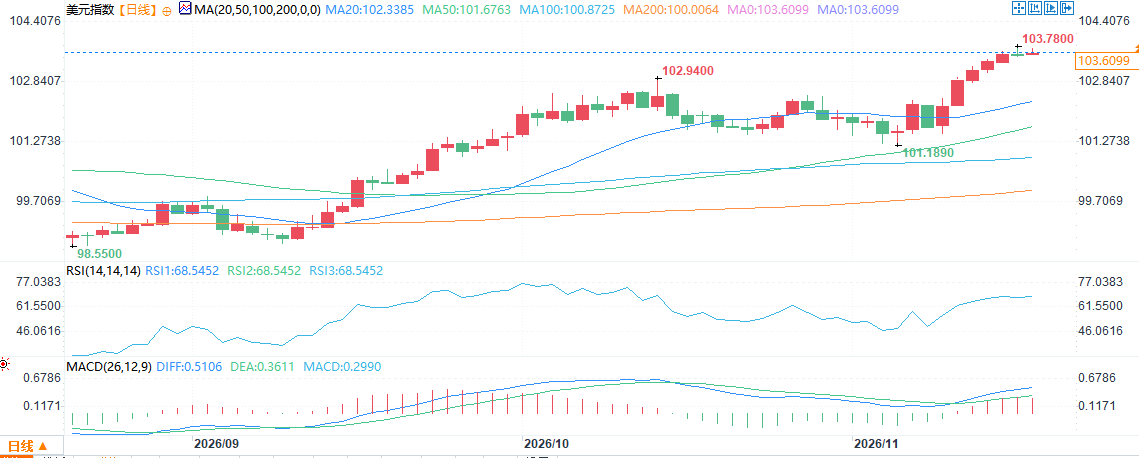 (US Dollar Index Daily Chart, Source: FX678) At 10:11 Beijing time, the US Dollar Index was at 103.62.
Key statement: A 50 basis point rate hike in December is ruled out; aggressive policies are rejected.
New York Federal Reserve President John Williams, in a media Q&A session, clearly signaled a shift away from market expectations of a one-off 50-basis-point rate hike in December. He stated that the current economic situation is not conducive to drastic policy action. Williams also acknowledged that recent inflation data sent a clear signal that the Fed still has a task to complete, requiring timely and sustainable efforts to bring inflation back to the 2% policy target. This statement was a direct response to the recent unexpectedly high inflation data. He further pointed out that the policy path over the past few months has been functioning well overall, and the committee will continue to base its decisions on data rather than resorting to sudden, large adjustments. Following his remarks, the market quickly narrowed its expectations, pushing the probability of a 25-basis-point rate hike in December to near 100%, indicating that Williams' statement effectively stabilized discussions on the short-term policy path.Inflation data was relatively strong, and the market had previously speculated on the possibility of aggressive interest rate hikes.
Several inflation indicators have recently exceeded market expectations. The US October CPI rose 0.4% month-on-month, higher than the expected 0.3%; the core CPI, excluding food and energy, rose 0.3% month-on-month, also higher than the expected 0.2%. The Fed's preferred core PCE price index rose 3.1% year-on-year in September, up 0.1 percentage points from August. Following the strong inflation data, the market briefly began assessing the possibility of a 50 basis point rate hike. Fed Governor Waller had previously stated that he was willing to consider a significant rate hike if prices exceeded expectations. After Williams' speech, market expectations quickly converged, with the probability of a 25 basis point rate hike in December rising to 98%. After the data release, traders initially increased their pricing for a larger rate hike, but after Williams explicitly ruled out "dramatic action," the futures market quickly returned to its normal trajectory, indicating that officials' statements have a strong anchoring effect on short-term expectations and also leave more room for policy discussions at subsequent meetings.Inflation Structure Breakdown: Multiple Factors Drive Up Prices, AI Has Long-Term Impact
Williams does not believe that inflation has fully spread, but points out that multiple upward price pressures persist: tariffs are pushing up the prices of imported goods, energy costs are being passed on to end consumers, and the AI investment boom is driving up prices of products such as semiconductors. In his framework, AI is the most likely persistent driver of this round of inflation. The current resilience of the US economy largely relies on the AI industry, coupled with a strong stock market, which together support household consumption and maintain robust aggregate demand. He emphasizes that the impact of tariffs and energy shocks may gradually fade over time, but the support for demand and prices from AI-related investments and the wealth effect is more sustainable. If the AI industry remains robust, related capital expenditures and consumption momentum may continue to push up inflation, becoming a core variable that policymakers need to monitor in the long term, rather than a short-term disturbance.Policy Outlook: The pace of interest rate hikes depends on the evolution of AI, and the outlook is highly uncertain.
Williams pointed out that the number and pace of subsequent interest rate hikes by the Federal Reserve will need to be continuously monitored in light of the development and changes in the AI industry. If the economic boom brought about by AI continues, inflationary pressures may persist, and the Fed may raise interest rates further. However, he also emphasized that this projection path itself is highly uncertain, and policy adjustments still require dynamic observation of changes in various economic indicators. He stated that the current economy remains resilient and continues to strengthen, and the labor market remains robust, but the inflation trend is not ideal. Therefore, measures are still needed to ensure that prices return to the 2% target in a timely and sustainable manner. Future policy paths will heavily depend on the intensity of AI investment, the wealth effect of the stock market, and the actual evolution of consumption data, rather than pre-setting a fixed number or magnitude.Summarize
Williams' speech cooled market expectations for aggressive rate hikes, explicitly ruling out a 50-basis-point increase in December, and the market re-anchored to the baseline scenario of a 25-basis-point rate hike. However, he did not turn dovish, still emphasizing that the task of controlling inflation is not over, and suggesting that AI may become a long-term variable disrupting inflation. The Fed's future policy path will continue to be influenced by inflation data, the state of the AI industry, and changes in the US stock market and household consumption. (US Dollar Index Daily Chart, Source: FX678) At 10:11 Beijing time, the US Dollar Index was at 103.62.
- Risk Warning and Disclaimer
- The market involves risk, and trading may not be suitable for all investors. This article is for reference only and does not constitute personal investment advice, nor does it take into account certain users’ specific investment objectives, financial situation, or other needs. Any investment decisions made based on this information are at your own risk.